
Being told that your father, mother or husband can come home with a tracheostomy is a strange mix of relief and dread. Relief because the hospital stay is ending. Dread because in the ward there was always a nurse a few steps away, and at home there is you.
Most families leave with a discharge summary, a bag of supplies and a follow-up date, and are expected to work out the rest. Here is the direct answer, before anything else.
Table of Contents
Home care for tracheostomy patients
Yes, many people with a tracheostomy are cared for safely at home. Home care for tracheostomy patients means carrying out the patient’s individual care plan day to day – keeping the tube and the skin around it clean, managing secretions, keeping the air moist, watching for early warning signs, and knowing exactly when to call for help.
What that looks like in practice varies enormously from one patient to another. A person who is alert, walking about and producing very little mucus needs a completely different level of support from someone who is bedridden, ventilator-dependent and needs suctioning through the night. Both are “tracheostomy patients”. Their days look nothing alike.
That is why most articles on this subject are only partly useful to you. Below is what home care for tracheostomy patients actually involves day to day, how to work out how much nursing support your patient needs, what to watch for, when to stop reading and call an ambulance, and how to judge a home nursing provider properly.
What tracheostomy care at home involves: the daily picture
Every care plan is individual, but the areas of care are fairly consistent. This is the shape of a normal day.
| Area of care | What it means day to day | Usually handled by |
| Tube and stoma care | Keeping the tube and the skin around the opening clean, as instructed | Trained nurse, or a family member specifically trained by the clinical team |
| Managing secretions | Clearing mucus, including suctioning where it has been prescribed | Trained nurse or formally trained family member – never an untrained person |
| Humidification | Keeping the air moist, because the nose is bypassed | Set up by the clinical team, maintained daily at home |
| Observation | Watching breathing, secretions, temperature, the stoma site and comfort | Everyone involved in the patient’s care |
| Equipment checks | Making sure suction, oxygen or humidification equipment is clean, working and charged | Nurse and family together |
| Positioning and skin care | Repositioning, pressure area care, comfort | Nurse or attendant |
| Nutrition and hydration | Feeding by mouth or by tube, as instructed | Depends on the care plan |
| Medication | Giving prescribed medicines and keeping an accurate record | Nurse, or a trained family member |
| Communication support | Helping the patient make themselves understood | Mostly family |
| Coordination | Follow-up appointments, supplies, reporting changes to the doctor | Family, supported by the nurse |
You will notice this article describes what each of these involves, but does not tell you how to perform them. That is deliberate. Suctioning, tube changes and cuff management are procedures that have to be taught hands-on, by clinicians who can watch you do it and confirm you have got it right. Reading about a procedure is not training in it, and this is not the topic to learn from a website.
Families almost always ask the same thing first: what will I actually be doing all day? The honest answer is that home care for tracheostomy patients is not one big frightening task. It is a lot of small ones, repeated at fairly predictable times. Once the rhythm settles, most families find the day more manageable than they feared on the drive back from the hospital.
Mornings: the busiest stretch of the day
Mornings are usually the busiest stretch. Secretions build up overnight, so the first hour tends to involve clearing the airway, checking the skin around the stoma, changing dressings and ties if it is the day for it, refilling the humidifier, and giving the morning medicines and feeds. It is also when a nurse takes a set of baseline observations, so that any change from yesterday gets noticed at eight in the morning rather than at midnight.
Midday: watchful rather than busy
The middle of the day is lighter and mostly watchful: suctioning as and when the patient needs it rather than by the clock, keeping humidification going, repositioning to protect pressure areas, feeds and medicines at their appointed times, and short spells of sitting up or walking if the treating team has cleared it. This is also the best window for chest physiotherapy, family visits, and anything that needs the patient at their most alert.
Nights: where tracheostomy care at home is won or lost
Nights are where tracheostomy care at home is won or lost. Secretions often thicken after dark, patients become restless, and equipment alarms do not wait until morning. A household where somebody is genuinely awake and trained overnight copes. A household where one exhausted relative dozes beside the bed with one ear open does not, at least not for long. If you take nothing else from this page, look honestly at your nights before deciding how much nursing support to arrange.
Suctioning at home: what families should expect
Suctioning is the part of trach care at home that worries families most, and the part most often misunderstood. It is not done to a timetable. It is done when the patient needs it: when you can hear secretions rattling, when breathing sounds wetter or more laboured, when the patient signals for it, or when a cough has not quite cleared the tube.
How often that turns out to be is the single most useful thing you can tell a nurse or a provider. Some patients need it two or three times a day. Others need it every hour or two, including overnight, particularly in the first weeks after a tracheostomy is formed or during a chest infection. The equipment is the same in both cases. The amount of human help required is not remotely the same.
Watch the character of the secretions as much as the quantity. Thick, sticky secretions often mean the air is not moist enough or the patient is not taking enough fluid, and both are worth raising with the treating team before they turn into a blocked tube. A change in colour or smell is a different matter altogether, and belongs in the warning signs further down this page.
We are not going to explain the technique here, and you should be wary of any website that does. Suction depth, pressure settings, catheter size and how long each pass should last are prescribed for the individual patient, and getting them wrong causes harm. Ask the ward to teach you hands-on before discharge, and ask them to stand and watch you do it twice.
Preparing your home before discharge: a tracheostomy home care checklist
Most of the panic in the first week comes from things that could have been sorted out before the patient came home. If you still have a few days, use them. The aim is a room where everything needed at three in the morning is within arm’s reach of the bed, and nothing has to be hunted for.
What families usually need in place before a tracheostomy patient is discharged:
- A bed the patient can be sat upright in, ideally a hospital bed with a pressure-relieving mattress for someone bedridden, positioned so a nurse can reach both sides.
- A working suction machine with spare catheters, and a backup means of suction. A manual or foot-operated unit is worth having in a city with power cuts.
- Humidification equipment as prescribed, with a supply of the sterile water or saline it needs.
- Spare tracheostomy tubes in the sizes the treating team specifies, usually including one a size smaller, kept together in a clearly marked box that never leaves the room.
- Dressings, ties or tapes, gloves, hand sanitiser, and a lidded bin for clinical waste.
- A pulse oximeter, a thermometer, and a written observation chart or notebook that stays by the bed.
- Oxygen if it has been prescribed, with the supplier’s number saved in more than one phone.
- An inverter, UPS or generator arrangement if the patient depends on any powered equipment.
- Feeding supplies and prescribed nutrition if the patient is tube fed.
- The written emergency plan, the discharge summary and the treating team’s numbers, printed and taped up somewhere visible rather than saved on one person’s phone.
Two practical points that families in Chennai raise often. Keep a running list of consumables and reorder well before you are down to the last few, because suction catheters and specialist dressings are not always on the shelf at the nearest pharmacy. And decide early who the second trained pair of hands in the family will be. One person cannot cover a tracheostomy patient indefinitely, however willing they are.
Why two tracheostomy patients need completely different care
This is the part that makes every generic guide frustrating, and it is worth understanding before you speak to any provider. Four things drive almost all of the difference.
1. Whether the patient is breathing on their own
A patient breathing independently through the tracheostomy needs observation, cleaning and secretion management. A ventilator-dependent patient needs all of that plus continuous equipment monitoring, an alarm response plan, backup power and a nurse who is genuinely experienced with ventilators. These are different services at different prices, and it is worth being blunt with a provider about which one you need.
2. How much the patient produces in secretions
Secretion load is the single biggest driver of how often someone needs attention. A patient needing suctioning twice a day can be managed with a day nurse and a trained family member. A patient needing it every hour, including overnight, cannot be managed by one exhausted relative, and pretending otherwise is how families end up back in casualty at 3 am.
3. Whether the tracheostomy is new or long-established
The first weeks after a tracheostomy is formed are the most demanding, and the period when families are least practised. Someone who has lived with a tracheostomy for two years, whose stoma is well healed and whose routine is settled, often needs far less. If you are arranging care for a fresh discharge, plan for the first month to be the heaviest and reassess after that rather than committing to a long arrangement on day one.
4. Everything else going on
Most tracheostomy patients cared for at home in Chennai are recovering from a long ICU stay, a stroke, head and neck cancer, or a severe respiratory illness. Limited mobility, tube feeding, diabetes, pressure area risk and cognitive change all add to the workload – and none of them are the tracheostomy. Judge the care requirement by the whole patient, not by the tube.
When you ask a provider for a quotation, describe these four things first. A provider who quotes a number before asking about ventilator dependence and secretion load is not assessing your patient; they are reading from a price list.
Home nurse or family caregiver: who does what
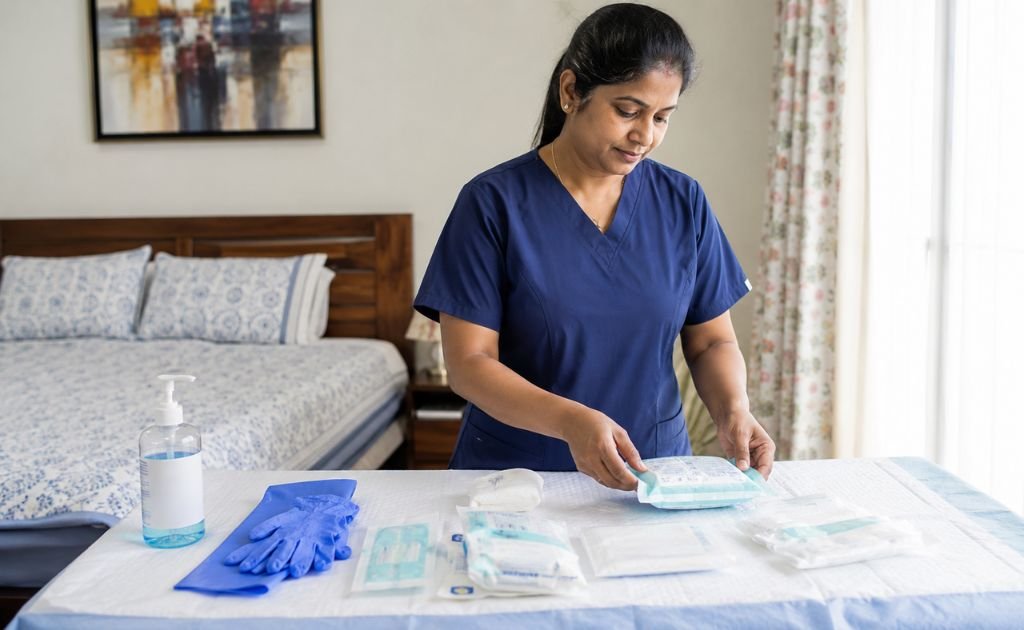
These boundaries are not fixed. They depend on the care plan and on what the clinical team has actually trained the family to do.
| Responsibility | Trained home nurse | Family caregiver |
| Suctioning, tube and stoma care, tube feeding | Yes, within their training and the prescribed plan | Only after hands-on training by the clinical team, and only what they have been cleared to do |
| Structured observation and record-keeping | Yes, as a routine discipline | Yes – and family often notice subtle changes first |
| Recognising and escalating a clinical change | Trained to assess and escalate | Should report anything unusual promptly, without needing to interpret it |
| Talking to the treating doctor | Can report clinically and keep documentation | Usually leads decisions and consent |
| Daily assistance, hygiene, positioning | Yes | Yes |
| Emotional support and familiarity | Contributes | Irreplaceable |
| Supplies, appointments, logistics | Can support and remind | Usually family-led |
Families are not passengers in this. Many relatives become genuinely skilled at parts of the routine, and patients usually prefer it that way. The point is simply that the training has to come from clinicians, in person, and has to match what that particular person is competent and comfortable doing. “My brother watched the nurse do it” is not training.
How much nursing support does your patient actually need?
This is where families either overspend or, more dangerously, underprovide. There are broadly three levels.
Nurse visits
A nurse comes once or twice a day for specific tasks – cleaning, dressing, checks – and the family manages the rest. This suits a stable, long-established tracheostomy where the family has been properly trained and the patient needs little attention between visits.
A 12-hour shift
Usually the sensible middle option, and more often the right answer than families assume. A day shift covers the busiest hours. A night shift is what families ask for when secretions are worse overnight, when the patient becomes restless after dark, or simply when the main caregiver has not slept properly in three weeks. Night cover alone transforms a household.
Round-the-clock cover
Necessary when the patient cannot safely be left unattended at any point – ventilator-dependent, needing frequent suctioning, or newly discharged and still unstable.
If you are arranging continuous cover, ask one question that changes everything: is this one nurse or two? A single live-in nurse has to sleep at some point. Two nurses rotating on 12-hour shifts means someone is always awake. For a patient who needs attention at 3 am, that distinction is the whole difference between the arrangement working and not working – and it is the main reason two quotations for “24-hour care” can look so far apart. If you are comparing costs across those options, our guide to home nurse cost in Chennai explains how the two models are priced.
What is usually included – and what families have to arrange themselves
A home nursing engagement normally covers the nursing time and the clinical tasks in the care plan. These are the things that are typically not included, and they add up:
- Consumables – suction catheters, gloves, dressings, cleaning supplies, and for many patients adult diapers and nutrition supplements. Usually billed at actuals.
- Equipment, whether rented or bought – suction machine, oxygen concentrator, humidification equipment, pulse oximeter, hospital bed, air mattress.
- Relief cover on the nurse’s weekly off. Ask whether the replacement is included in your monthly rate or charged extra. For a tracheostomy patient this is not a detail.
- Food and a place to rest for a live-in nurse.
- Doctor or physiotherapist home visits, which are almost always separate.
- Night differentials, festival allowances, registration or deposit, and applicable GST.
Ask for the quotation in writing and ask specifically what is excluded. A provider who volunteers this list before you ask is telling you something useful about how they will behave three months in.
Warning signs that need a call to the treating team
MedlinePlus, from the US National Library of Medicine, advises contacting the healthcare provider for signs including fever or chills; redness, swelling or pain that is getting worse; bleeding or drainage from the opening; too much mucus that is hard to suction or cough up; cough or shortness of breath even after suctioning; nausea or vomiting; and any new or unusual symptoms.
On secretions specifically, Johns Hopkins Medicine notes that they should be white or clear, and that yellow, brown or greenish secretions may be a sign of infection. It also advises calling the surgeon’s office if the stoma area becomes red, swollen, inflamed, warm to the touch or develops a foul odour, or if the patient develops a fever.
The NHS adds a further set of reasons to seek prompt advice: difficulty swallowing, coughing or being sick after eating or drinking, breathing that has become noisy during the day or at night, or pain around the tracheostomy.
None of these are things to leave overnight and see how they look in the morning.
When home care is not a substitute for emergency care
This section matters more than anything else on this page. Home nursing is not an emergency service, and no home setup replaces a hospital.
Call emergency services immediately and follow the patient’s emergency plan if any of these happen:
- Severe difficulty breathing, or the patient suddenly cannot breathe through the tracheostomy
- The tube becomes completely blocked and cannot be cleared
- The tube comes out and cannot be replaced – MedlinePlus advises calling emergency services in this situation
- Significant bleeding from the tracheostomy
- Lips, face or skin turning blue or grey
- Sudden collapse, unresponsiveness, or a marked change in consciousness
- Any severe or rapidly worsening symptom
In India, the national emergency number is 112 and the ambulance number is 108.
Every tracheostomy patient discharged home should leave hospital with a written emergency plan naming who to call and what to do. If your family does not have one, ask the treating team for it – before discharge if you still can, or at the very next appointment. Ask them to write it down. A verbal explanation given on a busy ward round is not something anyone remembers at two in the morning.
This article gives no emergency procedures, and no untrained person should attempt to reinsert or replace a tracheostomy tube. Those are skills taught in person, by clinicians, to specific people, for a specific patient.
What different situations look like
Coming home with a new tracheostomy
The first few weeks are the most demanding and the least familiar. Most families arranging home care for tracheostomy patients at this stage need trained nursing support at least for a day shift, both for the clinical tasks and because it is when families learn. Ask the nurse to teach you as they go – a good one will. Plan to reassess after the first month rather than locking into a long arrangement while you are still in shock.
A long-established or permanent tracheostomy
Once the stoma is healed and the routine is settled, many families manage with visits or a single shift, with the family covering the rest. The risk here is complacency rather than crisis: supplies run low, observation gets casual, and a slow change goes unnoticed. Keeping a simple daily record is what prevents that.
Ventilator-dependent patients
This is the highest level of home care there is. It needs a nurse genuinely experienced with ventilators, a plan for equipment failure, a plan for power cuts, and realistically continuous cover. Do not accept vague reassurance here. Ask directly what experience the assigned nurse has with ventilated patients at home, and what happens if an alarm sounds and the family is alone.
Elderly and bedridden patients
Very common in Chennai, and the combination that quietly gets hardest. Limited mobility means pressure areas develop silently, several conditions run alongside each other so medication gets complicated, and communication is doubly difficult when speech is gone and hearing or memory is also affected. The family is often elderly too – a wife in her seventies managing overnight care is a situation that needs an honest conversation, not quiet endurance. Where age brings several overlapping conditions, structured geriatric care at home is a better framework than ad-hoc help.
Does health insurance cover tracheostomy home nursing in India?
Usually not, and it catches families out. Standard Indian health insurance is built around hospitalisation. Some policies carry a domiciliary hospitalisation clause that may cover treatment at home where a hospital bed was genuinely unavailable or the patient could not be moved, but the conditions are narrow and it rarely covers a long-term nurse.
A few insurers now sell home healthcare as an add-on rider, and some corporate group policies include it. Call your insurer, ask specifically about “domiciliary hospitalisation” and “home healthcare cover”, and get the answer in writing. Keep every invoice and prescription regardless – medical expenses for a dependent senior citizen may have tax implications worth raising with your chartered accountant.
What tracheostomy home nursing costs in Chennai
Very few providers in Chennai publish rates for tracheostomy nursing specifically, and a figure quoted before anyone has assessed the patient is close to meaningless. What is more useful is knowing what actually moves the price:
- The nurse’s qualification and clinical exposure. A nurse experienced with tracheostomy and ventilator patients costs more than a general nurse, and considerably more than a non-clinical attendant.
- Shift pattern – visits, 12 hours, or continuous cover.
- Whether continuous cover is one live-in nurse or two rotating.
- Ventilator dependence and secretion load, which together determine the level of nurse required.
- Night cover, usually priced differently from day cover.
- Equipment and consumables, normally billed separately.
For the wider picture on what home nursing costs across the city, including how 12-hour and 24-hour arrangements are priced, see our detailed guide to home nurse cost in Chennai. Home care for tracheostomy patients generally sits at the higher end of those ranges because of the skill level involved.
How to choose a home nursing provider for a tracheostomy patient
Price is the easiest thing to compare and it tells you the least. Ask these ten questions instead, and write the answers down.
- Do you provide home nursing for tracheostomy patients, and how often do you actually do it?
- What are the qualifications of the nurse who would be assigned – and can I see the certificate and council registration number?
- What specific experience does that nurse have with tracheostomy patients, and with ventilated patients if that applies to us?
- Who supervises the nurse, and how often is the care plan reviewed?
- How does the nurse coordinate with our treating doctor, and what gets documented?
- If we need continuous cover, is that one live-in nurse or two on rotating shifts?
- What happens on the nurse’s weekly off, and how fast can you send a replacement if they fall ill?
- What is your escalation process if the patient’s condition changes – and what are your limits? What will you tell us to call an ambulance for?
- What exactly is included in the quoted fee, and what is billed separately?
- Has the nurse been background-verified, and will you confirm that in writing?
A provider who answers question two with an adjective rather than a document has answered it. You are entitled to see credentials for someone who will be doing clinical work on your relative in your own home.
Home care for tracheostomy patients in Chennai and Mylapore
For a patient who tires easily or depends on equipment, travelling across Chennai for routine care is exhausting and sometimes not sensible at all. Care delivered at home removes that journey while hospital follow-up continues for reviews, tube changes and specialist input as the treating team directs.
What matters practically is coordination. The nurse needs to know what the treating team wants, the treating team needs to hear what is happening at home, and the family needs to know who to call in the middle of the night. Ask any provider how those three things work, and be wary of vague answers.
If you are arranging care in Mylapore, Santhome, R A Puram, T Nagar or nearby, a few local questions are worth settling early. Confirm the provider genuinely serves your area rather than nominally covering it. Ask how quickly a replacement can reach you. And ask whether the same nurse will be assigned consistently – continuity is worth a great deal with a patient whose normal only becomes obvious over time.
Sashitha Home Health Care is based at Santhome in Mylapore, provides tracheostomy nursing care at home across the surrounding areas, and lists tracheostomy and catheter care among its home nursing services in Chennai, alongside skilled nursing in Mylapore covering areas such as oxygen therapy, tube feeding and post-surgical care. Because tracheostomy needs differ so much between patients, families should confirm directly with the team whether the nurse who would be assigned has the specific training and experience their patient’s care plan requires.
Getting the right home care for your tracheostomy patient

Everything in this article is general. Your patient is not. Home care for tracheostomy patients only works when it is built around one particular person. The care they need depends on things that only come out in a proper conversation: what the discharge summary says, whether they are on a ventilator, how often they need suctioning, how they are overnight, and who at home can realistically help.
If you are preparing for a discharge or already managing tracheostomy care at home, have the discharge summary to hand and be ready to describe the nights. That one detail tells an experienced nurse more than anything else.
You can reach Sashitha Home Health Care on +91 91760 00011 or through the contact page to discuss your patient’s requirement and confirm what nursing support is available for their care plan. Ask the ten questions above – of us, and of everyone else you are considering.
Frequently asked questions
Can a tracheostomy patient be cared for at home?
Yes, many are. It requires that the treating medical team considers the patient clinically suitable for home management, and that the people providing care have been properly trained. Suitability depends on how stable the patient is, how much support they need, and what help is realistically available at home.
What does tracheostomy care at home involve?
Keeping the tube and stoma clean, managing secretions, humidifying the air, observing breathing and the site for changes, checking equipment, supporting nutrition and communication, and staying in contact with the treating team. The exact routine, frequency and technique come from the patient’s individual care plan.
Does a tracheostomy patient need a home nurse?
Not always. It depends on the complexity of the care plan and whether family members have been trained and can sustain the routine. Patients who are ventilator-dependent, need frequent suctioning, or have recently been discharged usually benefit from trained nursing support, at least for the first weeks.
Who can provide tracheostomy nursing care at home?
Nurses trained in tracheostomy care with genuine experience of such patients. Ask to see qualifications and council registration rather than accepting a general assurance. Family members can take on parts of the routine, but only tasks they have been formally trained and cleared to perform by the clinical team.
Is home nursing available for tracheostomy patients in Mylapore?
Home nursing operates across Mylapore, Santhome and the surrounding areas. Whether tracheostomy-specific nursing is available depends on the provider and on the individual nurse assigned, so confirm directly that the nurse has the relevant training and experience before care begins.
Can a tracheostomy patient get 24-hour nursing care at home?
Continuous cover is offered by some providers, but confirm what is actually meant. A single live-in nurse who has to sleep is a different arrangement from two nurses rotating on 12-hour shifts. For a patient needing attention overnight, that distinction matters. Ask which model any quotation refers to.
How much does tracheostomy home nursing cost in Chennai?
Few providers publish tracheostomy-specific rates. Cost depends on the nurse’s qualification, shift pattern, whether cover is continuous, ventilator dependence, secretion load, night requirements and equipment. Ask for a written quotation for your specific patient and ask what is excluded. Tracheostomy care usually sits at the higher end of general home nursing rates.
Can family members learn routine tracheostomy care?
Often yes, and many do it very well. Training should be hands-on, given by the clinical team around discharge, and matched to what the individual is competent and comfortable doing. Watching someone else do it, or reading instructions online, is not training and should not be treated as such.
What signs of infection should I watch for?
MedlinePlus advises contacting the healthcare provider for fever or chills, worsening redness, swelling or pain, or bleeding or drainage from the opening. Johns Hopkins Medicine notes that secretions should be white or clear, and that yellow, brown or greenish secretions may indicate infection.
When does a tracheostomy patient need emergency help?
Seek emergency help immediately for severe difficulty breathing, a blocked tube that cannot be cleared, a tube that has come out and cannot be replaced, significant bleeding, blue or grey lips or skin, or sudden collapse or unresponsiveness. Call 112 or 108 and follow the patient’s written emergency plan.
Is home care suitable for every tracheostomy patient?
No. Patients who are unstable, need intensive monitoring, or whose home circumstances cannot support safe care may need to stay in hospital or a suitable facility. That is a clinical judgement for the treating team, and it should not be decided on cost grounds.
What should I ask before hiring a home nurse for a tracheostomy patient?
Ask about the nurse’s qualifications and registration, their specific tracheostomy and ventilator experience, who supervises them, how they coordinate with your doctor, shift and continuous-cover options, replacement arrangements, the escalation process, and exactly what the fee includes and excludes.
How do you care for a tracheostomy patient at home each day?
A normal day is built around a repeating routine rather than one big task: clearing secretions when the patient needs it, keeping the tube and the skin around the stoma clean, keeping the air humidified, giving feeds and medicines on time, repositioning to protect pressure areas, and recording observations so that changes are spotted early. Mornings are usually the busiest period and nights are usually the hardest. The exact technique for each task must be taught hands-on by the treating team for that particular patient.
What supplies and equipment are needed for tracheostomy home care?
Most families need a suction machine with spare catheters and a backup means of suction, humidification equipment with sterile water or saline, spare tracheostomy tubes in the sizes the treating team specifies, dressings and ties, gloves, a pulse oximeter and thermometer, an observation record, oxygen if prescribed, a power backup arrangement, feeding supplies if the patient is tube fed, and the written emergency plan kept where everyone can see it.
How often does a tracheostomy patient need suctioning at home?
There is no fixed schedule. Suctioning is done when the patient needs it, which may be two or three times a day for a settled patient or every hour or two, including overnight, for someone with a heavy secretion load, a new tracheostomy or a chest infection. Secretion load is the main thing that determines how much nursing support a household actually needs, so describe it clearly when you speak to a provider.
Is trach care at home safe for an elderly or bedridden patient?
It can be, provided the treating team considers the patient suitable and the care is delivered by people who have been properly trained. Older and bedridden patients usually need more support rather than less, because limited mobility brings pressure area risk, several conditions often run alongside each other, and communication is harder. An honest assessment of who is available at home, especially overnight, matters more than the age of the patient.