
If a doctor has just told you that your father can be discharged tomorrow but will need nursing support at home, one question usually comes before all the others: what is this going to cost?
Here is the direct answer, before anything else.
Home nurse cost in Chennai:
In Chennai, a trained home nurse generally costs ₹1,000 to ₹2,500 per day, depending on shift length and the nurse’s clinical skill level. A non-clinical patient attendant costs less – usually ₹700 to ₹1,500 per day. On a monthly basis, most families in the city end up somewhere between ₹25,000 and ₹70,000, and critical-care nursing can go above ₹1,00,000.
That is a wide band, and it is wide for a reason. Two agencies can quote you ₹25,000 and ₹65,000 for what sounds like exactly the same request. Most of this article is about why that happens, so that you can read a quote properly instead of simply picking the cheapest one.
Table of Contents
Chennai home nursing rates: the current picture
This table is the closest thing to a realistic market map for the city right now.
| Type of care | Typical daily rate | Typical monthly range |
|---|---|---|
| Single nurse visit (injection, dressing, catheter change, IV) | ₹500 – ₹1,500 per visit | Billed per visit |
| Patient attendant / caregiver – 12-hour shift | ₹700 – ₹1,100 | ₹15,000 – ₹25,000 |
| Patient attendant / caregiver – 24-hour live-in | ₹900 – ₹1,500 | ₹25,000 – ₹45,000 |
| Trained nurse (GNM / B.Sc Nursing) – 12-hour shift | ₹1,000 – ₹1,800 | ₹25,000 – ₹45,000 |
| Trained nurse – 24-hour cover | ₹1,500 – ₹2,500 | ₹35,000 – ₹70,000 |
| Critical care / ICU-trained nurse – 24-hour | ₹2,500 – ₹4,500 | ₹65,000 – ₹1,00,000+ |
Two things worth noticing. First, the cheapest 24-hour option and the most expensive one differ by four times. Second, the overlap between a 12-hour nurse and a 24-hour attendant is almost complete – they cost roughly the same, but they are not the same service at all. Getting this distinction right is where families save the most money.
Why the same request gets very different quotes
Four variables account for nearly all of the price spread.
1. Whether you are hiring a nurse or an attendant
This is the single biggest one. A registered nurse can administer injections, manage an IV line, do sterile wound dressing, handle a Ryle’s tube or catheter, and read deteriorating vitals early. An attendant cannot legally or safely do any of that. If your patient only needs help with bathing, feeding, turning and toileting, you are paying a large premium for clinical skills you will never use.
2. The nurse’s qualification and clinical exposure
An ANM-qualified nurse, a GNM diploma nurse and a B.Sc nurse with three years of ICU experience sit at very different points on the scale. A nurse who can manage a tracheostomy, a ventilator or a central line will always cost more – and for those patients, that cost is not optional.
3. Hours and how the shift is structured
Twelve hours is not half the price of twenty-four. Round-the-clock cover done properly needs either two nurses or a live-in nurse plus a relief arrangement, and that is a step change in cost rather than a doubling.
4. Agency-managed versus direct hire
A freelance nurse arranged through a contact will quote less. An agency rate includes credential verification, police verification, supervision, a documented care plan, and – the part families underestimate until they need it – a replacement nurse within hours when someone falls ill or goes home for a family function. When a bedridden patient is involved, the day that replacement does not arrive is an expensive day.
Beyond these four, distance matters a little. A team travelling to Perungudi or Ramapuram may be priced slightly differently from one working in Mylapore or T Nagar, simply because of Chennai’s traffic and the shift-handover timing it affects.
Nurse, caregiver or patient attendant: which one do you actually need?
Families often ask for “a nurse” when they mean “someone to look after amma.” Here is the practical difference.
| Patient attendant / caregiver | Trained home nurse | |
|---|---|---|
| Bathing, feeding, toileting, changing position | Yes | Yes |
| Mobility support, companionship, walking assistance | Yes | Yes |
| Reminding and handing over prescribed medicines | Yes | Yes |
| Injections, IV fluids, IM medication | No | Yes |
| Sterile wound dressing, drain and suture care | No | Yes |
| Catheter, Ryle’s tube, colostomy management | No | Yes |
| Vitals monitoring and clinical escalation | Basic only | Yes |
| Typical monthly cost, 24-hour | ₹25,000 – ₹45,000 | ₹35,000 – ₹70,000 |
There is also a middle path that very few providers mention and that works extremely well for long stretches of care: a nurse for a defined daily window and an attendant for the rest. A stroke patient six weeks past discharge often needs skilled nursing for two hours in the morning – dressing, catheter care, medication – and steady non-clinical support for the other twenty-two. Structured that way, a family can cut their monthly outgo substantially without cutting the clinical care that matters.
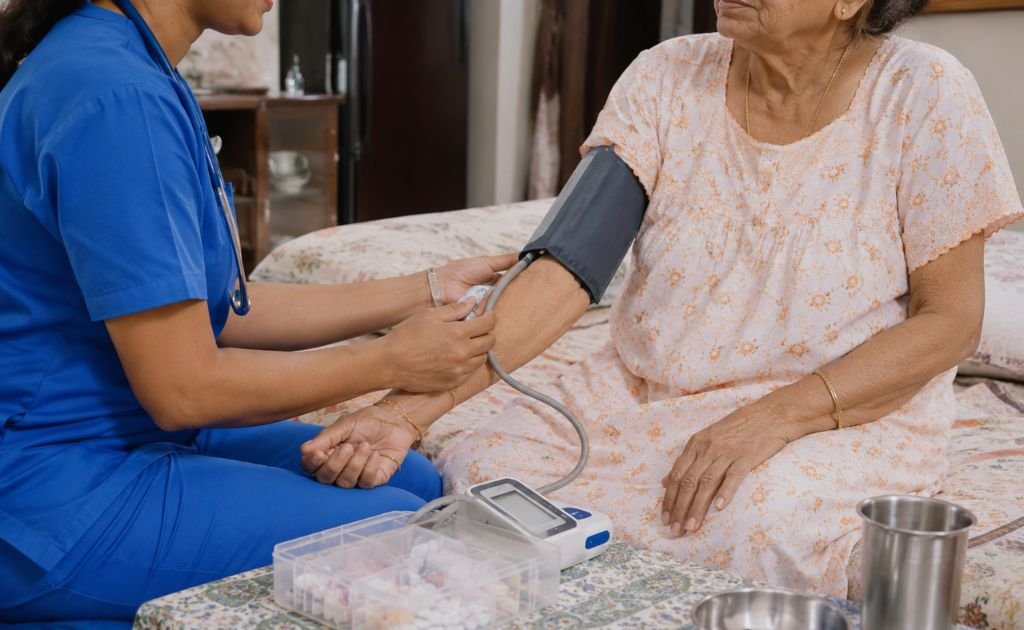
12-hour versus 24-hour nursing: what changes
A 12-hour shift, day or night, suits families where someone at home can take the other half. It is the right answer more often than people assume – particularly in the second or third week after surgery, when the patient is mobile enough to manage short periods alone but still needs dressing changes and medication discipline.
Night-only 12-hour cover is worth calling out separately. It is what families ask for when a parent is disoriented after dark, is at risk of getting up alone, or needs turning through the night to prevent bedsores. It usually costs a little more than a day shift for the same hours, and it is often the difference between a caregiving daughter or son sleeping and not sleeping.
Move to 24-hour cover when the patient cannot be left alone at any point: bedridden with pressure-sore risk, oxygen-dependent, advanced dementia with wandering, or in the first days after a major surgery or discharge from ICU.
24-hour nursing care at home cost in Chennai
For continuous, round-the-clock cover in Chennai, expect roughly ₹35,000 to ₹70,000 per month for a trained nurse, and ₹25,000 to ₹45,000 per month if a non-clinical attendant is sufficient. Where the patient needs ICU-level support at home – tracheostomy, ventilator, frequent suctioning – the range moves to ₹65,000 to over ₹1,00,000 per month.
Before you compare two quotes at that level, ask one question that changes everything: is this one person or two?
The two ways “24-hour care” is actually delivered
Model A – one live-in nurse. A single nurse stays at your home, sleeps there, and is available around the clock. This is the cheaper of the two, and it is what most low quotations refer to. It works well when the patient sleeps through the night and needs only occasional attention. It is a genuine problem when the patient needs turning every two hours or suctioning at 3 am, because no one can work twenty-four hours a day for weeks. With this model you must confirm, in writing: what rest hours the nurse gets, what the weekly off arrangement is, and who covers that day.
Model B – two nurses on 12-hour shifts. Two nurses rotate, so someone is always awake and alert. It costs meaningfully more and it is the correct choice for genuinely dependent or unstable patients. Insist on a handover: a two-minute verbal update and a written log at each shift change is what prevents a missed dose or an unnoticed change in a wound.
If you are being quoted at the bottom of the range for a patient who needs active night care, you are almost certainly being quoted Model A for a Model B situation. That gap is worth clarifying before the first day, not on day nine.
Live-in arrangements: the part families forget to plan for
A live-in nurse needs somewhere to sleep, a place to keep a bag, bathroom access and meals. In a two-bedroom flat in Ashok Nagar or Besant Nagar, this needs a conversation before the nurse arrives, not on the evening of arrival. Most providers expect the family to provide food; some charge a food allowance instead. Clarify it upfront and it will never become a source of friction.
Daily rates or a monthly package?
Daily billing makes sense for short, defined needs – the first ten days after a knee replacement, or cover while the regular caregiver travels. You pay a slight premium per day, but you stop the moment you no longer need it.
Monthly packages generally work out cheaper per day and give you continuity, which matters more than families expect. A nurse who has been with your mother for three weeks notices when something is off. A rotating stranger does not.
One practical suggestion: start on a short daily arrangement for the first week. It gives you a real look at how the patient is recovering and whether the nurse is the right fit, before you commit to a month.
What is included – and what is billed separately
A standard home nursing engagement in Chennai typically covers vital signs monitoring, medication administration as prescribed, wound care and dressing, catheter and tube care, injections and IV therapy where ordered by the treating doctor, mobility and positioning support, personal hygiene assistance, and reporting back to the family and the doctor.
These are the items that are usually not in the base rate. Ask about each one before you sign:
- Medical consumables – dressings, gloves, syringes, catheters, adult diapers, nutrition supplements. These are typically at actuals and can add several thousand rupees a month for a bedridden patient.
- Equipment on rent – hospital bed, air mattress, oxygen concentrator, suction machine, wheelchair.
- The weekly off and relief cover – is the replacement included in your monthly rate, or billed extra?
- Food and stay for live-in staff, if not provided by the family.
- Specific procedures that fall outside routine care.
- Doctor or physiotherapist home visits, which are almost always separate.
- Festival and holiday allowances, and any night-shift differential.
- Registration or deposit at the start, and applicable GST.
A provider who volunteers this list without being asked is telling you something useful about how they will behave three months in.
What different situations typically cost
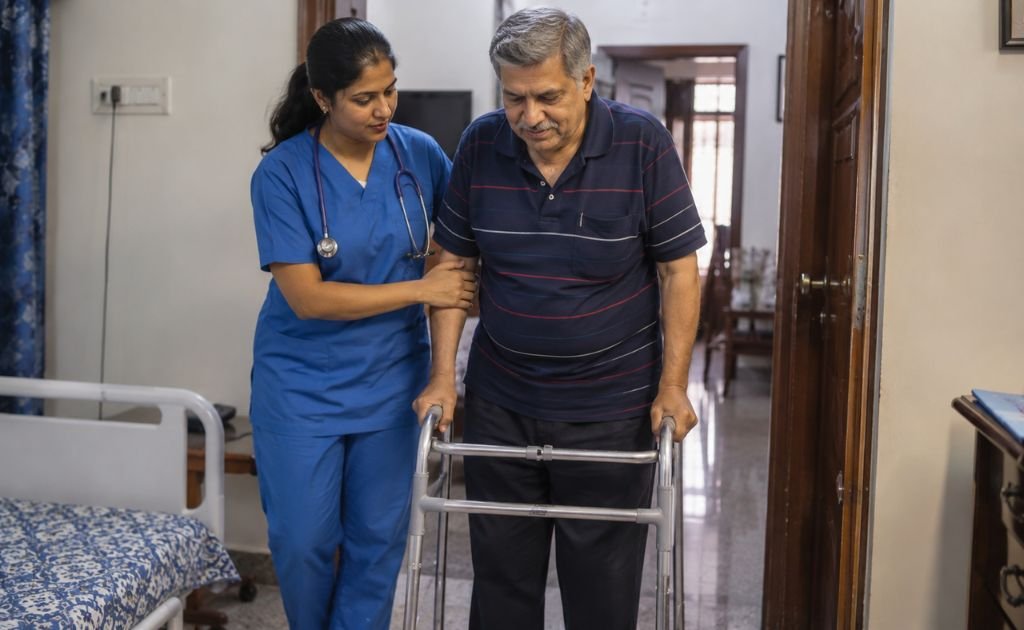
Post-surgery recovery at home
After orthopaedic, cardiac or abdominal surgery, most families need skilled nursing for one to four weeks. Often a 12-hour day shift is enough, sometimes only daily visits for dressing and injections. This is usually the least expensive category, because the need is short and clearly defined. Discharge instructions, drain and suture care, and watching for early signs of infection are where a trained nurse earns their fee. Sashitha’s team also handles post-surgery care at home across Chennai on exactly this short-term basis.
Elderly parents needing daily support
This is the most common request in Chennai, and often the least clinical. Where the need is companionship, mobility support, medication discipline and fall prevention, an attendant or caregiver is usually the right and far more affordable choice, with a nurse visiting periodically. The World Health Organization notes that adults over sixty suffer the greatest number of fatal falls worldwide, which is why supervision at home is genuinely preventive care and not a luxury. Where age brings multiple overlapping conditions, structured geriatric care at home is a better framework than ad-hoc help.
Bedridden and long-term chronic care
Bedridden patients – after a stroke, with advanced Parkinson’s, or in the later stages of dementia – are the most expensive category outside critical care, because the need is continuous and long. Two-hourly repositioning, skin checks, tube feeding and bowel and bladder care are unrelenting, and the cost of getting them wrong is high: as the NHS explains, pressure ulcers develop when the same areas of skin bear body weight continuously, and they are far easier to prevent than to heal. Budget for a year rather than a month, and plan the nurse-plus-attendant combination described earlier.
Skilled and critical care at home
Ventilator support, tracheostomy care, dialysis support and complex oncology care at home need an ICU-trained nurse and specific equipment. If this applies to your family, our guide to home care for tracheostomy patients explains what the daily care involves and how to judge a provider. It is expensive, but it is worth comparing against the alternative: a private hospital bed in Chennai costs several thousand rupees a day before any treatment, so extended home-based care is often the cheaper path for a medically stable patient. Skilled nursing at home covers this level of clinical support.
Does health insurance cover home nursing in Chennai?
Usually not, and this catches many families by surprise. Standard Indian health insurance policies are built around hospitalisation. Some policies include a domiciliary hospitalisation clause, which may cover treatment at home when a hospital bed was genuinely unavailable or the patient could not be moved, but the conditions are narrow and it rarely covers a long-term attendant or nurse.
A few insurers now offer home healthcare as an add-on rider, and some corporate group policies include it. Call your insurer, ask specifically about “domiciliary hospitalisation” and “home healthcare cover”, and get the answer in writing. Meanwhile, keep every invoice and prescription: even where insurance does not pay, medical expenses for a dependent senior citizen may have tax implications worth discussing with your chartered accountant.
How to choose a home nursing provider in Chennai
Price is the easiest thing to compare and the least useful. These are the things that actually determine whether the arrangement works.
- Ask for the nurse’s registration. A qualified nurse in Tamil Nadu holds a registration number with the Tamil Nadu Nurses and Midwives Council. Ask to see it. A provider who hesitates has told you what you need to know.
- Confirm background and police verification for anyone who will be alone in your home with a vulnerable person.
- Get the scope of duties in writing. Most disputes are about expectations, not competence – whether cooking, cleaning or shopping is included, for instance.
- Ask about the replacement guarantee. “How quickly can you send someone if our nurse is unwell?” is the most revealing question you can ask.
- Ask who supervises. Is there a nursing supervisor reviewing the care plan, or is the nurse left entirely alone?
- Check language and cultural fit. A Tamil-speaking caregiver often matters enormously for an elderly patient’s comfort, especially with dementia. So does a preference for a female caregiver – a female caretaker service is a reasonable and common request, not an awkward one.
- Confirm response time to your area. Chennai traffic is real. A provider who reaches Vadapalani in twenty minutes may take much longer to Perungudi.
- Ask how care is documented. A daily log of vitals, medication and intake is what lets a doctor make good decisions at the next review.
The government’s National Programme for the Health Care of the Elderly sets out India’s public framework for geriatric care, and it is a useful reference point for the standard of long-term care your family is entitled to expect – whether it comes from a public facility or a private provider.
Getting a real number for your situation
Every figure in this article is a range, and ranges only get you so far. The actual cost for your family depends on things that can only be established by talking through the case: what the discharge summary says, how mobile the patient is, whether there is a wound or a catheter, how many hours are genuinely needed, and whether anyone at home can share the load.
Sashitha Home Health Care is based at Santhome, Mylapore, and provides home nursing across Chennai – including Mylapore, T Nagar, Anna Nagar, Ashok Nagar, R A Puram, Besant Nagar, Vadapalani, Ramapuram and Perungudi. Rather than a fixed price list, the team assesses the patient’s requirement first and then puts together a plan and a quotation for that specific situation, which is the only honest way to price care that varies this much.
If you are working out what your family needs and what it will cost, speak to the Sashitha team on +91 91760 00011. A short conversation about the patient’s condition will get you a clearer answer than any table on the internet, including this one.
Frequently asked questions
How much does a home nurse cost per day in Chennai?
A trained home nurse in Chennai typically costs ₹1,000 to ₹1,800 per day for a 12-hour shift and ₹1,500 to ₹2,500 per day for 24-hour cover. A single nurse visit for a procedure such as an injection or dressing change usually costs ₹500 to ₹1,500. Critical-care nurses cost more.
What is the cost of 24-hour nursing care at home in Chennai?
Around ₹35,000 to ₹70,000 per month for a trained nurse, and ₹25,000 to ₹45,000 per month if a non-clinical patient attendant meets the need. ICU-level care at home, such as ventilator or tracheostomy support, generally starts around ₹65,000 and can exceed ₹1,00,000 per month.
Is 24-hour care one nurse or two?
It can be either, and this is the main reason quotes differ so much. A single live-in nurse is cheaper but must sleep at some point. Two nurses on 12-hour shifts cost more and are the correct arrangement for patients who need active care through the night. Always confirm which model a quotation refers to.
What is the difference between a home nurse and a patient attendant?
A nurse holds a formal nursing qualification and can perform clinical tasks – injections, IV therapy, sterile wound dressing, catheter and tube care, and clinical monitoring. An attendant or caregiver supports daily living: bathing, feeding, mobility, positioning and companionship. An attendant costs roughly 30 to 40 per cent less.
Is home nursing cheaper than staying in hospital?
For a medically stable patient who needs ongoing care rather than active treatment, generally yes. A private hospital bed in Chennai runs into several thousand rupees a day before treatment costs, while 24-hour home nursing works out to roughly ₹1,500 to ₹2,500 a day. Home care also lowers the risk of hospital-acquired infection.
Do I have to pay extra for a live-in nurse’s food and accommodation?
Most providers expect the family to provide meals and a place to rest for a live-in nurse. Some charge a food allowance instead. It is not always stated in the base quotation, so ask about it before the nurse arrives.
Does health insurance cover home nursing in India?
Standard health insurance policies usually do not, because they are built around hospitalisation. Some policies have a limited domiciliary hospitalisation clause, and a few insurers offer home healthcare as a paid add-on. Check with your insurer directly and get confirmation in writing.
What does home nursing cost per month for a bedridden patient in Chennai?
Most families budget ₹35,000 to ₹70,000 a month for continuous nursing, plus consumables such as adult diapers, dressings and nutrition supplements, and any equipment rental such as an air mattress or hospital bed. Combining a nurse for clinical tasks with an attendant for the remaining hours is often the most cost-effective long-term structure.
How do I check whether a home nurse is genuinely qualified?
Ask for the nurse’s council registration number and qualification certificate, confirm that background and police verification has been done, and ask who supervises the nurse’s work. A reputable agency will share all three without hesitation.
Can I hire a home nurse for just a few days after surgery?
Yes. Short-term post-surgical nursing is one of the most common requests, and daily or weekly arrangements are normal. Many families start with a week and extend only if recovery is slower than expected.