
When a doctor advises a Ryles tube for a family member – after a stroke, a surgery, or an illness that makes swallowing unsafe – the practical questions arrive quickly. Who will insert it? Must the patient travel to a hospital every time it needs attention?
For Chennai families caring for an elderly, bedridden, or recovering patient, that journey is often the hardest part. A trained home nurse can carry out selected procedures at the bedside, within the plan set by the treating doctor. This guide explains what Ryles tube insertion at home involves, why professional handling matters, what it may cost in Chennai, and how to arrange the right support – without turning tube care into a do-it-yourself exercise.
Table of Contents
What Is Ryles Tube Insertion at Home?
Ryles tube insertion at home is a clinical nursing procedure in which a trained nurse passes a Ryles (nasogastric) tube through the patient’s nose into the stomach at the patient’s residence, on a doctor’s advice, to support feeding and medication when swallowing is unsafe. Correct tube position must be confirmed using accepted clinical methods before the tube is used.
What Is a Ryles Tube?
A Ryles tube (often written Ryle’s tube, or “RT”) is the name commonly used in India for a type of nasogastric (NG) tube – a thin, flexible tube passing through the nose, down the food pipe, into the stomach. In everyday clinical language, “Ryles tube”, “NG tube”, and “nasal feeding tube” are used almost interchangeably, although tubes vary in material and design. An NG tube may be used for:
- Feeding – delivering prescribed liquid nutrition (enteral feeding) directly to the stomach
- Medication – giving prescribed medicines when swallowing is not possible
- Gastric decompression – draining stomach contents where a doctor has advised it
The purpose, tube type, and duration of use are decided by the treating medical team – not by the nursing agency or the family.
Who May Need a Ryles Tube?
A doctor may recommend a Ryles/NG tube when a patient cannot eat or drink safely by mouth. Common situations include:
- Stroke recovery, where swallowing is temporarily or persistently affected
- Neurological conditions such as advanced Parkinson’s disease or dementia that impair safe swallowing
- Post-surgical recovery, when oral intake must be paused or supplemented
- Reduced consciousness or severe weakness in bedridden patients
- Any condition requiring enteral feeding as judged by the treating team
Whether a patient needs a tube – and when it can come out – is always the treating doctor’s decision; the home nursing team carries out the plan the doctor sets.
Why Professional Ryles Tube Insertion at Home Matters
A nasogastric tube looks simple; the risk lies in where the tip ends up. If a tube is misplaced – most seriously into the airway or lungs – and then used for feeding or medicine, the consequences can be severe. NHS England treats feeding through a misplaced NG tube as a “Never Event”: an incident so serious it should never happen, and one that has caused deaths where checks were skipped or done informally.
That is why professional handling is not a luxury. A trained nurse brings:
- Assessment first – confirming the doctor’s instructions and the patient’s suitability
- Correct, gentle technique – insertion to clinical protocol
- Placement confirmation – the tube is never used until its position is verified
- Securement and documentation – checks recorded for the treating team
- Monitoring and escalation – knowing what is normal and when the patient needs a doctor
The single most important message on this page: never attempt to insert, reinsert, or replace a Ryles tube yourself. If a tube comes out, contact your nursing provider or doctor.
How Professional Home Insertion Works – A High-Level View
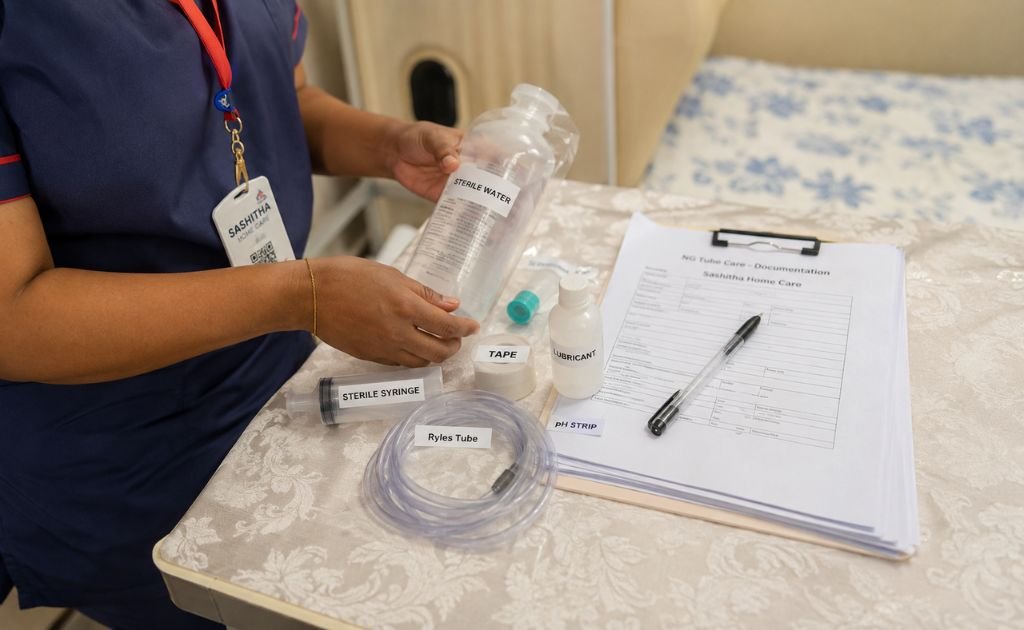
Families often feel calmer knowing the shape of the visit. Here is the process at a high level – deliberately not a how-to guide.
- Care assessment. The nurse reviews the doctor’s prescription or discharge notes and the patient’s condition.
- Preparation. The appropriate tube and prescribed supplies are readied, with attention to hygiene and comfort.
- Professional insertion. The nurse performs the procedure to clinical training and protocol.
- Placement confirmation. The tube’s position is confirmed by an accepted clinical method before any use.
- Securement and documentation. The tube is secured, the external marking noted, details recorded.
- Family guidance. The family learns what to observe, which warning signs matter, and whom to call.
How Is Tube Placement Confirmed? The Safety Check That Matters Most
Before a newly inserted Ryles/NG tube is used for feeding or medication, its position must be confirmed by a competency-assessed professional. NHS patient-safety guidance sets out two checks, and they are not interchangeable:
- Gastric aspirate pH testing — the first-line check. Fluid is drawn from the tube and tested. The safe range is pH 1 to 5.5.
- X-ray — the second-line check. Used when a safe pH reading cannot be obtained, or when the clinical situation requires it. It is not used routinely for every patient.
Just as important is what is not acceptable. NHS guidance instructs staff not to use the “whoosh test” or “bubble test” — pushing air through the tube and listening over the stomach — and not to rely on blue litmus paper or on the appearance of the aspirate.
This is not a theoretical risk. In England, a misplaced naso- or oro-gastric tube that is not detected before a feed is given is classified as a Never Event — the category reserved for wholly preventable incidents of serious harm. It is the clearest reason this is not a procedure to attempt at home without a trained professional.
What Happens After Insertion?
Ongoing care follows the patient’s individual plan: the tube is kept secured and its external marking observed for movement; feeding and medicines are given strictly per the clinician’s plan; position is re-checked in the situations the care plan specifies (for example after vomiting); observations are documented; and the family knows whom to contact if anything looks wrong.
Ryles Tube Feeding at Home
Many families need more than a one-time insertion visit – they need help running safe tube feeding day after day. Professional support for Ryles tube feeding at home typically includes:
- Following the schedule and quantities prescribed by the doctor or dietitian – never improvised
- Safe, hygienic use of the tube during feeds and medication rounds
- Monitoring feed tolerance – discomfort, bloating, reflux
- Tube-care routines that keep the tube clean and running
- Prompt communication with the family and treating team when anything changes
Exact feed volumes, formulas, and timings belong to the patient’s individual clinical plan, so this page publishes no generic instructions.
Ryles Tube Change & Replacement at Home
A common belief – repeated on many websites – is that every Ryles tube must be changed on a fixed “2–4 week” schedule. This is not accurate as a universal rule. How long a tube can stay in depends on:
- Tube material — short-term PVC tubes are typically replaced after around 7–10 days, while long-term polyurethane tubes can remain for several weeks to around three months. These intervals come from the national nursing guidance on NG tube care and from the manufacturer’s instructions for the specific tube — always follow the interval specified for the tube your patient actually has.
- Manufacturer’s instructions for the specific tube
- The treating clinician’s plan for the individual patient
A tube may need earlier attention if dislodged, blocked, or damaged – and after any replacement, placement must be confirmed again before use. Ask the treating doctor what schedule applies to your patient’s tube. Whatever the schedule, replacement is a clinical procedure – performed by a trained professional, never by family members.
Ryles Tube Removal at Home
When the treating team decides the tube is no longer needed – for example, once swallowing recovers after a stroke – removal can often be done at home by a trained nurse, on the clinician’s instruction. Pulling out a tube without medical advice can interrupt essential nutrition and set recovery back. Removal starts with a conversation with the doctor, not with the tube.
Nasogastric (NG) Tube Care by Trained Nurses
Families searching for NG tube care at home in Chennai usually need the same core service: trained nursing support for a nasogastric tube. Ongoing professional care covers tube security and nostril comfort, hygiene around feeds and medicines, monitoring for early trouble, keeping the tube clear, and structured escalation to the treating doctor when anything is abnormal. Whether your discharge summary says “Ryles tube”, “RT”, “NG tube”, or “nasal feeding tube”, describe the patient’s situation when you enquire.
Home Nursing Care for Ryles Tube Patients
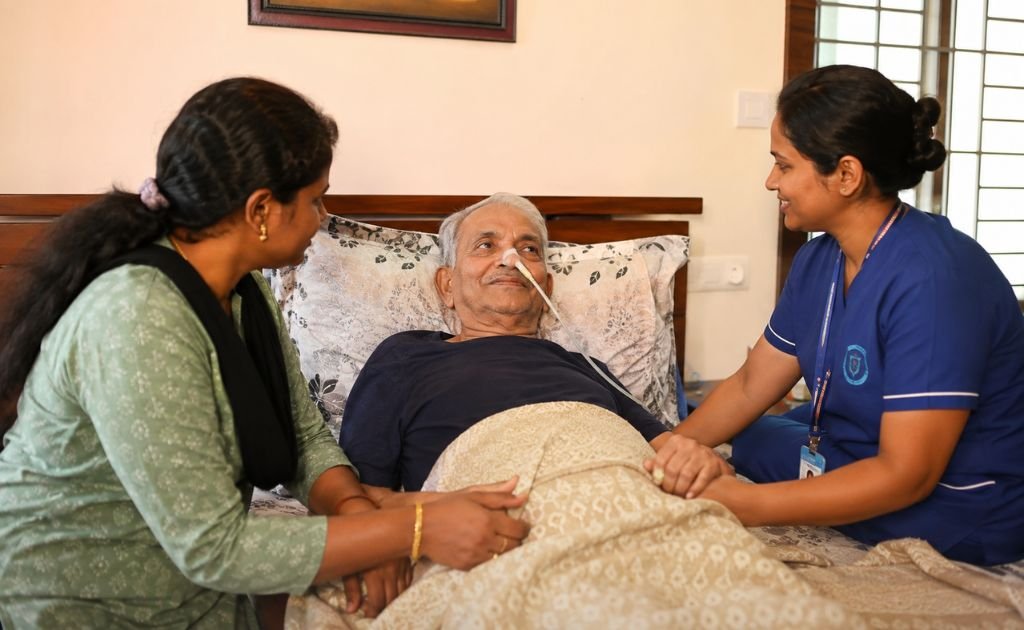
The tube is rarely the whole story. Most patients who need one are also elderly, bedridden, post-surgical, or living with the after-effects of a stroke – so the right level of nursing depends on the patient’s overall condition, not just the tube:
- A one-time nursing visit for a stable patient needing a specific procedure
- Daily or 12-hour nursing for feeding support, medication, and daytime monitoring
- 24-hour skilled nursing for bedridden or post-ICU patients, of which tube care is one part
Sashitha’s skilled nursing care at home covers medication administration, IV therapy, wound care, and catheter and ostomy care, alongside post-surgery care at home and geriatric care at home. A short assessment conversation – not a guess – matches the nursing level to the patient.
What Problems Need Medical Attention?
Contact the treating doctor or your nursing provider promptly if:
- The tube comes out, or the external marking has clearly moved
- There is coughing, choking, or breathlessness during or after feeds
- There is repeated vomiting or retching, especially if the tube may have shifted
- The tube appears blocked and feeds will not pass
- There is significant bleeding from the nose or tube
- There is redness, swelling, or skin damage around the nostril
- The patient shows feed intolerance – bloating, distress, refusal
If the patient has severe difficulty breathing, turns pale or blue, or becomes unresponsive, treat it as a medical emergency and seek urgent hospital care immediately. Do not attempt to fix, reinsert, or use the tube – get help.
Ryles Tube Insertion at Home Cost in Chennai
Published rate cards from Chennai home healthcare providers put a single nurse visit for a clinical procedure in the ₹500–₹1,500 range — Helpee lists ₹650–₹1,100 and Apollo HomeCare ₹1,500 plus consumables. These are market figures, not Sashitha’s rates. For the wider picture on home nursing pricing across the city, see our guide to home nurse cost in Chennai.
What shapes the actual quote:
| Factor | Why it matters |
| One-time visit vs ongoing care | A single visit is priced differently from daily or 24-hour nursing |
| Nurse qualification | Registered-nurse procedures cost more than attendant-level care |
| Patient complexity | Bedridden or post-ICU patients need more skilled time |
| Materials | Tube and consumables may be billed separately or per prescription |
| Location & timing | Distance within Chennai and urgency can affect the charge |
| Related procedures | Combined visits (e.g., tube care plus wound dressing) are quoted together |
For a broader picture of rates, see Sashitha’s guide to home nurse cost in Chennai, then call for an exact quotation.
How to Choose a Home Nurse for Ryles Tube Care
Before booking any provider – including Sashitha – ask:
- Is the assigned nurse qualified and registered (e.g., GNM/B.Sc nursing)?
- Is the nurse specifically trained in NG/Ryles tube procedures?
- How will placement be confirmed before use? (Never an informal air or “whoosh” test.)
- Will the nurse coordinate with the treating doctor and follow the written care plan?
- Do we need a one-time visit or ongoing nursing – and can the service scale up?
- Is a replacement nurse available if needed?
- Is the quote for a single visit or a package, and what does it include?
- What is the protocol if the tube comes out or blocks between visits?
- What documentation will we receive?
- What should the family do in an emergency?
A professional service will welcome these questions. Hesitation is itself an answer.
Ryles Tube Care Across Chennai
Home nursing removes the hardest part of tube care: repeated travel with a frail or bedridden patient. Sashitha provides home nursing services in Chennai across Mylapore, R.A. Puram, T. Nagar, Anna Nagar, Ashok Nagar, Besant Nagar, Vadapalani, Ramapuram, and Perungudi – one-time procedure visits and ongoing arrangements, coordinated with the treating doctor. See all home care services in Chennai.
Ryles Tube Support in Mylapore
Sashitha is based in Santhome, Mylapore – so for families in Mylapore, Santhome, R.A. Puram, and nearby areas, arranging an assessment is especially convenient. The dedicated home nursing in Mylapore service covers skilled nursing for elderly and recovering patients; enquire about Ryles/NG tube support and the team will confirm a nurse with appropriate tube-care training.
Why Consider Sashitha Home Health Care?
- Chennai-based, Mylapore-rooted: a local team at 8/13, Rosary Church Road, Santhome, Mylapore
- Skilled nursing at home: medication administration, IV therapy, wound care, catheter and ostomy care, post-surgical nursing, chronic disease support
- Device-care experience: nurses experienced with clinical devices including catheters and feeding tubes. Because competency requirements differ by procedure, the team confirms the assigned nurse’s training for your patient’s specific tube-care plan before booking.
- Care built around the patient: geriatric care, post-surgery care, customised care plans, 24×7 support
- Transparent about fit: the team confirms nurse availability and the specific training your patient’s tube care requires before booking
One honest note: because every patient’s tube, condition, and doctor’s plan differ, always confirm during your enquiry that the assigned nurse has the appropriate training for the Ryles/NG tube care your patient’s plan requires. A good provider will confirm this in writing.
How to Book a Home Nursing Visit
- Call or WhatsApp +91 91760 00011, or use the contact Sashitha Home Health Care page
- Describe the requirement – insertion, replacement, feeding support, or ongoing care
- Share your location and preferred timing within Chennai
- Keep the doctor’s prescription or discharge summary ready
- Confirm nurse availability and competency for the specific procedure
- Receive your quotation and schedule the visit
Need a trained home nurse for Ryles/NG tube care in Chennai? Contact Sashitha Home Health Care to discuss your patient’s requirements and confirm the right nursing support. Call +91 91760 00011 or request a home nursing assessment.
Frequently Asked Questions
What is Ryles tube insertion at home?
A clinical procedure in which a trained nurse inserts a Ryles (nasogastric) tube through the nose into the stomach at home, on a doctor’s advice, confirming its position by accepted methods before any use.
Is Ryles tube insertion at home safe?
It can be, when performed by a trained nurse who follows clinical protocol and confirms placement before use. It is never safe as a DIY procedure – misplaced tubes can cause serious harm.
Who can perform Ryles tube insertion at home?
Only a trained healthcare professional – typically a registered nurse with NG-tube training – under the patient’s medical plan. Family members should never insert, reinsert, or replace a tube.
What is the difference between a Ryles tube and an NG tube?
A Ryles tube is the common Indian/British name for a type of nasogastric (NG) tube. In everyday use the terms overlap, though tubes vary in material and design.
Does a Ryles tube need to be changed every 2–4 weeks?
No universal schedule applies. Timing depends on tube material (PVC tubes are changed after days; polyurethane tubes can last months), the manufacturer’s instructions, and the clinician’s plan. A blocked or dislodged tube needs attention sooner.
Can Ryles tube feeding be managed at home?
Yes – home tube feeding under professional supervision is established practice. A trained nurse follows the prescribed plan, maintains the tube, monitors tolerance, and escalates concerns.
What should I do if the Ryles tube comes out?
Do not try to reinsert it. Put nothing down the tube and contact your nursing provider or doctor promptly. If the patient has breathing difficulty, seek emergency care immediately.
How is tube placement confirmed?
Gastric aspirate pH testing is the first-line check, with a safe range of pH 1 to 5.5. X-ray is used as a second-line check when a safe pH reading cannot be obtained. Both are performed by competency-assessed professionals. Informal “whoosh” or bubble air tests are unreliable and are explicitly rejected by NHS patient-safety guidance.
How much does Ryles tube insertion at home cost in Chennai?
Single procedure visits in Chennai generally fall around ₹500–₹1,500 depending on nurse qualification, patient complexity, materials, and location. Contact Sashitha for an exact quotation.
Can I book Ryles tube care for an elderly or bedridden patient?
Yes. Tube care is commonly part of home nursing for elderly, bedridden, stroke, and post-surgery patients – from one-time visits to 24-hour skilled nursing.
Is Ryles tube nursing available in Mylapore?
Sashitha is based in Santhome, Mylapore, and serves Mylapore and nearby areas. Describe the tube-care requirement when enquiring so the team can assign an appropriately trained nurse.
When should I seek urgent medical help?
For severe breathing difficulty, choking during feeds, unresponsiveness, or significant bleeding. For a displaced or blocked tube without emergency signs, contact your doctor or nursing provider promptly instead of attempting fixes at home.
A note on this article
This guide is general educational information for families and does not replace advice from the patient’s doctor or treating healthcare team. Ryle’s tube requirements vary between patients. Always follow the individual care plan given by the qualified healthcare professionals responsible for the patient, and contact them directly with any clinical question or concern.