
A stroke can change a family’s routine overnight. One week, your father is walking to the Mylapore market on his own; the next, you are standing at a hospital discharge desk with a file of prescriptions, a list of exercises, and a quiet question nobody has fully answered: how are we going to manage this at home?
This guide explains what stroke patient care at home in Chennai actually involves – what a trained home nurse does, how daily care is organized, where rehabilitation fits in, what home nursing realistically costs, and the warning signs that mean you should seek emergency help.
Home care after a stroke is not a replacement for medical treatment or rehabilitation. It is the support system that makes recovery at home safer and more sustainable – for the stroke survivor and for the family carrying the daily load. The right level of support depends on the person’s medical and functional needs, so treat everything below as a starting point for a conversation with the treating doctor, not a substitute for one.
Table of Contents
What Does Stroke Patient Care at Home Involve?
Stroke patient care at home combines nursing support, help with mobility and personal care, medication support as prescribed, feeding and swallowing assistance where appropriate, skin care to prevent pressure sores, coordination with physiotherapists and doctors, and ongoing monitoring of the patient’s condition. It also supports family caregivers. The right mix is individualized – some patients need short daily visits, while others need 12-hour or 24-hour nursing care.
Every stroke is different, so every home-care plan should be too. The sections below walk through each element in detail.
What Happens After a Stroke?
A stroke happens when blood supply to part of the brain is interrupted. Depending on which part of the brain is affected and how severely, a stroke survivor may experience weakness or paralysis on one side of the body, difficulty speaking or understanding language, trouble swallowing, poor balance, changes in memory and thinking, and changes in mood.
Recovery varies enormously from person to person. According to the NHS, some people recover in days or weeks, while for others it takes months or years. Rehabilitation typically begins in hospital, often within the first 48 hours, and continues after discharge (NINDS). What happens at home in the months after discharge plays a major role in how safely that recovery continues.
Stroke is also common in India – studies report roughly 108–172 new strokes per 100,000 people each year (International Journal of Stroke) – so thousands of Chennai families face this situation every year. You are not alone in figuring this out.
Who May Benefit From Home Care After a Stroke?
Not every stroke survivor needs a full-time nurse. Home-care support is usually worth considering when the person:
- Has just been discharged from hospital and still needs clinical monitoring or procedures at home
- Has reduced mobility – needs help to walk, transfer from bed to chair, or is bedridden
- Has swallowing difficulty or is on a modified diet or feeding tube
- Needs help with bathing, toileting, grooming and other personal care
- Takes multiple medications on a strict schedule
- Has communication or memory difficulties that make being alone unsafe
- Is elderly, lives alone, or lives with an elderly spouse who cannot physically manage the care
- Has family members who work full-time or live in another city or abroad
For a patient who is walking safely and managing daily activities, a few supportive visits per week may be enough. For a bedridden patient with a feeding tube, structured nursing care becomes much more important.
Home Nurse vs Caregiver (Attendant): What’s the Difference?
Families in Chennai often use “nurse” loosely for anyone hired to help at home. In practice there is a real difference – in training, in what each is allowed to do, and in cost.
| Need | Home Nurse (GNM/B.Sc qualified) | Caregiver / Attendant |
| Monitoring vitals and clinical changes | Yes | Basic observation only |
| Giving medications as prescribed | Yes | Reminders only |
| Ryles tube feeding, catheter, wound care | Yes, where trained | No – these are nursing procedures |
| Help with walking, transfers, positioning | Yes | Yes |
| Bathing, toileting, personal hygiene | Yes | Yes |
| Assisting meals for patients cleared to eat | Yes | Yes |
| Companionship and daily routine | Yes | Yes |
| Escalating problems to doctors/family | Yes, with clinical judgment | Reports to family |
Many families use a practical combination: a qualified nurse for clinical tasks (daily or on shifts) plus an attendant for round-the-clock personal care and supervision. An honest provider will help you match the staffing level to the patient’s actual needs – Sashitha’s skilled nursing team handles the clinical side, including medication administration, wound care and catheter care, while trained attendants support daily living.
Daily Stroke Patient Care at Home: The Core Elements
Medication support
Giving or prompting doses on time as prescribed, keeping an updated medication list, and reporting side effects or missed doses to the treating doctor – never adjusting doses independently.
Mobility and positioning
Help with safe walking, bed-to-chair transfers and comfortable positioning as advised by the physiotherapist and doctors. For bedridden patients, regular position changes are a core daily task.
Personal hygiene
Bathing, grooming, oral care, toileting and continence care – done with dignity and patience. This is often the heaviest daily burden on families, and where professional support helps most immediately.
Feeding
Meal assistance for patients cleared to eat normally, or support for the modified diet or tube feeding plan the treating team has prescribed (more on swallowing below).
Skin care
Daily skin checks and reducing prolonged pressure on vulnerable areas – critical for anyone spending long hours in bed or a chair.
Communication and emotional support
Speaking clearly and unhurriedly, allowing time to respond, keeping the person involved in family life, and maintaining a predictable routine. Recovery is not only physical.
Mobility and Fall Prevention at Home
Falls are one of the most common complications after stroke – research suggests roughly half of stroke survivors fall within the first year, several times the rate of healthy adults (Frontiers, 2022 systematic review). Chennai homes and apartments can be made significantly safer with simple changes recommended by the American Stroke Association:
- Remove loose rugs, mats and trailing wires from walking paths
- Ensure good lighting, especially for night-time bathroom trips
- Add grab bars in the bathroom and consider a showaer chair
- Keep frequently used items within easy reach
- Use walking aids only as prescribed, and keep them within reach
- Never rush transfers – unhurried, supported movement prevents most falls
Transfers for patients with significant weakness require proper technique. If the patient cannot bear weight reliably, ask the physiotherapist or nursing team to demonstrate safe methods rather than improvising – protecting the family caregiver’s back matters too.
Swallowing and Feeding After a Stroke
This is one of the most underestimated parts of stroke care at home. Around half of stroke patients admitted to hospital have some degree of swallowing difficulty (dysphagia) (peer-reviewed research). Unsafe feeding can cause food or liquid to enter the airway (aspiration), which can lead to serious chest infections, malnutrition and dehydration.
For this reason:
- Swallowing should be assessed by the treating team – usually involving a speech and language therapist – before deciding how the person eats and drinks (NHS guidance on dysphagia)
- Any modified diet (softened food, thickened fluids) should follow the team’s specific instructions, not general advice
- Some patients need temporary or longer-term tube feeding, most commonly through a nasogastric (Ryles) tube – a decision made by doctors, with the tube inserted and managed by trained professionals
If your family member has been discharged with a feeding tube, trained nurses can manage feeds, positioning and tube care at home. Sashitha’s detailed guide to Ryles tube insertion and feeding at home in Chennai explains how professional NG-tube care works and why families should never attempt insertion themselves.
Medication Management and Preventing Another Stroke
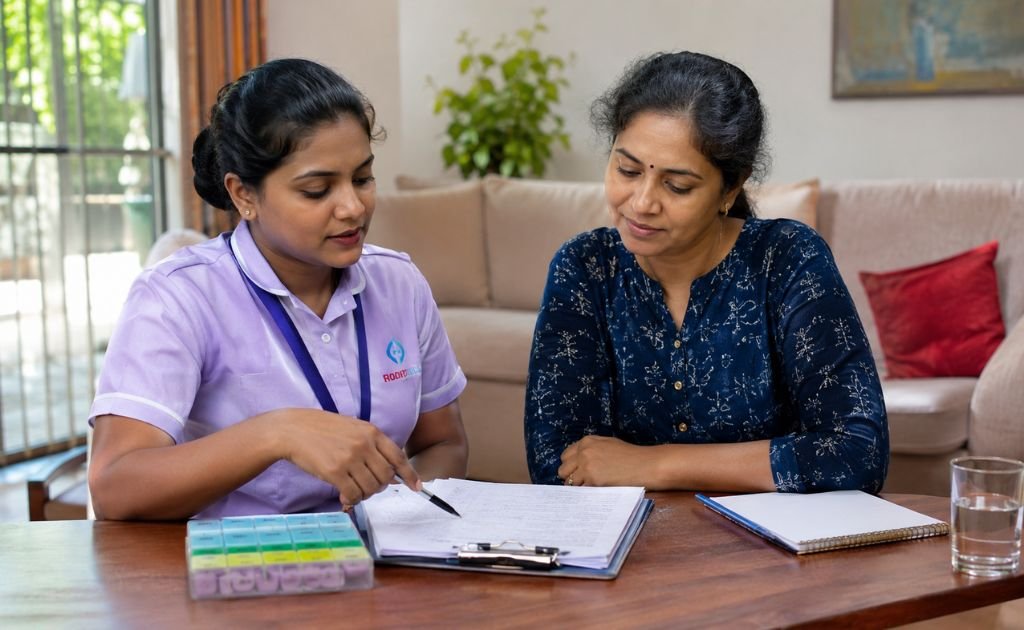
According to the American Stroke Association, nearly 1 in 4 stroke survivors will have another stroke – and consistent control of blood pressure, cholesterol, blood sugar and other risk factors substantially reduces that risk (ASA: Preventing Another Stroke). In practice, at home this means:
- Taking every prescribed medicine exactly as directed, without skipped doses
- Keeping one written, current medication list that travels to every appointment
- Attending follow-up reviews with the neurologist or physician
- Reporting side effects, dizziness, unusual bleeding or new symptoms to the doctor promptly – rather than stopping the medicine
A home nurse can administer medications on schedule and keep records the doctor can actually use. Since high blood pressure and diabetes are the biggest drivers of recurrent stroke, ongoing disease management support at home is a meaningful part of long-term stroke care, not an optional extra.
Preventing Pressure Sores in Bedridden Stroke Patients
For a bedridden stroke patient, pressure sores (bed sores) are among the most serious avoidable complications. Prevention principles from MedlinePlus (U.S. National Library of Medicine) include:
- Regular repositioning – typically every couple of hours in bed, as set out in the patient’s care plan
- Daily skin inspection, paying attention to the tailbone, hips, heels and elbows
- Pressure-redistributing surfaces such as an air mattress where clinically appropriate
- Keeping skin clean and dry, especially with incontinence
- Adequate nutrition and hydration as medically advised
- Early escalation – any persistent redness or broken skin should be reported to the nurse or doctor immediately, not watched for days
This is one area where professional bedridden care clearly earns its cost: trained staff reposition correctly, spot early skin changes, and manage hygiene systematically.
Physiotherapy and Rehabilitation at Home
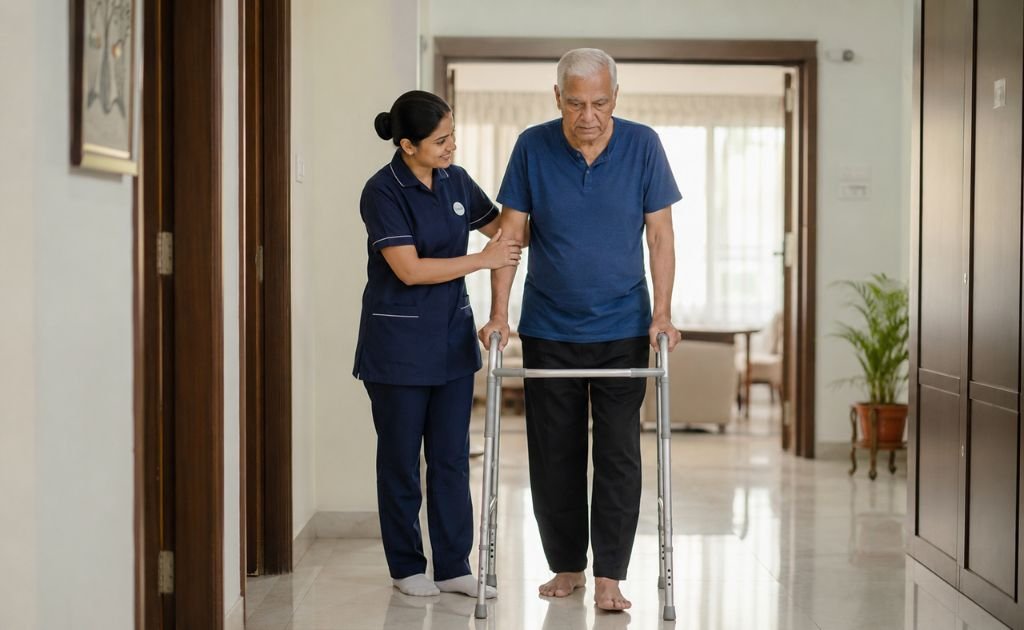
Rehabilitation is the engine of stroke recovery, and home care works best when it supports – never replaces – the rehabilitation plan. Depending on the patient’s needs, the treating team may include physiotherapy (strength, balance, walking), occupational therapy (relearning daily activities like dressing and eating) and speech and language therapy (communication and swallowing). People who participate in structured rehabilitation recover better (American Stroke Association), and research on supported discharge shows that coordinated, professional home-based rehabilitation can genuinely improve outcomes (Cochrane review).
At home, nurses and trained attendants support this by helping the patient practise therapist-directed routines between sessions, ensuring exercises actually happen on the days the therapist doesn’t visit, and reporting progress or setbacks back to the team. Exercises themselves should always follow the individualized plan set by qualified clinicians – well-meaning improvised exercises can do harm.
Speech, Communication and Emotional Wellbeing
Communication changes
Around one in three stroke survivors experiences aphasia – difficulty speaking, understanding, reading or writing (Stroke Association). Aphasia affects language, not intelligence. At home, it helps to speak in short, clear sentences, allow generous time for responses, minimize background noise (switch off the TV during conversations), and use gestures, writing or pictures where they help. A speech and language therapist can guide specific communication strategies.
Mood and emotional health
Roughly one in three stroke survivors develops depression (American Heart Association). Losing independence is hard, and mood changes after stroke are common and treatable – they are not weakness or “attitude”. If your family member seems persistently low, withdrawn, tearful or hopeless, raise it with the treating doctor. And watch the family caregiver’s wellbeing too: caregiver exhaustion is real, and respite support (even a 12-hour shift a few days a week) protects everyone.
Warning Signs That Need Medical Attention
During home care, certain changes should always prompt a call to the treating doctor – or emergency care if severe:
- New or worsening weakness, numbness or facial droop
- New difficulty speaking, understanding or swallowing
- New confusion, drowsiness or reduced responsiveness
- New vision changes
- A severe or unusual headache
- Breathing difficulty, chest pain, or fever with cough
- Repeated vomiting
- Signs of infection: fever, burning urination, worsening wounds or skin breakdown
- Pain, swelling or redness in a leg (report promptly)
When in doubt, contact the doctor. A good home-care provider will have a clear escalation process so concerns reach the family and the treating team quickly.
Emergency: Suspected New Stroke – Act Immediately
If a stroke survivor develops sudden new symptoms, do not wait for the home nurse’s next visit, do not “monitor overnight”, and do not try to manage it at home. Call an ambulance (108 / 112) or get to the nearest emergency department immediately.
Use the BE-FAST check promoted by the American Stroke Association:
- B – Balance: sudden loss of balance or coordination
- E – Eyes: sudden blurred, double or lost vision
- F – Face: one side of the face droops when smiling
- A – Arms: one arm drifts down when both are raised
- S – Speech: slurred or strange speech; can’t repeat a simple sentence
- T – Time: call emergency services immediately
Two points matter enormously. First, minutes matter – emergency stroke treatments are time-critical, which is why the CDC advises calling an ambulance rather than driving. Second, seek emergency care even if the symptoms pass – symptoms that resolve can signal a transient ischaemic attack, which still needs urgent assessment (NHS).
How Many Hours of Home Nursing Does a Stroke Patient Need?
There is no standard answer – the right arrangement depends on mobility, feeding method, continence, medication complexity, tubes or devices, cognitive status, night-time safety and how much family support is realistically available. Common arrangements in Chennai:
- Nursing visits – for specific procedures (injections, wound care, tube changes) or periodic monitoring
- 8–12 hour care – daytime nursing or attendant support while family covers nights
- 24-hour care – for high-dependency patients, via a live-in arrangement or two 12-hour shifts
- Nurse + attendant combination – often the most cost-effective model: an attendant for continuous personal care with a qualified nurse for daily clinical tasks
A proper needs assessment before starting – rather than defaulting to the most expensive option – is the mark of a trustworthy provider.
Cost of Stroke Patient Care at Home in Chennai
Costs depend on qualification level, hours, and how complex the patient’s needs are. As indicative 2026 Chennai market ranges (from Sashitha’s detailed home nurse cost guide):
| Type of care | Indicative daily rate | Indicative monthly range |
| Single nursing visit (procedures) | ₹500 – ₹1,500 per visit | – |
| Attendant, 12-hour | ₹700 – ₹1,100 | ₹15,000 – ₹25,000 |
| Attendant, 24-hour (live-in) | ₹900 – ₹1,500 | ₹25,000 – ₹45,000 |
| Trained nurse (GNM/B.Sc), 12-hour | ₹1,000 – ₹1,800 | ₹25,000 – ₹45,000 |
| Trained nurse, 24-hour | ₹1,500 – ₹2,500 | ₹35,000 – ₹70,000 |
| Critical-care trained nurse, 24-hour | ₹2,500 – ₹4,500 | ₹65,000 – ₹1,00,000+ |
Rates are indicative, vary by provider and patient condition, and change over time. Budget separately for consumables (dressings, adult diapers, feeding syringes), equipment rental (hospital bed, air mattress, wheelchair), and physiotherapy sessions, which are usually billed independently. Note that home nursing is typically not covered by health insurance in India, so confirm costs in writing before starting. A stroke patient’s exact quote should always follow an assessment of their actual needs – be cautious of providers who quote a single price before understanding the case.
When Is 24-Hour Nursing Appropriate?
Round-the-clock nursing is usually considered when the patient has high dependency – for example severe mobility limitation or complete bed rest, feeding-tube or tracheostomy care, frequent monitoring needs, significant confusion or cognitive impairment, or night-time safety risks (falls, wandering, choking). For patients with very complex needs, Sashitha’s guide to tracheostomy care at home shows what high-dependency home nursing involves. But 24-hour nursing is not automatic for every stroke patient – the decision should follow an assessment involving the treating doctor, and many families do well with 12-hour care or a nurse-plus-attendant model.
How to Choose a Stroke Home-Care Provider in Chennai
Before committing, ask any provider:
- Are your nurses qualified (GNM/B.Sc), and can I verify credentials?
- Have your staff cared for stroke or bedridden patients before?
- Can you handle the clinical tasks this patient needs – medications, Ryles tube feeding, catheter care, wound care?
- How do you coordinate with our doctors and physiotherapist?
- Is there a replacement policy if the nurse is absent?
- What shift options exist (visits, 12-hour, 24-hour, nurse + attendant)?
- Is there a written care plan and daily documentation?
- How do you keep the family informed, especially children living abroad?
- What is your escalation process if the patient’s condition changes?
- Is pricing transparent – what’s included, what’s billed separately?
- Do you actually serve our area of Chennai?
- Can you share genuine references or reviews?
A provider who answers these directly – and insists on assessing the patient before quoting – is behaving the way good home healthcare should.
Stroke Patient Home Care with Sashitha Home Health Care
Sashitha Home Health Care is a Chennai-based home nursing provider operating from Mylapore (Santhome), supporting families across the city including Mylapore, Alwarpet, R.A. Puram, T. Nagar, Ashok Nagar, Anna Nagar, Vadapalani, Besant Nagar, Perungudi and Ramapuram.
For families caring for a stroke survivor, Sashitha’s home nursing services in Chennai cover the areas this guide describes: skilled nursing with medication administration and wound care, bedridden care with repositioning and skin monitoring, Ryles tube feeding support, catheter and tracheostomy care, personal care, support for physiotherapy routines, and post-hospital discharge care – available as visits, 12-hour shifts or 24-hour care, with attendant and geriatric care options for longer-term support. Care plans are individualized after understanding the patient’s condition, and support is available around the clock.
Talk to us about stroke patient home care in Chennai. Call +91 91760 00011 or send an enquiry through our contact page – we’ll discuss your family member’s needs and help you work out the right level of support, honestly.
Frequently Asked Questions
What does stroke patient care at home involve?
It combines nursing support (medication, monitoring, clinical procedures), help with mobility and personal care, feeding support as prescribed, pressure-sore prevention, rehabilitation coordination and family support – individualized to the patient’s condition and the treating team’s plan.
Can a stroke patient be cared for safely at home?
Often, yes – provided the support level matches the patient’s needs and rehabilitation continues as planned. Research shows coordinated home-based care after early discharge can support good outcomes. The treating doctor should confirm the patient is stable for home care.
Does every stroke patient need a home nurse?
No. Mobile, independent patients may need little help. A nurse matters when there are clinical needs – medications to administer, tubes, wounds, monitoring – while an attendant may be enough for personal care and supervision alone.
What does a home nurse do for a stroke patient?
Monitors vitals and condition changes, gives medications as prescribed, manages Ryles tube feeding, catheters and wound care where needed, assists safe mobility and hygiene, keeps care records, and escalates concerns to the family and treating doctor.
Can stroke rehabilitation be done at home?
Yes – physiotherapy, occupational therapy and speech therapy can all be delivered at home under an individualized plan from qualified therapists. Home nurses and caregivers support the routine between sessions; they do not replace therapists.
How many hours of home nursing does a stroke patient need?
Anywhere from occasional visits to 24-hour care, depending on mobility, feeding method, medication needs, cognition and family availability. Many families use 12-hour care or a nurse-plus-attendant combination. A needs assessment should decide this, not a standard package.
How much does stroke patient home care cost in Chennai?
Indicatively (2026): attendants roughly ₹15,000–₹45,000 per month, qualified nurses roughly ₹25,000–₹70,000 depending on 12 vs 24-hour cover, critical-care nursing higher. Consumables and equipment are usually extra; exact quotes should follow an assessment.
Can a bedridden stroke patient receive home nursing?
Yes. Bedridden care is a core part of home nursing – regular repositioning, daily skin checks, pressure-sore prevention, hygiene and continence care, feeding support and monitoring, under the treating doctor’s plan.
Can home nurses help with feeding or Ryles tube care?
Trained nurses can manage prescribed tube feeds, positioning and tube care at home. Tube insertion and feeding decisions belong to the treating team; families should never attempt insertion themselves.
How can I prevent falls for a stroke patient at home?
Remove loose rugs and clutter, improve lighting, add bathroom grab bars, keep essentials within reach, use prescribed walking aids, and support transfers without rushing. Ask the physiotherapist to review the home and demonstrate safe techniques.
When should a stroke patient be taken to emergency care?
Immediately, if any sudden new symptom appears – facial droop, arm weakness, slurred speech, loss of balance, vision changes, severe headache or reduced consciousness. Call 108/112 without waiting, even if symptoms seem to pass.
Does Sashitha Home Health Care provide stroke patient care in Chennai?
Yes – through its home nursing services: skilled nursing, bedridden care, Ryles tube feeding support, personal care, and 12-hour or 24-hour arrangements across its Chennai service areas, with plans individualized after an assessment. Call +91 91760 00011 to discuss your situation.