
Elderly care is practical support that helps an older person manage the parts of daily life that have become difficult – washing, moving safely around the house, eating well, taking medicines on time, and simply not being alone for long stretches. It ranges from a few hours of help a day to round-the-clock nursing, and the right level depends entirely on the person.
That last point is where most families get stuck. Searching for an elderly care service in Chennai brings up dozens of providers, but very few of them help you answer the first question: how much help does my mother or father really need, and from whom? Get that wrong and you either pay for clinical skills nobody uses, or you hire a companion for someone who needs a nurse.
This guide is written for the family member doing the deciding. It explains what elderly care at home includes, when professional support is worth considering, how to judge the level of support required, who does what (a caregiver and a home nurse are not the same person), the types of care you can arrange in Chennai, what drives the cost, and what to check before anyone walks through your parent’s door.
Table of Contents
What elderly care means (and what it doesn’t)
Elderly care – you’ll also see it called elder care, senior care or, in a clinical setting, geriatric care – is support with the everyday activities a person can no longer manage alone, delivered either at home or in a residential facility. The National Institute on Aging describes long-term care as services designed to meet a person’s health or personal care needs when everyday activities become hard to do independently, and notes that the need can arrive suddenly after a stroke or fall, or build up gradually over years.
Two things elderly care is not:
- It is not medical treatment. A caregiver supports daily life. Diagnosis, prescriptions and changes to treatment stay with the treating doctor.
- It is not one product. “Elder care” covers everything from a companion who visits in the afternoon to an ICU-trained nurse living in the house. The label on a provider’s website tells you very little until you know which level they mean.
What elderly care at home includes
Most families in Chennai who search for elderly care are looking for help at home rather than a move to a facility. Here is what a well-run home care arrangement typically covers. Not every family needs every item – the point of a care plan is to choose.
Personal care and hygiene
Help with bathing, dressing, grooming, oral care and toileting, done in a way that protects the older person’s dignity. For many parents this is the hardest help to accept, and it is often the reason families bring in a trained outsider rather than doing it themselves.
Mobility and fall prevention
Support with getting out of bed, walking to the bathroom, using stairs, and transfers to and from a chair or wheelchair. This matters more than it sounds: the World Health Organization reports that adults over 60 suffer the highest number of fatal falls, and a single fall at home in Chennai’s typical two-storey house or a slippery bathroom can end a parent’s independence. A good caregiver also spots the loose rug, the dark corridor and the missing grab bar.
Meals, hydration and medication reminders
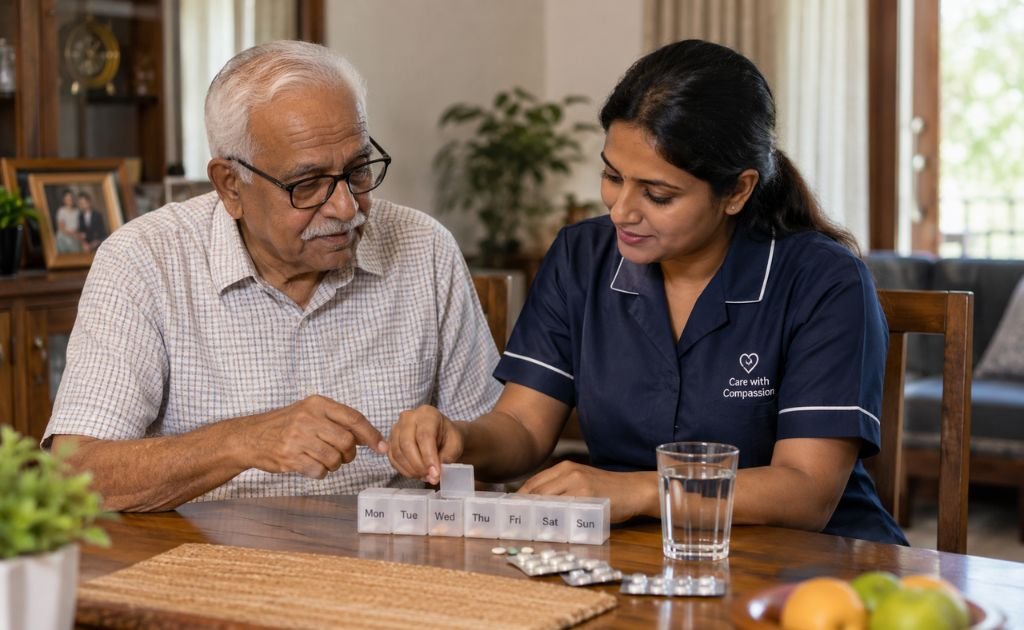
Preparing or serving meals that suit the person’s dietary needs, making sure they drink enough through a Chennai summer, and reminding them to take medicines at the right time. Note the word reminding: a caregiver can prompt and hand over prescribed medicines; giving injections or managing IV lines is nursing work (more on that below).
Companionship, routine and family communication
Conversation, a walk to the temple or the park, help with the phone or the TV remote, keeping a daily routine going, and – often the part families value most – a regular update to the son in Bengaluru or the daughter in Dubai about how the day went, what was eaten and whether anything seemed off.
Some arrangements also include light household tasks directly related to the older person (their laundry, their room), accompanying them to appointments, and basic observation – noticing a new cough, a swollen ankle or unusual confusion and telling the family.
When should a family consider professional elderly care?
There is rarely a single moment. More often it’s an accumulation – a fall that was “nothing”, a fridge with expired food, a missed dose, a phone call where your father sounded confused at 4 pm. A useful way to decide is to ask four questions:
- Safety: has anything happened in the last three months that could have ended badly – a fall, a burn, a wandering episode, a medicine taken twice?
- Daily living: is your parent struggling with any of the six activities listed in the next section?
- Health: is there a new diagnosis, a recent hospital stay, or a condition that needs monitoring the family can’t provide?
- The carer: is the person currently providing care – often a spouse in their seventies, or a daughter juggling a job – close to burning out?
A “yes” to any one of these is enough to start a conversation with a provider, even if only for a few hours a week. For a fuller list of the warning signs families tend to notice first, read our article on the signs your parents might need professional elder care.
How to tell what level of support your parent needs
A simple way to assess: the six daily activities
Healthcare professionals often use “activities of daily living” (ADLs) to judge how much support someone needs. WHO’s Integrated Care for Older People (ICOPE) guidance for health workers is built on the same principle: assess the individual person’s capacities, identify their support needs, and only then build a personalised care plan. You can do a simple version of that assessment yourself. Sit down and honestly ask, for each one, whether your parent can do it alone, with a little help, or not at all:
- Bathing
- Dressing
- Using the toilet
- Moving around the home and getting in and out of bed
- Eating (not cooking – actually eating)
- Continence
If the answer is “alone” for all six, your parent probably needs companionship, safety supervision and help with shopping, cooking or transport rather than hands-on care. If two or more are “with help” or “not at all”, daily hands-on support is likely. If there is also a wound, a catheter, a feeding tube, oxygen, injections or a recent hospital discharge, nursing is in the picture.
When a doctor’s assessment should come first
Some changes look like “getting old” but need a medical opinion before you decide on care: sudden confusion or memory loss, repeated falls, unexplained weight loss, new incontinence, or a decline that happened over weeks rather than years. In those cases, ask the treating doctor what level of support they recommend and for how long. A discharge summary or a physician’s note is also the most useful document you can hand to a care provider – it stops guesswork on both sides.
Caregiver, home attendant, home nurse or geriatric care: who does what
This is the distinction that saves families the most money and the most worry. In Chennai the terms are used loosely – “caretaker”, “attender”, “ayah”, “nurse” – so judge by what the person is actually trained and permitted to do, not the label.
| Caregiver / home attendant | Trained home nurse (ANM / GNM / B.Sc) | Skilled or critical-care nurse | Geriatric care (structured) | |
| Bathing, dressing, toileting, feeding | Yes | Yes | Yes | Yes (via caregiver) |
| Mobility support, fall prevention, companionship | Yes | Yes | Yes | Yes |
| Medication reminders and handing over prescribed medicines | Yes | Yes | Yes | Yes |
| Injections, IV lines, sterile wound dressing | No | Yes | Yes | Through nurse |
| Catheter, feeding-tube, tracheostomy care | No | Yes | Yes | Through nurse |
| Ventilator / ICU-level support at home | No | No | Yes | No |
| Monitoring vitals and escalating to a doctor | Basic observation only | Yes | Yes | Yes |
| Coordinated care plan across multiple conditions | No | Partly | Partly | Yes – the defining feature |
Caregiver / home attendant. Trained in personal care, safe lifting, hygiene and basic observation. The right choice when the need is daily-living support, supervision and company. This is the most common request in Chennai and often the most affordable.
Trained home nurse. Holds a nursing qualification and, in Tamil Nadu, a registration with the Tamil Nadu Nurses and Midwives Council. Needed when there are clinical tasks – dressings, injections, tube or catheter care, post-surgical monitoring. Our separate guide explains home nurse costs in Chennai and how to read a nursing quote.
Skilled / critical-care nurse. ICU experience; required for tracheostomy, ventilator or complex oncology care at home. If this is your situation, our guide to home care for tracheostomy patients goes into detail.
Geriatric care. Less a job title, more an approach: a coordinated plan for an older person with several overlapping conditions (say, diabetes, arthritis and early dementia), combining caregiver support, periodic nursing, medication management and doctor coordination. Sashitha describes its version on the geriatric care at home page.
A combination is often the sensible answer. A parent recovering from a hip replacement might need a nurse for an hour each morning and a caregiver for the rest of the day – far cheaper than a 24-hour nurse and no less safe.
Types of elderly care you can arrange in Chennai
Part-time and full-day care
A caregiver for a defined block – typically 4 to 12 hours – covering the morning routine, meals and the afternoon. Suits parents who are mostly independent but shouldn’t be alone all day, and families where someone is home in the evenings. Most providers in Chennai, including Sashitha, offer plans from a few hours a day upward.
Overnight care
Cover through the night for a parent who wakes confused, is at risk of getting up alone, or needs repositioning to prevent pressure sores. Often the arrangement that lets a caregiving son or daughter sleep for the first time in months.
Live-in and 24-hour care (one person or two?)
Continuous cover is right when the person cannot safely be left alone at any point – advanced dementia with wandering, bedridden with pressure-sore risk, or the first days after a major discharge. Ask every provider one question: is 24-hour care one live-in person or two people on 12-hour shifts? One live-in caregiver is cheaper and works when the parent sleeps through the night; two rotating staff cost more and are the correct model when active care is needed at 3 am. Also confirm rest hours, the weekly off, who covers it, and where a live-in caregiver will sleep and eat – sort this out before day one, not day nine.
Temporary and post-hospitalisation care
Short-term care for one to four weeks after surgery, a stroke or an infection, or while the regular family caregiver travels. Daily or weekly billing is normal. Many families start with a short arrangement precisely to see whether the caregiver is the right fit before committing to a month. Our guides on post-surgery recovery and stroke patient care at home in Chennai cover these situations in depth.
Elderly care at home vs other options in Chennai
| Care at home | Old-age home / senior living | Assisted living / care facility | Hospital | |
| Familiar surroundings and routine | Yes | No | No | No |
| One-to-one attention | Yes | Shared | Shared | Shared |
| Flexibility (hours, level, start/stop) | High | Low | Medium | N/A |
| Suitable for clinical needs | Yes, with a nurse | Usually not | Some facilities | Yes |
| Family involvement day to day | High | Limited | Limited | Limited |
| Social contact with peers | Depends on family and caregiver | Built in | Built in | No |
| Typical cost pattern | Scales with hours and level | Monthly fee | Higher monthly fee | Daily, high |
| Best fit | Most seniors who want to stay home; NRI families arranging care remotely | Seniors who are lonely at home and mobile enough to enjoy community | Seniors needing supervision plus some clinical support | Acute illness only |
Home care is not automatically better – a parent who is isolated and mobile may thrive in a good senior community – but for most Chennai families the deciding factor is that the parent wants to stay in the house they know, near the temple, the market and the neighbours they’ve had for forty years. Sashitha also lists old age home services if that route suits your family better.
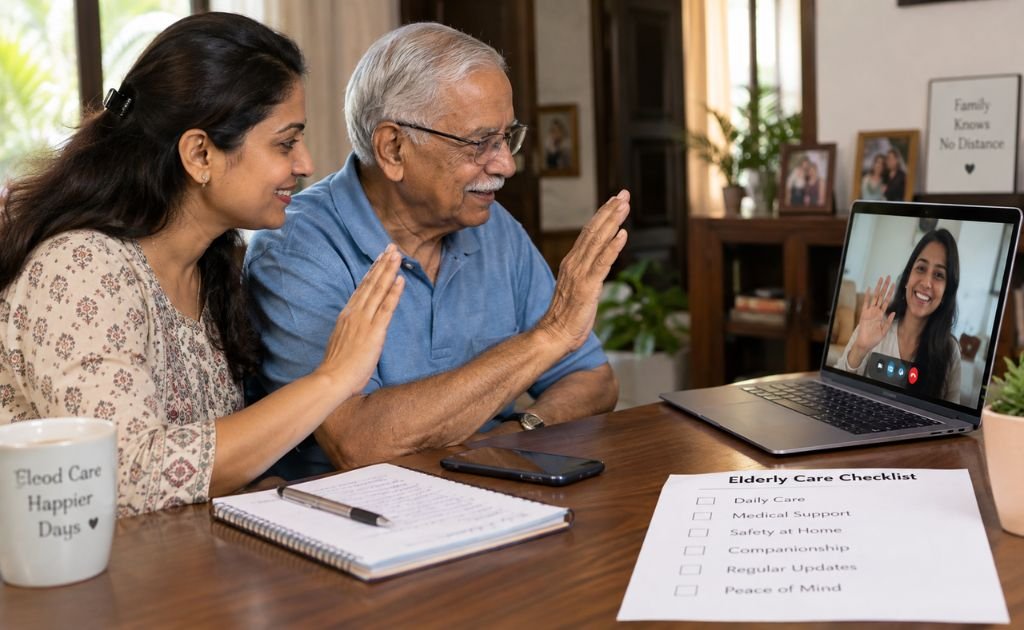
How to choose an elderly care service in Chennai: a practical checklist
Before the first call
- Write down the six ADLs above and your honest answers.
- Gather the latest prescriptions, discharge summary and doctor’s advice.
- Decide the hours you actually need, not the hours you’re afraid you might need.
- Note any preferences that matter: Tamil-speaking, female caregiver, vegetarian cooking, comfortable with a dog in the house. These are reasonable requests, not awkward ones.
Questions to ask the provider
- Will someone assess my parent at home before quoting? A provider that quotes over the phone without seeing the person is guessing.
- What training does the caregiver have, and can I see it? For nurses, ask for the council registration number.
- Is background and police verification done? For anyone alone in a home with a vulnerable person, yes is the only acceptable answer.
- Who supervises the caregiver? Is there a nursing supervisor or care manager reviewing the plan, or is the person on their own?
- What happens if the caregiver is unwell or goes on leave? Ask for the replacement time in hours. This is the most revealing question you can ask.
- How will you keep the family informed? Daily WhatsApp update, written log, weekly call – agree the format.
- What is the emergency process? Who does the caregiver call first, which hospital, and does the provider have a doctor to escalate to?
- Can I start short-term? A one-week trial before a monthly commitment is a fair request.
- What exactly is included, and what is billed extra? Consumables, equipment rental, food for live-in staff, festival allowances, GST.
- Can the plan change? Care needs move – up after a fall, down after recovery. The plan should move with them.
What should be in writing
The scope of duties (including what the caregiver will not do), hours, rate, replacement guarantee, notice period, and the family’s emergency contacts. Most disputes in home care are about expectations, not competence – a written scope prevents most of them.
Arranging care from outside Chennai or abroad
A large share of Chennai’s elderly parents have children in Bengaluru, Hyderabad, the Gulf, the US or the UK. If that’s you: insist on a home assessment you can join by video call, ask for a named point of contact rather than a helpline, agree a fixed update routine, nominate a local relative or neighbour as the on-ground contact for emergencies, and set up a small standing arrangement for consumables so nobody is waiting on a bank transfer at 2 am. Providers with a physical Chennai office and staff who will pick up the phone matter far more when you’re 8,000 km away.
What elderly care costs in Chennai (and what changes the price)
Prices vary widely because “elderly care” covers so many levels. Rather than a fixed price list – which no honest provider can give without assessing the person – here is what moves the number, with the market ranges published in our Chennai home nurse cost guide for reference:
- Level of care. A caregiver or attendant costs meaningfully less than a qualified nurse. Across Chennai, a 12-hour attendant typically runs in the ₹15,000–₹25,000 per month band; a 24-hour live-in attendant roughly ₹25,000–₹45,000; a trained nurse on 24-hour cover ₹35,000–₹70,000; critical-care nursing higher still.
- Hours. Twelve hours is not half the price of twenty-four. Round-the-clock cover done properly is a step change, not a doubling.
- One person or two. Two rotating shifts cost more than one live-in caregiver and are sometimes the only safe option.
- Duration. Monthly packages usually work out cheaper per day than daily billing, but short-term daily arrangements are normal after surgery.
- Medical complexity. Dementia care, bedridden care and post-ICU care sit at the upper end because the work is continuous and skilled.
- Extras. Adult diapers, dressings, nutrition supplements, hospital-bed or air-mattress rental, food for live-in staff and doctor visits are usually billed separately. Ask.
- Insurance. Standard Indian health policies are built around hospitalisation and rarely cover a long-term caregiver. Check for a domiciliary or home-healthcare rider and get the answer in writing.
The most cost-effective structure for long-term care is often a nurse for a short daily window plus a caregiver for the remaining hours. It gives the clinical care that matters without paying nursing rates for companionship.
How Sashitha Home Care supports elderly people in Chennai
Sashitha Home Health Care India Pvt Ltd is based at Santhome, Mylapore, and provides home-based care across Chennai, including Mylapore, R A Puram, Alwarpet, T Nagar, Ashok Nagar, Anna Nagar, Besant Nagar, Vadapalani, Ramapuram and Perungudi.
For elderly people the team provides:
- Caregiver and attendant support with daily activities, mobility, hygiene, meals, medication reminders and companionship, with a female caretaker option where families prefer it.
- Geriatric care at home – a coordinated plan covering health monitoring, fall prevention, medication assistance and personal care for seniors with several conditions, including experience supporting people with dementia and Alzheimer’s.
- Home nursing and skilled nursing for clinical needs – wound care, injections, catheter and tube care, post-surgery monitoring.
- Flexible schedules from a few hours a day to overnight and live-in cover, with staff who are background-checked and trained.
- A home assessment first, so the care plan and the quotation reflect the actual person rather than a phone description, and regular updates so the family stays informed.
The team’s approach is to work out the right level of support before recommending anything – which, if you’ve read this far, is exactly the process this article has walked you through.
Frequently asked questions
What is included in elderly care at home?
Typically: help with bathing, dressing, toileting and grooming; mobility support and fall prevention; meal support and hydration; medication reminders; companionship; accompanying to appointments; and regular updates to the family. Clinical tasks such as injections or wound dressing are added through a home nurse when the doctor advises them.
What is the difference between a caregiver and a home nurse?
A caregiver (or attendant) supports daily living and safety. A home nurse holds a nursing qualification and can perform clinical tasks – injections, IV therapy, sterile dressings, catheter and tube care, and vital-signs monitoring with escalation to a doctor. Many families use both: a nurse for a short daily window and a caregiver for the rest.
How do I know what level of care my parent needs?
Assess the six activities of daily living (bathing, dressing, toileting, mobility, eating, continence). If most are managed alone, companionship and supervision may be enough. If two or more need help, daily hands-on care is likely. Any wound, tube, catheter, oxygen or recent discharge means nursing should be discussed with the treating doctor.
Is 24-hour elderly care available at home in Chennai?
Yes. It is delivered either as one live-in caregiver (suitable when the person sleeps through the night) or as two people on 12-hour shifts (needed when active care is required at night). Always confirm which model a quotation refers to, and what the rest and weekly-off arrangements are.
How much does elderly care cost in Chennai?
It depends on the level of care and hours. Across the Chennai market, a 12-hour attendant is typically in the ₹15,000–₹25,000 per month range, a 24-hour live-in attendant roughly ₹25,000–₹45,000, and a trained nurse on 24-hour cover ₹35,000–₹70,000, with consumables and equipment usually extra. A home assessment is the only way to get an accurate figure for your parent.
Can elderly care be arranged after hospital discharge?
Yes, and it is one of the most common requests. Short-term arrangements of one to four weeks after surgery, a stroke or an infection are normal, and can be extended or reduced as recovery progresses.
Can I arrange care for my parents in Chennai if I live abroad?
Yes. Ask to join the home assessment by video, get a named point of contact, agree a fixed update routine, and nominate a local relative or neighbour as the on-ground emergency contact. Providers with a physical Chennai office are easier to work with remotely.
What should I check before hiring an elderly caregiver in Chennai?
Home assessment before quoting, training certificates (and council registration for nurses), background and police verification, who supervises the caregiver, replacement time if they are unwell, the emergency process, the family-update routine, and a written scope of duties with what is and isn’t included in the rate.
A last word for the person reading this at 11 pm
Nobody arrives at this decision feeling ready. What helps is breaking it into the four questions this guide covers: what level of help is needed, who is qualified to give it, how many hours, and what to check before you commit. Answer those and the choice of provider becomes much simpler.
If you’d like to talk it through, the Sashitha team is at +91 91760 00011 and will start with a conversation about your parent, not a price list. Government support for older people’s health also exists in India through the National Programme for Health Care of the Elderly, which is worth knowing about alongside private care – particularly for families managing long-term conditions on a budget.