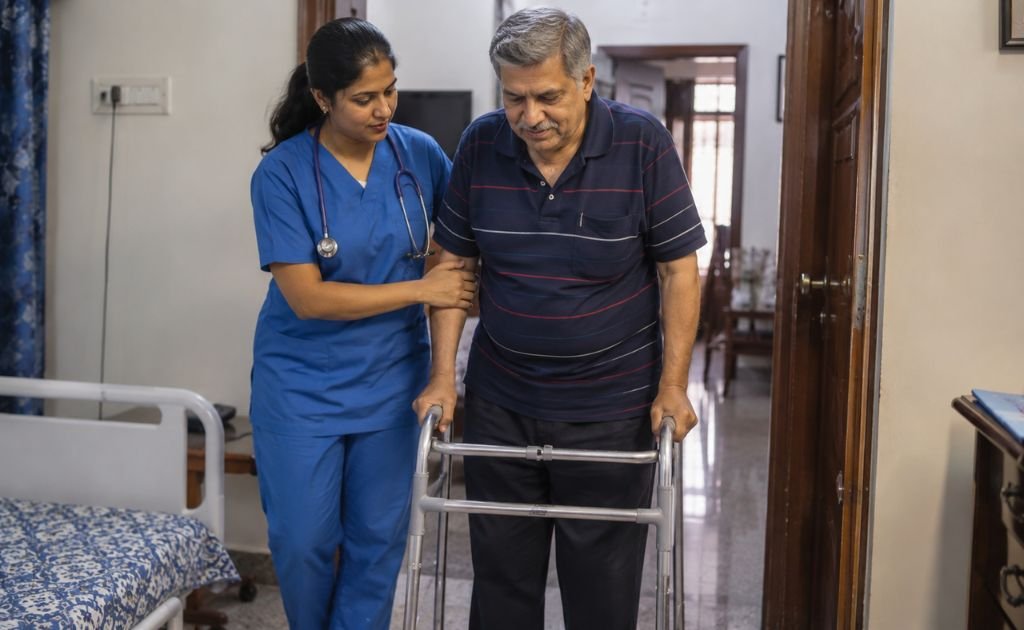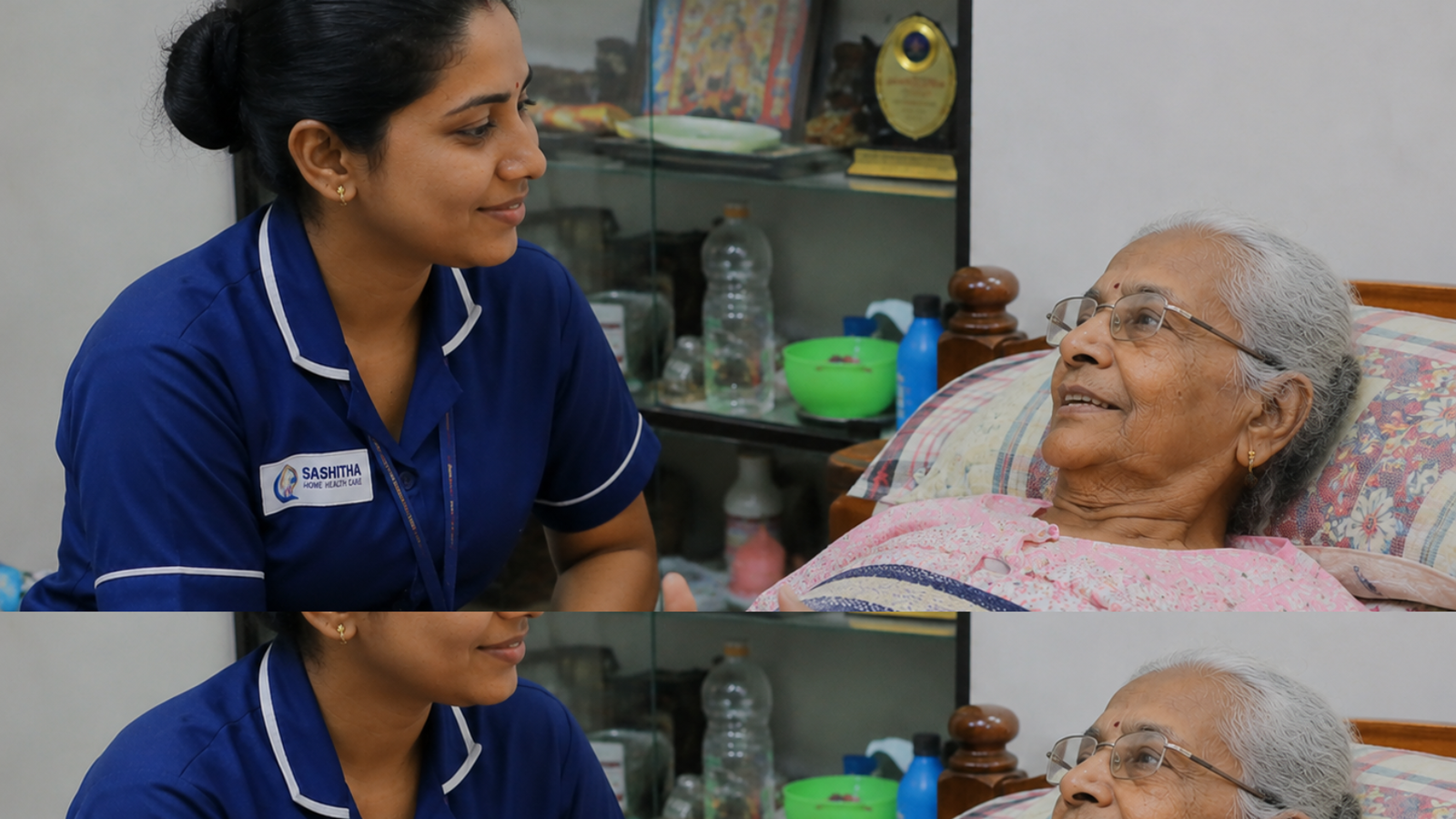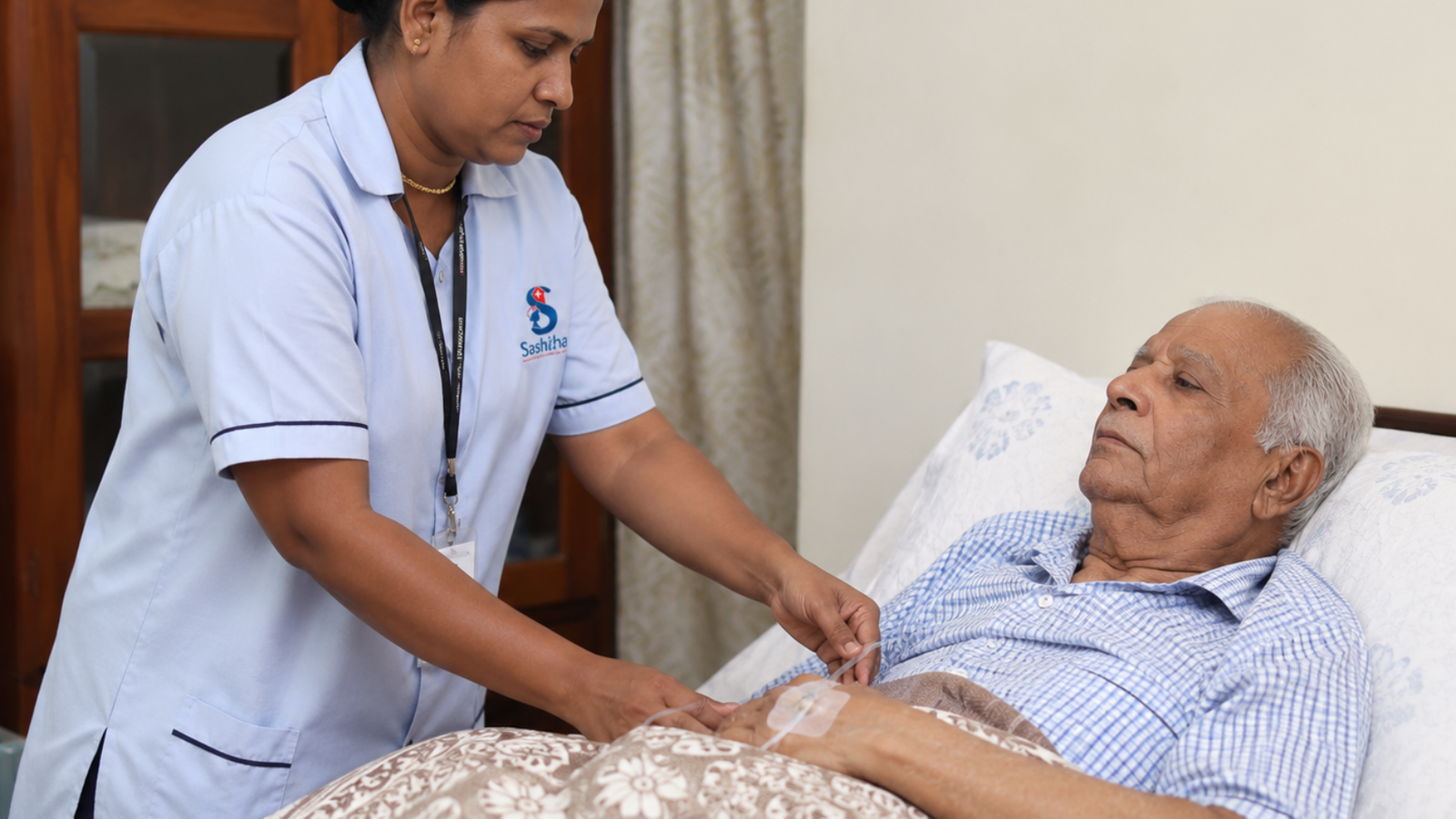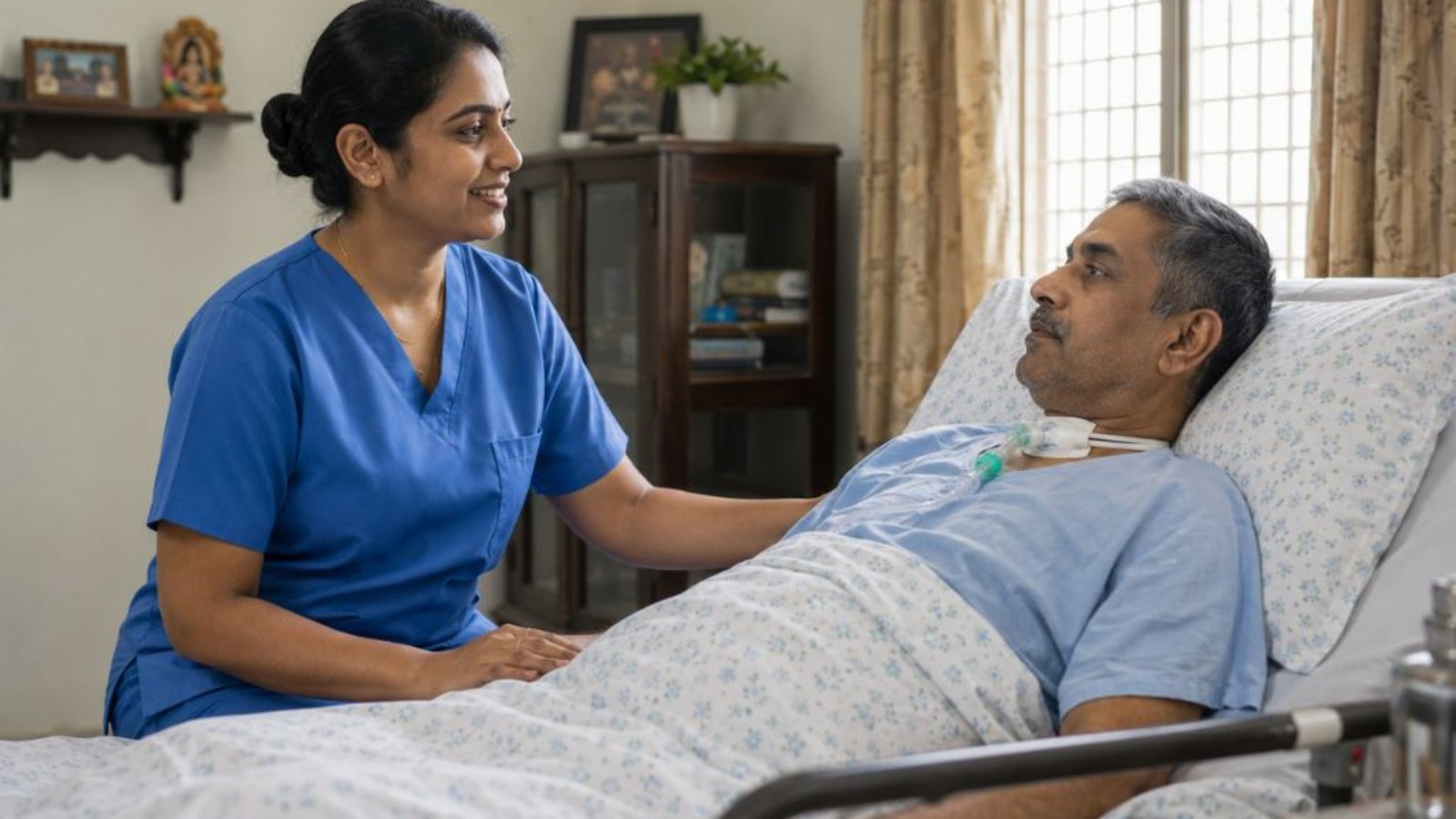
Home nurse sitting with an adult patient in a bright home living area

Home Care for Tracheostomy Patients: What Families in Chennai Need to Know

Being told that your father, mother or husband can come home with a tracheostomy is a strange mix of relief and dread. Relief because the hospital stay is ending. Dread because in the ward there was always a nurse a few steps away, and at home there is you.

Most families leave with a discharge summary, a bag of supplies and a follow-up date, and are expected to work out the rest. Here is the direct answer, before anything else.

Home care for tracheostomy patients

Yes, many people with a tracheostomy are cared for safely at home. Home care for tracheostomy patients means carrying out the patient’s individual care plan day to day – keeping the tube and the skin around it clean, managing secretions, keeping the air moist, watching for early warning signs, and knowing exactly when to call for help.

What that looks like in practice varies enormously from one patient to another. A person who is alert, walking about and producing very little mucus needs a completely different level of support from someone who is bedridden, ventilator-dependent and needs suctioning through the night. Both are “tracheostomy patients”. Their days look nothing alike.

That is why most articles on this subject are only partly useful to you. Below is what home care for tracheostomy patients actually involves day to day, how to work out how much nursing support your patient needs, what to watch for, when to stop reading and call an ambulance, and how to judge a home nursing provider properly.

What tracheostomy care at home involves: the daily picture

Every care plan is individual, but the areas of care are fairly consistent. This is the shape of a normal day.

Area of careWhat it means day to dayUsually handled by
Tube and stoma careKeeping the tube and the skin around the opening clean, as instructedTrained nurse, or a family member specifically trained by the clinical team
Managing secretionsClearing mucus, including suctioning where it has been prescribedTrained nurse or formally trained family member – never an untrained person
HumidificationKeeping the air moist, because the nose is bypassedSet up by the clinical team, maintained daily at home
ObservationWatching breathing, secretions, temperature, the stoma site and comfortEveryone involved in the patient’s care
Equipment checksMaking sure suction, oxygen or humidification equipment is clean, working and chargedNurse and family together
Positioning and skin careRepositioning, pressure area care, comfortNurse or attendant
Nutrition and hydrationFeeding by mouth or by tube, as instructedDepends on the care plan
MedicationGiving prescribed medicines and keeping an accurate recordNurse, or a trained family member
Communication supportHelping the patient make themselves understoodMostly family
CoordinationFollow-up appointments, supplies, reporting changes to the doctorFamily, supported by the nurse

You will notice this article describes what each of these involves, but does not tell you how to perform them. That is deliberate. Suctioning, tube changes and cuff management are procedures that have to be taught hands-on, by clinicians who can watch you do it and confirm you have got it right. Reading about a procedure is not training in it, and this is not the topic to learn from a website.

Families almost always ask the same thing first: what will I actually be doing all day? The honest answer is that home care for tracheostomy patients is not one big frightening task. It is a lot of small ones, repeated at fairly predictable times. Once the rhythm settles, most families find the day more manageable than they feared on the drive back from the hospital.

Mornings: the busiest stretch of the day

Mornings are usually the busiest stretch. Secretions build up overnight, so the first hour tends to involve clearing the airway, checking the skin around the stoma, changing dressings and ties if it is the day for it, refilling the humidifier, and giving the morning medicines and feeds. It is also when a nurse takes a set of baseline observations, so that any change from yesterday gets noticed at eight in the morning rather than at midnight.

Midday: watchful rather than busy

The middle of the day is lighter and mostly watchful: suctioning as and when the patient needs it rather than by the clock, keeping humidification going, repositioning to protect pressure areas, feeds and medicines at their appointed times, and short spells of sitting up or walking if the treating team has cleared it. This is also the best window for chest physiotherapy, family visits, and anything that needs the patient at their most alert.

Nights: where tracheostomy care at home is won or lost

Nights are where tracheostomy care at home is won or lost. Secretions often thicken after dark, patients become restless, and equipment alarms do not wait until morning. A household where somebody is genuinely awake and trained overnight copes. A household where one exhausted relative dozes beside the bed with one ear open does not, at least not for long. If you take nothing else from this page, look honestly at your nights before deciding how much nursing support to arrange.

Suctioning at home: what families should expect

Suctioning is the part of trach care at home that worries families most, and the part most often misunderstood. It is not done to a timetable. It is done when the patient needs it: when you can hear secretions rattling, when breathing sounds wetter or more laboured, when the patient signals for it, or when a cough has not quite cleared the tube.

How often that turns out to be is the single most useful thing you can tell a nurse or a provider. Some patients need it two or three times a day. Others need it every hour or two, including overnight, particularly in the first weeks after a tracheostomy is formed or during a chest infection. The equipment is the same in both cases. The amount of human help required is not remotely the same.

Watch the character of the secretions as much as the quantity. Thick, sticky secretions often mean the air is not moist enough or the patient is not taking enough fluid, and both are worth raising with the treating team before they turn into a blocked tube. A change in colour or smell is a different matter altogether, and belongs in the warning signs further down this page.

We are not going to explain the technique here, and you should be wary of any website that does. Suction depth, pressure settings, catheter size and how long each pass should last are prescribed for the individual patient, and getting them wrong causes harm. Ask the ward to teach you hands-on before discharge, and ask them to stand and watch you do it twice.

Preparing your home before discharge: a tracheostomy home care checklist

Most of the panic in the first week comes from things that could have been sorted out before the patient came home. If you still have a few days, use them. The aim is a room where everything needed at three in the morning is within arm’s reach of the bed, and nothing has to be hunted for.

What families usually need in place before a tracheostomy patient is discharged:

  • A bed the patient can be sat upright in, ideally a hospital bed with a pressure-relieving mattress for someone bedridden, positioned so a nurse can reach both sides.
  • A working suction machine with spare catheters, and a backup means of suction. A manual or foot-operated unit is worth having in a city with power cuts.
  • Humidification equipment as prescribed, with a supply of the sterile water or saline it needs.
  • Spare tracheostomy tubes in the sizes the treating team specifies, usually including one a size smaller, kept together in a clearly marked box that never leaves the room.
  • Dressings, ties or tapes, gloves, hand sanitiser, and a lidded bin for clinical waste.
  • A pulse oximeter, a thermometer, and a written observation chart or notebook that stays by the bed.
  • Oxygen if it has been prescribed, with the supplier’s number saved in more than one phone.
  • An inverter, UPS or generator arrangement if the patient depends on any powered equipment.
  • Feeding supplies and prescribed nutrition if the patient is tube fed.
  • The written emergency plan, the discharge summary and the treating team’s numbers, printed and taped up somewhere visible rather than saved on one person’s phone.

Two practical points that families in Chennai raise often. Keep a running list of consumables and reorder well before you are down to the last few, because suction catheters and specialist dressings are not always on the shelf at the nearest pharmacy. And decide early who the second trained pair of hands in the family will be. One person cannot cover a tracheostomy patient indefinitely, however willing they are.

Why two tracheostomy patients need completely different care

This is the part that makes every generic guide frustrating, and it is worth understanding before you speak to any provider. Four things drive almost all of the difference.

1. Whether the patient is breathing on their own

A patient breathing independently through the tracheostomy needs observation, cleaning and secretion management. A ventilator-dependent patient needs all of that plus continuous equipment monitoring, an alarm response plan, backup power and a nurse who is genuinely experienced with ventilators. These are different services at different prices, and it is worth being blunt with a provider about which one you need.

2. How much the patient produces in secretions

Secretion load is the single biggest driver of how often someone needs attention. A patient needing suctioning twice a day can be managed with a day nurse and a trained family member. A patient needing it every hour, including overnight, cannot be managed by one exhausted relative, and pretending otherwise is how families end up back in casualty at 3 am.

3. Whether the tracheostomy is new or long-established

The first weeks after a tracheostomy is formed are the most demanding, and the period when families are least practised. Someone who has lived with a tracheostomy for two years, whose stoma is well healed and whose routine is settled, often needs far less. If you are arranging care for a fresh discharge, plan for the first month to be the heaviest and reassess after that rather than committing to a long arrangement on day one.

4. Everything else going on

Most tracheostomy patients cared for at home in Chennai are recovering from a long ICU stay, a stroke, head and neck cancer, or a severe respiratory illness. Limited mobility, tube feeding, diabetes, pressure area risk and cognitive change all add to the workload – and none of them are the tracheostomy. Judge the care requirement by the whole patient, not by the tube.

When you ask a provider for a quotation, describe these four things first. A provider who quotes a number before asking about ventilator dependence and secretion load is not assessing your patient; they are reading from a price list.

Home nurse or family caregiver: who does what
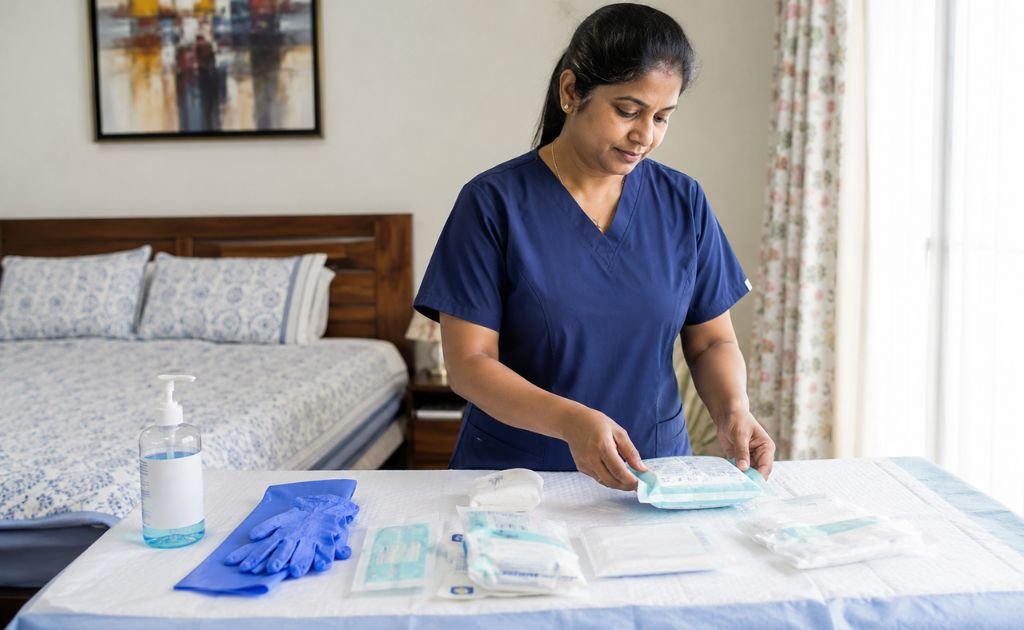
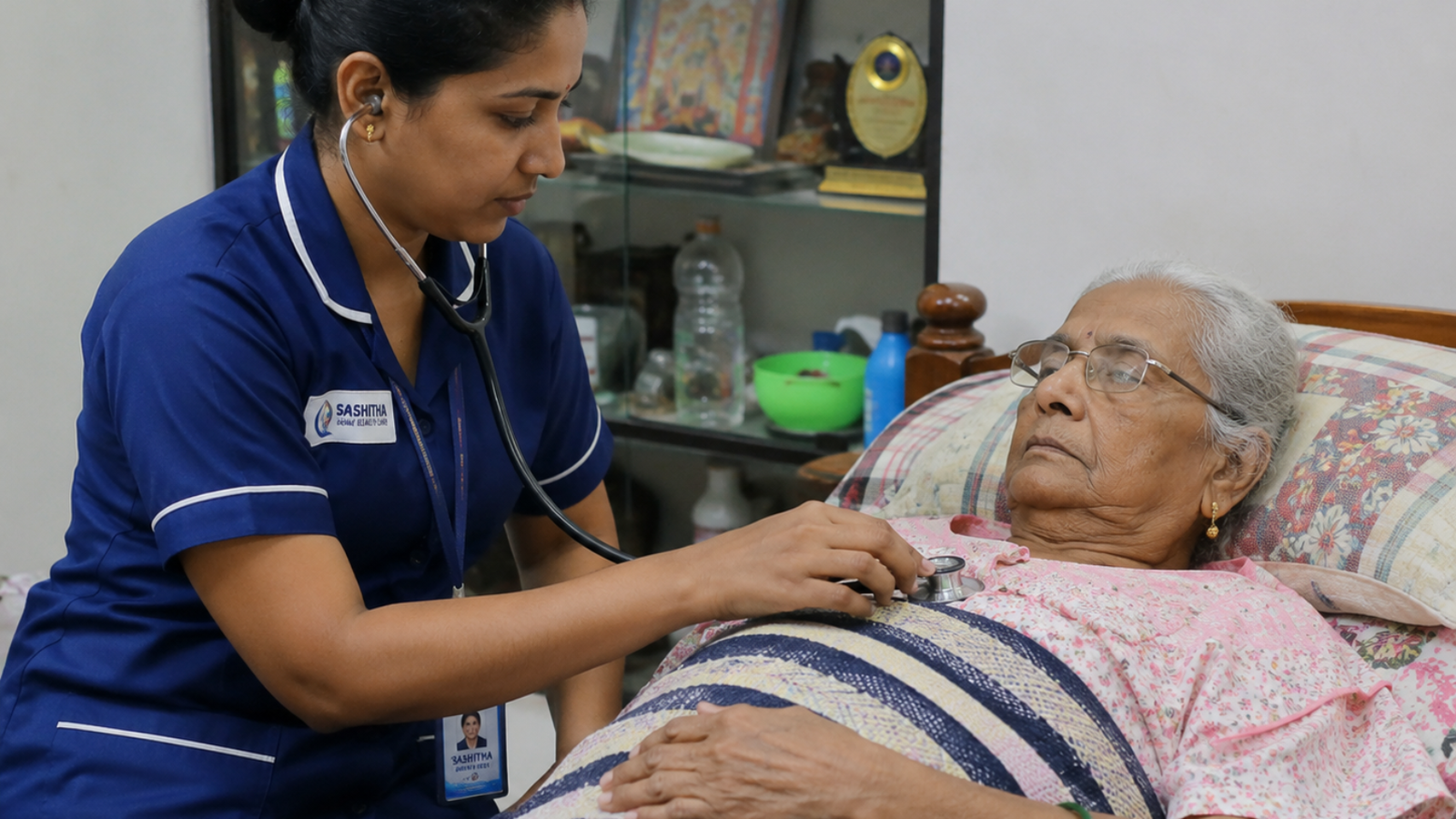
Nurse organising medical supplies on a clean surface in a home care area

These boundaries are not fixed. They depend on the care plan and on what the clinical team has actually trained the family to do.

ResponsibilityTrained home nurseFamily caregiver
Suctioning, tube and stoma care, tube feedingYes, within their training and the prescribed planOnly after hands-on training by the clinical team, and only what they have been cleared to do
Structured observation and record-keepingYes, as a routine disciplineYes – and family often notice subtle changes first
Recognising and escalating a clinical changeTrained to assess and escalateShould report anything unusual promptly, without needing to interpret it
Talking to the treating doctorCan report clinically and keep documentationUsually leads decisions and consent
Daily assistance, hygiene, positioningYesYes
Emotional support and familiarityContributesIrreplaceable
Supplies, appointments, logisticsCan support and remindUsually family-led

Families are not passengers in this. Many relatives become genuinely skilled at parts of the routine, and patients usually prefer it that way. The point is simply that the training has to come from clinicians, in person, and has to match what that particular person is competent and comfortable doing. “My brother watched the nurse do it” is not training.

How much nursing support does your patient actually need?

This is where families either overspend or, more dangerously, underprovide. There are broadly three levels.

Nurse visits

A nurse comes once or twice a day for specific tasks – cleaning, dressing, checks – and the family manages the rest. This suits a stable, long-established tracheostomy where the family has been properly trained and the patient needs little attention between visits.

A 12-hour shift

Usually the sensible middle option, and more often the right answer than families assume. A day shift covers the busiest hours. A night shift is what families ask for when secretions are worse overnight, when the patient becomes restless after dark, or simply when the main caregiver has not slept properly in three weeks. Night cover alone transforms a household.

Round-the-clock cover

Necessary when the patient cannot safely be left unattended at any point – ventilator-dependent, needing frequent suctioning, or newly discharged and still unstable.

If you are arranging continuous cover, ask one question that changes everything: is this one nurse or two? A single live-in nurse has to sleep at some point. Two nurses rotating on 12-hour shifts means someone is always awake. For a patient who needs attention at 3 am, that distinction is the whole difference between the arrangement working and not working – and it is the main reason two quotations for “24-hour care” can look so far apart. If you are comparing costs across those options, our guide to home nurse cost in Chennai explains how the two models are priced.

What is usually included – and what families have to arrange themselves

A home nursing engagement normally covers the nursing time and the clinical tasks in the care plan. These are the things that are typically not included, and they add up:

  • Consumables – suction catheters, gloves, dressings, cleaning supplies, and for many patients adult diapers and nutrition supplements. Usually billed at actuals.
  • Equipment, whether rented or bought – suction machine, oxygen concentrator, humidification equipment, pulse oximeter, hospital bed, air mattress.
  • Relief cover on the nurse’s weekly off. Ask whether the replacement is included in your monthly rate or charged extra. For a tracheostomy patient this is not a detail.
  • Food and a place to rest for a live-in nurse.
  • Doctor or physiotherapist home visits, which are almost always separate.
  • Night differentials, festival allowances, registration or deposit, and applicable GST.

Ask for the quotation in writing and ask specifically what is excluded. A provider who volunteers this list before you ask is telling you something useful about how they will behave three months in.

Warning signs that need a call to the treating team

MedlinePlus, from the US National Library of Medicine, advises contacting the healthcare provider for signs including fever or chills; redness, swelling or pain that is getting worse; bleeding or drainage from the opening; too much mucus that is hard to suction or cough up; cough or shortness of breath even after suctioning; nausea or vomiting; and any new or unusual symptoms.

On secretions specifically, Johns Hopkins Medicine notes that they should be white or clear, and that yellow, brown or greenish secretions may be a sign of infection. It also advises calling the surgeon’s office if the stoma area becomes red, swollen, inflamed, warm to the touch or develops a foul odour, or if the patient develops a fever.

The NHS adds a further set of reasons to seek prompt advice: difficulty swallowing, coughing or being sick after eating or drinking, breathing that has become noisy during the day or at night, or pain around the tracheostomy.

None of these are things to leave overnight and see how they look in the morning.

When home care is not a substitute for emergency care

This section matters more than anything else on this page. Home nursing is not an emergency service, and no home setup replaces a hospital.

Call emergency services immediately and follow the patient’s emergency plan if any of these happen:

  • Severe difficulty breathing, or the patient suddenly cannot breathe through the tracheostomy
  • The tube becomes completely blocked and cannot be cleared
  • The tube comes out and cannot be replaced – MedlinePlus advises calling emergency services in this situation
  • Significant bleeding from the tracheostomy
  • Lips, face or skin turning blue or grey
  • Sudden collapse, unresponsiveness, or a marked change in consciousness
  • Any severe or rapidly worsening symptom

In India, the national emergency number is 112 and the ambulance number is 108.

Every tracheostomy patient discharged home should leave hospital with a written emergency plan naming who to call and what to do. If your family does not have one, ask the treating team for it – before discharge if you still can, or at the very next appointment. Ask them to write it down. A verbal explanation given on a busy ward round is not something anyone remembers at two in the morning.

This article gives no emergency procedures, and no untrained person should attempt to reinsert or replace a tracheostomy tube. Those are skills taught in person, by clinicians, to specific people, for a specific patient.

What different situations look like

Coming home with a new tracheostomy

The first few weeks are the most demanding and the least familiar. Most families arranging home care for tracheostomy patients at this stage need trained nursing support at least for a day shift, both for the clinical tasks and because it is when families learn. Ask the nurse to teach you as they go – a good one will. Plan to reassess after the first month rather than locking into a long arrangement while you are still in shock.

A long-established or permanent tracheostomy

Once the stoma is healed and the routine is settled, many families manage with visits or a single shift, with the family covering the rest. The risk here is complacency rather than crisis: supplies run low, observation gets casual, and a slow change goes unnoticed. Keeping a simple daily record is what prevents that.

Ventilator-dependent patients

This is the highest level of home care there is. It needs a nurse genuinely experienced with ventilators, a plan for equipment failure, a plan for power cuts, and realistically continuous cover. Do not accept vague reassurance here. Ask directly what experience the assigned nurse has with ventilated patients at home, and what happens if an alarm sounds and the family is alone.

Elderly and bedridden patients

Very common in Chennai, and the combination that quietly gets hardest. Limited mobility means pressure areas develop silently, several conditions run alongside each other so medication gets complicated, and communication is doubly difficult when speech is gone and hearing or memory is also affected. The family is often elderly too – a wife in her seventies managing overnight care is a situation that needs an honest conversation, not quiet endurance. Where age brings several overlapping conditions, structured geriatric care at home is a better framework than ad-hoc help.

Does health insurance cover tracheostomy home nursing in India?

Usually not, and it catches families out. Standard Indian health insurance is built around hospitalisation. Some policies carry a domiciliary hospitalisation clause that may cover treatment at home where a hospital bed was genuinely unavailable or the patient could not be moved, but the conditions are narrow and it rarely covers a long-term nurse.

A few insurers now sell home healthcare as an add-on rider, and some corporate group policies include it. Call your insurer, ask specifically about “domiciliary hospitalisation” and “home healthcare cover”, and get the answer in writing. Keep every invoice and prescription regardless – medical expenses for a dependent senior citizen may have tax implications worth raising with your chartered accountant.

What tracheostomy home nursing costs in Chennai

Very few providers in Chennai publish rates for tracheostomy nursing specifically, and a figure quoted before anyone has assessed the patient is close to meaningless. What is more useful is knowing what actually moves the price:

  • The nurse’s qualification and clinical exposure. A nurse experienced with tracheostomy and ventilator patients costs more than a general nurse, and considerably more than a non-clinical attendant.
  • Shift pattern – visits, 12 hours, or continuous cover.
  • Whether continuous cover is one live-in nurse or two rotating.
  • Ventilator dependence and secretion load, which together determine the level of nurse required.
  • Night cover, usually priced differently from day cover.
  • Equipment and consumables, normally billed separately.

For the wider picture on what home nursing costs across the city, including how 12-hour and 24-hour arrangements are priced, see our detailed guide to home nurse cost in Chennai. Home care for tracheostomy patients generally sits at the higher end of those ranges because of the skill level involved.

How to choose a home nursing provider for a tracheostomy patient

Price is the easiest thing to compare and it tells you the least. Ask these ten questions instead, and write the answers down.

  1. Do you provide home nursing for tracheostomy patients, and how often do you actually do it?
  2. What are the qualifications of the nurse who would be assigned – and can I see the certificate and council registration number?
  3. What specific experience does that nurse have with tracheostomy patients, and with ventilated patients if that applies to us?
  4. Who supervises the nurse, and how often is the care plan reviewed?
  5. How does the nurse coordinate with our treating doctor, and what gets documented?
  6. If we need continuous cover, is that one live-in nurse or two on rotating shifts?
  7. What happens on the nurse’s weekly off, and how fast can you send a replacement if they fall ill?
  8. What is your escalation process if the patient’s condition changes – and what are your limits? What will you tell us to call an ambulance for?
  9. What exactly is included in the quoted fee, and what is billed separately?
  10. Has the nurse been background-verified, and will you confirm that in writing?

A provider who answers question two with an adjective rather than a document has answered it. You are entitled to see credentials for someone who will be doing clinical work on your relative in your own home.

Home care for tracheostomy patients in Chennai and Mylapore

For a patient who tires easily or depends on equipment, travelling across Chennai for routine care is exhausting and sometimes not sensible at all. Care delivered at home removes that journey while hospital follow-up continues for reviews, tube changes and specialist input as the treating team directs.

What matters practically is coordination. The nurse needs to know what the treating team wants, the treating team needs to hear what is happening at home, and the family needs to know who to call in the middle of the night. Ask any provider how those three things work, and be wary of vague answers.

If you are arranging care in Mylapore, Santhome, R A Puram, T Nagar or nearby, a few local questions are worth settling early. Confirm the provider genuinely serves your area rather than nominally covering it. Ask how quickly a replacement can reach you. And ask whether the same nurse will be assigned consistently – continuity is worth a great deal with a patient whose normal only becomes obvious over time.

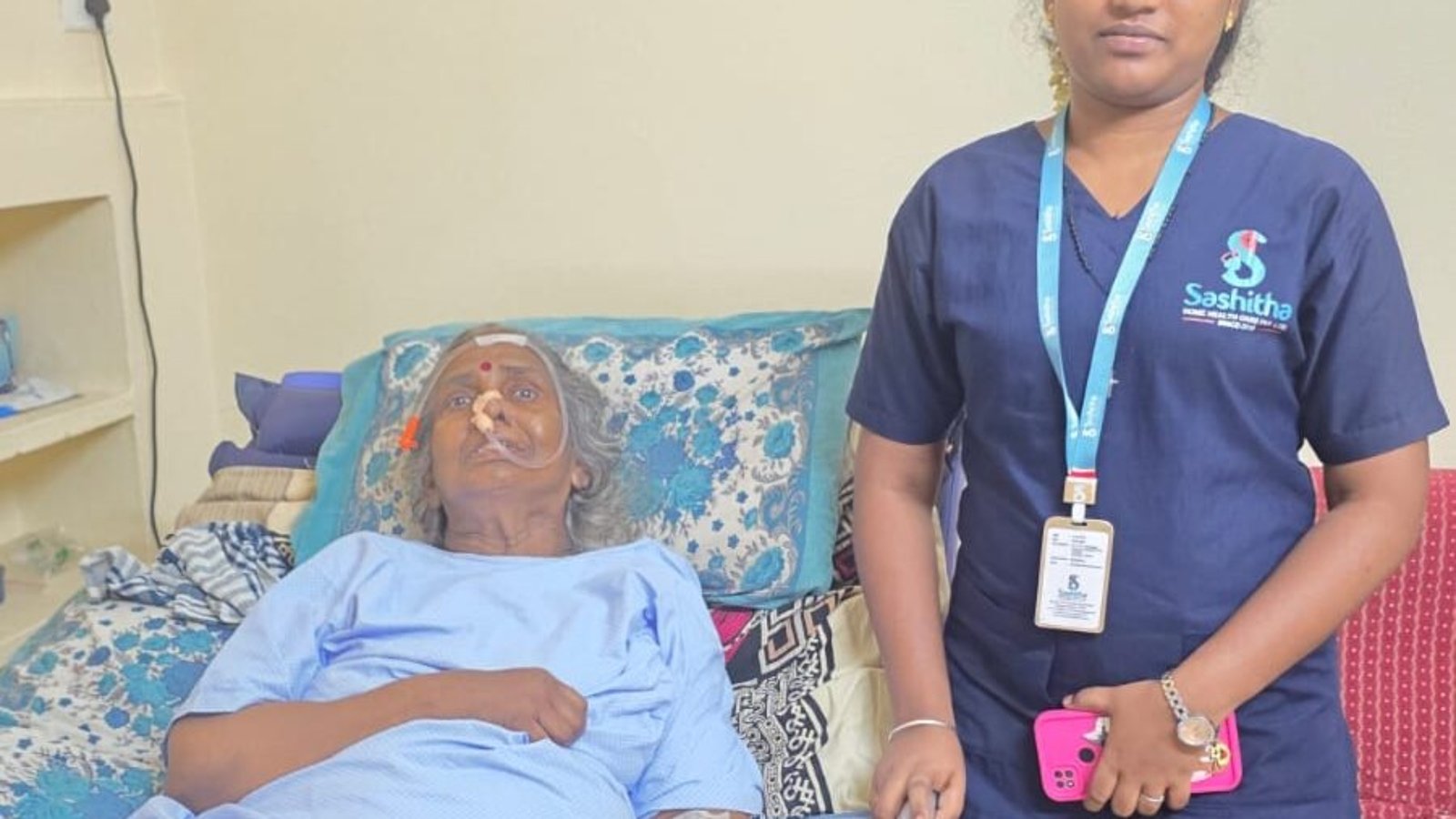
Sashitha Home Health Care is based at Santhome in Mylapore, provides tracheostomy nursing care at home across the surrounding areas, and lists tracheostomy and catheter care among its home nursing services in Chennai, alongside skilled nursing in Mylapore covering areas such as oxygen therapy, tube feeding and post-surgical care. Because tracheostomy needs differ so much between patients, families should confirm directly with the team whether the nurse who would be assigned has the specific training and experience their patient’s care plan requires.

Getting the right home care for your tracheostomy patient
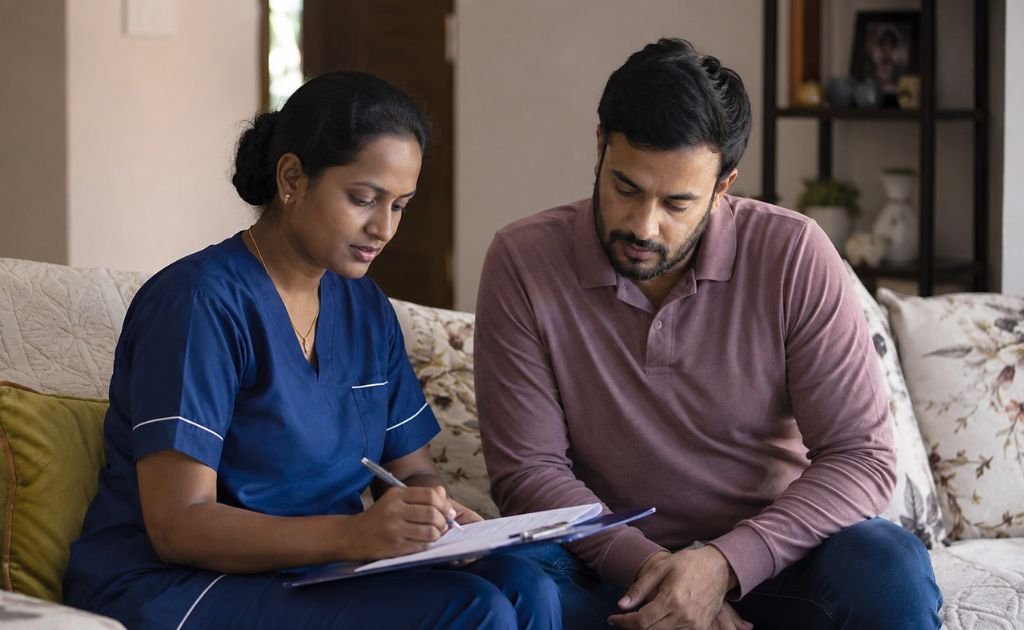
Nurse and family member discussing a patient's care plan at home

Everything in this article is general. Your patient is not. Home care for tracheostomy patients only works when it is built around one particular person. The care they need depends on things that only come out in a proper conversation: what the discharge summary says, whether they are on a ventilator, how often they need suctioning, how they are overnight, and who at home can realistically help.

If you are preparing for a discharge or already managing tracheostomy care at home, have the discharge summary to hand and be ready to describe the nights. That one detail tells an experienced nurse more than anything else.

You can reach Sashitha Home Health Care on +91 91760 00011 or through the contact page to discuss your patient’s requirement and confirm what nursing support is available for their care plan. Ask the ten questions above – of us, and of everyone else you are considering.

Frequently asked questions

Can a tracheostomy patient be cared for at home?

Yes, many are. It requires that the treating medical team considers the patient clinically suitable for home management, and that the people providing care have been properly trained. Suitability depends on how stable the patient is, how much support they need, and what help is realistically available at home.

What does tracheostomy care at home involve?

Keeping the tube and stoma clean, managing secretions, humidifying the air, observing breathing and the site for changes, checking equipment, supporting nutrition and communication, and staying in contact with the treating team. The exact routine, frequency and technique come from the patient’s individual care plan.

Does a tracheostomy patient need a home nurse?

Not always. It depends on the complexity of the care plan and whether family members have been trained and can sustain the routine. Patients who are ventilator-dependent, need frequent suctioning, or have recently been discharged usually benefit from trained nursing support, at least for the first weeks.

Who can provide tracheostomy nursing care at home?

Nurses trained in tracheostomy care with genuine experience of such patients. Ask to see qualifications and council registration rather than accepting a general assurance. Family members can take on parts of the routine, but only tasks they have been formally trained and cleared to perform by the clinical team.

Is home nursing available for tracheostomy patients in Mylapore?

Home nursing operates across Mylapore, Santhome and the surrounding areas. Whether tracheostomy-specific nursing is available depends on the provider and on the individual nurse assigned, so confirm directly that the nurse has the relevant training and experience before care begins.

Can a tracheostomy patient get 24-hour nursing care at home?

Continuous cover is offered by some providers, but confirm what is actually meant. A single live-in nurse who has to sleep is a different arrangement from two nurses rotating on 12-hour shifts. For a patient needing attention overnight, that distinction matters. Ask which model any quotation refers to.

How much does tracheostomy home nursing cost in Chennai?

Few providers publish tracheostomy-specific rates. Cost depends on the nurse’s qualification, shift pattern, whether cover is continuous, ventilator dependence, secretion load, night requirements and equipment. Ask for a written quotation for your specific patient and ask what is excluded. Tracheostomy care usually sits at the higher end of general home nursing rates.

Can family members learn routine tracheostomy care?

Often yes, and many do it very well. Training should be hands-on, given by the clinical team around discharge, and matched to what the individual is competent and comfortable doing. Watching someone else do it, or reading instructions online, is not training and should not be treated as such.

What signs of infection should I watch for?

MedlinePlus advises contacting the healthcare provider for fever or chills, worsening redness, swelling or pain, or bleeding or drainage from the opening. Johns Hopkins Medicine notes that secretions should be white or clear, and that yellow, brown or greenish secretions may indicate infection.

When does a tracheostomy patient need emergency help?

Seek emergency help immediately for severe difficulty breathing, a blocked tube that cannot be cleared, a tube that has come out and cannot be replaced, significant bleeding, blue or grey lips or skin, or sudden collapse or unresponsiveness. Call 112 or 108 and follow the patient’s written emergency plan.

Is home care suitable for every tracheostomy patient?

No. Patients who are unstable, need intensive monitoring, or whose home circumstances cannot support safe care may need to stay in hospital or a suitable facility. That is a clinical judgement for the treating team, and it should not be decided on cost grounds.

What should I ask before hiring a home nurse for a tracheostomy patient?

Ask about the nurse’s qualifications and registration, their specific tracheostomy and ventilator experience, who supervises them, how they coordinate with your doctor, shift and continuous-cover options, replacement arrangements, the escalation process, and exactly what the fee includes and excludes.

How do you care for a tracheostomy patient at home each day?

A normal day is built around a repeating routine rather than one big task: clearing secretions when the patient needs it, keeping the tube and the skin around the stoma clean, keeping the air humidified, giving feeds and medicines on time, repositioning to protect pressure areas, and recording observations so that changes are spotted early. Mornings are usually the busiest period and nights are usually the hardest. The exact technique for each task must be taught hands-on by the treating team for that particular patient.

What supplies and equipment are needed for tracheostomy home care?

Most families need a suction machine with spare catheters and a backup means of suction, humidification equipment with sterile water or saline, spare tracheostomy tubes in the sizes the treating team specifies, dressings and ties, gloves, a pulse oximeter and thermometer, an observation record, oxygen if prescribed, a power backup arrangement, feeding supplies if the patient is tube fed, and the written emergency plan kept where everyone can see it.

How often does a tracheostomy patient need suctioning at home?

There is no fixed schedule. Suctioning is done when the patient needs it, which may be two or three times a day for a settled patient or every hour or two, including overnight, for someone with a heavy secretion load, a new tracheostomy or a chest infection. Secretion load is the main thing that determines how much nursing support a household actually needs, so describe it clearly when you speak to a provider.

Is trach care at home safe for an elderly or bedridden patient?

It can be, provided the treating team considers the patient suitable and the care is delivered by people who have been properly trained. Older and bedridden patients usually need more support rather than less, because limited mobility brings pressure area risk, several conditions often run alongside each other, and communication is harder. An honest assessment of who is available at home, especially overnight, matters more than the age of the patient.
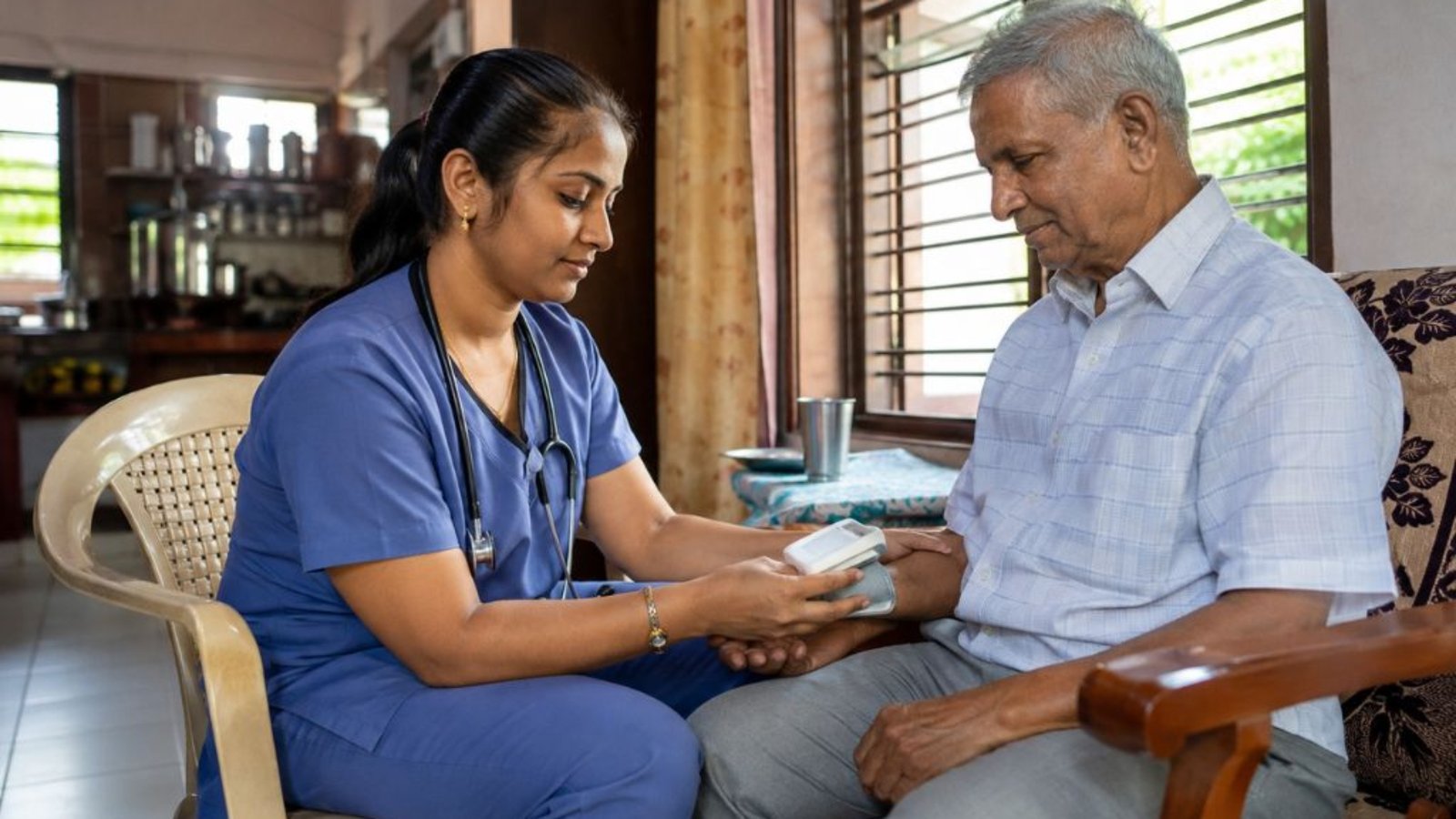
Home nurse in scrubs sitting beside an elderly man in his living room at home

Home Nurse Cost in Chennai: What Families Actually Pay in 2026

If a doctor has just told you that your father can be discharged tomorrow but will need nursing support at home, one question usually comes before all the others: what is this going to cost?

Here is the direct answer, before anything else.

Home nurse cost in Chennai:

In Chennai, a trained home nurse generally costs ₹1,000 to ₹2,500 per day, depending on shift length and the nurse’s clinical skill level. A non-clinical patient attendant costs less – usually ₹700 to ₹1,500 per day. On a monthly basis, most families in the city end up somewhere between ₹25,000 and ₹70,000, and critical-care nursing can go above ₹1,00,000.

That is a wide band, and it is wide for a reason. Two agencies can quote you ₹25,000 and ₹65,000 for what sounds like exactly the same request. Most of this article is about why that happens, so that you can read a quote properly instead of simply picking the cheapest one.

Chennai home nursing rates: the current picture

This table is the closest thing to a realistic market map for the city right now.

Type of careTypical daily rateTypical monthly range
Single nurse visit (injection, dressing, catheter change, IV)₹500 – ₹1,500 per visitBilled per visit
Patient attendant / caregiver – 12-hour shift₹700 – ₹1,100₹15,000 – ₹25,000
Patient attendant / caregiver – 24-hour live-in₹900 – ₹1,500₹25,000 – ₹45,000
Trained nurse (GNM / B.Sc Nursing) – 12-hour shift₹1,000 – ₹1,800₹25,000 – ₹45,000
Trained nurse – 24-hour cover₹1,500 – ₹2,500₹35,000 – ₹70,000
Critical care / ICU-trained nurse – 24-hour₹2,500 – ₹4,500₹65,000 – ₹1,00,000+

Two things worth noticing. First, the cheapest 24-hour option and the most expensive one differ by four times. Second, the overlap between a 12-hour nurse and a 24-hour attendant is almost complete – they cost roughly the same, but they are not the same service at all. Getting this distinction right is where families save the most money.

Why the same request gets very different quotes

Four variables account for nearly all of the price spread.

1. Whether you are hiring a nurse or an attendant

This is the single biggest one. A registered nurse can administer injections, manage an IV line, do sterile wound dressing, handle a Ryle’s tube or catheter, and read deteriorating vitals early. An attendant cannot legally or safely do any of that. If your patient only needs help with bathing, feeding, turning and toileting, you are paying a large premium for clinical skills you will never use.

2. The nurse’s qualification and clinical exposure

An ANM-qualified nurse, a GNM diploma nurse and a B.Sc nurse with three years of ICU experience sit at very different points on the scale. A nurse who can manage a tracheostomy, a ventilator or a central line will always cost more – and for those patients, that cost is not optional.

3. Hours and how the shift is structured

Twelve hours is not half the price of twenty-four. Round-the-clock cover done properly needs either two nurses or a live-in nurse plus a relief arrangement, and that is a step change in cost rather than a doubling.

4. Agency-managed versus direct hire

A freelance nurse arranged through a contact will quote less. An agency rate includes credential verification, police verification, supervision, a documented care plan, and – the part families underestimate until they need it – a replacement nurse within hours when someone falls ill or goes home for a family function. When a bedridden patient is involved, the day that replacement does not arrive is an expensive day.

Beyond these four, distance matters a little. A team travelling to Perungudi or Ramapuram may be priced slightly differently from one working in Mylapore or T Nagar, simply because of Chennai’s traffic and the shift-handover timing it affects.

Nurse, caregiver or patient attendant: which one do you actually need?

Families often ask for “a nurse” when they mean “someone to look after amma.” Here is the practical difference.

Patient attendant / caregiverTrained home nurse
Bathing, feeding, toileting, changing positionYesYes
Mobility support, companionship, walking assistanceYesYes
Reminding and handing over prescribed medicinesYesYes
Injections, IV fluids, IM medicationNoYes
Sterile wound dressing, drain and suture careNoYes
Catheter, Ryle’s tube, colostomy managementNoYes
Vitals monitoring and clinical escalationBasic onlyYes
Typical monthly cost, 24-hour₹25,000 – ₹45,000₹35,000 – ₹70,000

There is also a middle path that very few providers mention and that works extremely well for long stretches of care: a nurse for a defined daily window and an attendant for the rest. A stroke patient six weeks past discharge often needs skilled nursing for two hours in the morning – dressing, catheter care, medication – and steady non-clinical support for the other twenty-two. Structured that way, a family can cut their monthly outgo substantially without cutting the clinical care that matters.

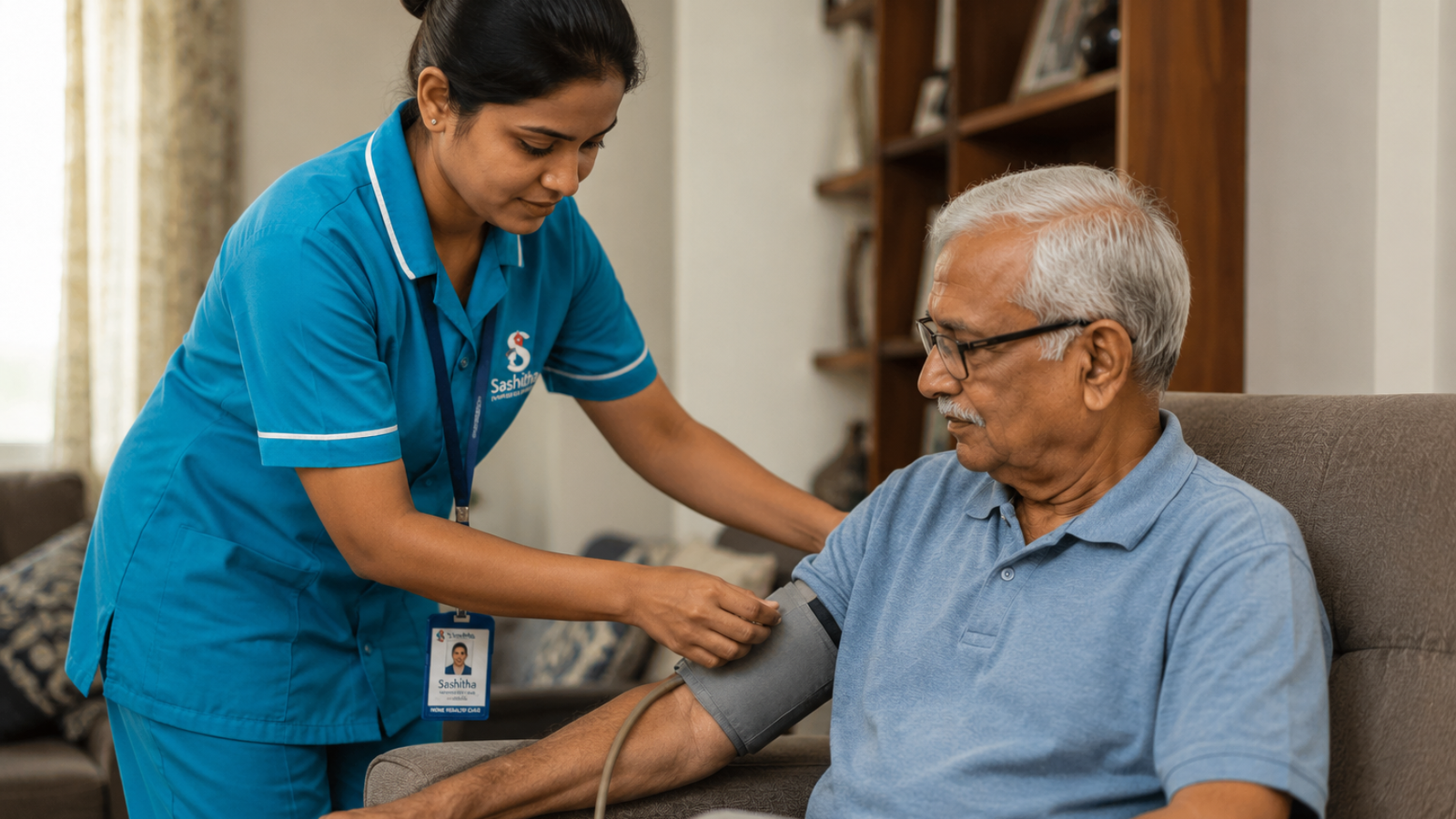
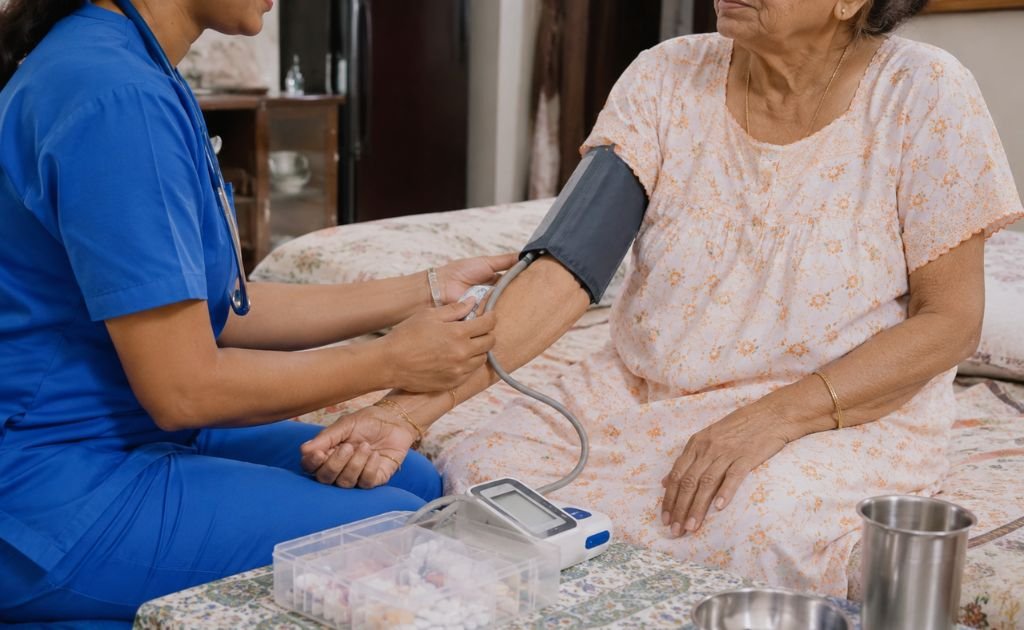
Nurse checking an elderly woman's blood pressure at her home in Chennai

12-hour versus 24-hour nursing: what changes

A 12-hour shift, day or night, suits families where someone at home can take the other half. It is the right answer more often than people assume – particularly in the second or third week after surgery, when the patient is mobile enough to manage short periods alone but still needs dressing changes and medication discipline.

Night-only 12-hour cover is worth calling out separately. It is what families ask for when a parent is disoriented after dark, is at risk of getting up alone, or needs turning through the night to prevent bedsores. It usually costs a little more than a day shift for the same hours, and it is often the difference between a caregiving daughter or son sleeping and not sleeping.

Move to 24-hour cover when the patient cannot be left alone at any point: bedridden with pressure-sore risk, oxygen-dependent, advanced dementia with wandering, or in the first days after a major surgery or discharge from ICU.

24-hour nursing care at home cost in Chennai

For continuous, round-the-clock cover in Chennai, expect roughly ₹35,000 to ₹70,000 per month for a trained nurse, and ₹25,000 to ₹45,000 per month if a non-clinical attendant is sufficient. Where the patient needs ICU-level support at home – tracheostomy, ventilator, frequent suctioning – the range moves to ₹65,000 to over ₹1,00,000 per month.

Before you compare two quotes at that level, ask one question that changes everything: is this one person or two?

The two ways “24-hour care” is actually delivered

Model A – one live-in nurse. A single nurse stays at your home, sleeps there, and is available around the clock. This is the cheaper of the two, and it is what most low quotations refer to. It works well when the patient sleeps through the night and needs only occasional attention. It is a genuine problem when the patient needs turning every two hours or suctioning at 3 am, because no one can work twenty-four hours a day for weeks. With this model you must confirm, in writing: what rest hours the nurse gets, what the weekly off arrangement is, and who covers that day.

Model B – two nurses on 12-hour shifts. Two nurses rotate, so someone is always awake and alert. It costs meaningfully more and it is the correct choice for genuinely dependent or unstable patients. Insist on a handover: a two-minute verbal update and a written log at each shift change is what prevents a missed dose or an unnoticed change in a wound.

If you are being quoted at the bottom of the range for a patient who needs active night care, you are almost certainly being quoted Model A for a Model B situation. That gap is worth clarifying before the first day, not on day nine.

Live-in arrangements: the part families forget to plan for

A live-in nurse needs somewhere to sleep, a place to keep a bag, bathroom access and meals. In a two-bedroom flat in Ashok Nagar or Besant Nagar, this needs a conversation before the nurse arrives, not on the evening of arrival. Most providers expect the family to provide food; some charge a food allowance instead. Clarify it upfront and it will never become a source of friction.

Daily rates or a monthly package?

Daily billing makes sense for short, defined needs – the first ten days after a knee replacement, or cover while the regular caregiver travels. You pay a slight premium per day, but you stop the moment you no longer need it.

Monthly packages generally work out cheaper per day and give you continuity, which matters more than families expect. A nurse who has been with your mother for three weeks notices when something is off. A rotating stranger does not.

One practical suggestion: start on a short daily arrangement for the first week. It gives you a real look at how the patient is recovering and whether the nurse is the right fit, before you commit to a month.

What is included – and what is billed separately

A standard home nursing engagement in Chennai typically covers vital signs monitoring, medication administration as prescribed, wound care and dressing, catheter and tube care, injections and IV therapy where ordered by the treating doctor, mobility and positioning support, personal hygiene assistance, and reporting back to the family and the doctor.

These are the items that are usually not in the base rate. Ask about each one before you sign:

  • Medical consumables – dressings, gloves, syringes, catheters, adult diapers, nutrition supplements. These are typically at actuals and can add several thousand rupees a month for a bedridden patient.
  • Equipment on rent – hospital bed, air mattress, oxygen concentrator, suction machine, wheelchair.
  • The weekly off and relief cover – is the replacement included in your monthly rate, or billed extra?
  • Food and stay for live-in staff, if not provided by the family.
  • Specific procedures that fall outside routine care.
  • Doctor or physiotherapist home visits, which are almost always separate.
  • Festival and holiday allowances, and any night-shift differential.
  • Registration or deposit at the start, and applicable GST.

A provider who volunteers this list without being asked is telling you something useful about how they will behave three months in.

What different situations typically cost

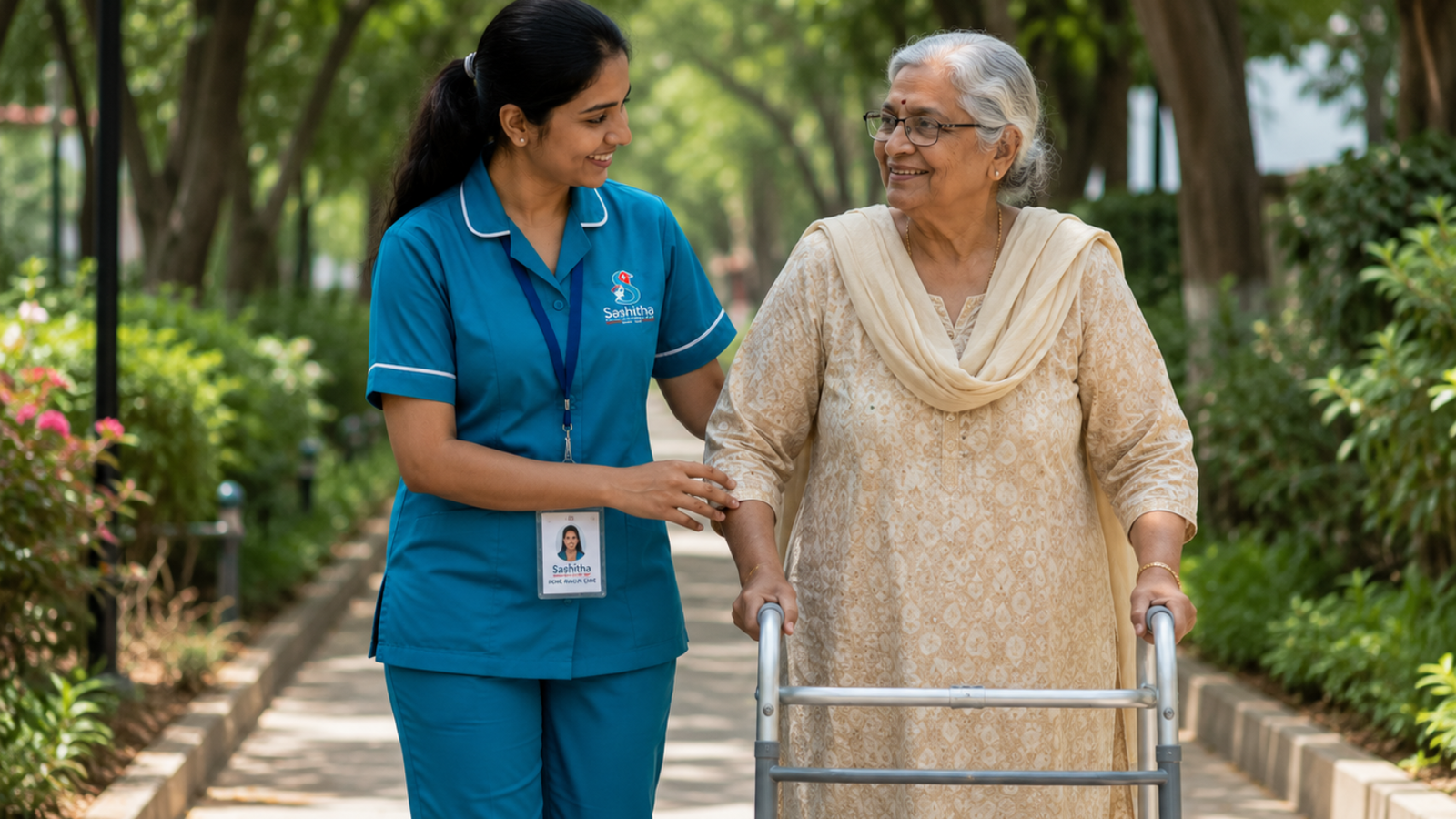
Nurse supporting a patient using a walking frame during recovery at home

Post-surgery recovery at home

After orthopaedic, cardiac or abdominal surgery, most families need skilled nursing for one to four weeks. Often a 12-hour day shift is enough, sometimes only daily visits for dressing and injections. This is usually the least expensive category, because the need is short and clearly defined. Discharge instructions, drain and suture care, and watching for early signs of infection are where a trained nurse earns their fee. Sashitha’s team also handles post-surgery care at home across Chennai on exactly this short-term basis.

Elderly parents needing daily support

This is the most common request in Chennai, and often the least clinical. Where the need is companionship, mobility support, medication discipline and fall prevention, an attendant or caregiver is usually the right and far more affordable choice, with a nurse visiting periodically. The World Health Organization notes that adults over sixty suffer the greatest number of fatal falls worldwide, which is why supervision at home is genuinely preventive care and not a luxury. Where age brings multiple overlapping conditions, structured geriatric care at home is a better framework than ad-hoc help.

Bedridden and long-term chronic care

Bedridden patients – after a stroke, with advanced Parkinson’s, or in the later stages of dementia – are the most expensive category outside critical care, because the need is continuous and long. Two-hourly repositioning, skin checks, tube feeding and bowel and bladder care are unrelenting, and the cost of getting them wrong is high: as the NHS explains, pressure ulcers develop when the same areas of skin bear body weight continuously, and they are far easier to prevent than to heal. Budget for a year rather than a month, and plan the nurse-plus-attendant combination described earlier.

Skilled and critical care at home

Ventilator support, tracheostomy care, dialysis support and complex oncology care at home need an ICU-trained nurse and specific equipment. If this applies to your family, our guide to home care for tracheostomy patients explains what the daily care involves and how to judge a provider. It is expensive, but it is worth comparing against the alternative: a private hospital bed in Chennai costs several thousand rupees a day before any treatment, so extended home-based care is often the cheaper path for a medically stable patient. Skilled nursing at home covers this level of clinical support.

Does health insurance cover home nursing in Chennai?

Usually not, and this catches many families by surprise. Standard Indian health insurance policies are built around hospitalisation. Some policies include a domiciliary hospitalisation clause, which may cover treatment at home when a hospital bed was genuinely unavailable or the patient could not be moved, but the conditions are narrow and it rarely covers a long-term attendant or nurse.

A few insurers now offer home healthcare as an add-on rider, and some corporate group policies include it. Call your insurer, ask specifically about “domiciliary hospitalisation” and “home healthcare cover”, and get the answer in writing. Meanwhile, keep every invoice and prescription: even where insurance does not pay, medical expenses for a dependent senior citizen may have tax implications worth discussing with your chartered accountant.

How to choose a home nursing provider in Chennai

Price is the easiest thing to compare and the least useful. These are the things that actually determine whether the arrangement works.

  • Ask for the nurse’s registration. A qualified nurse in Tamil Nadu holds a registration number with the Tamil Nadu Nurses and Midwives Council. Ask to see it. A provider who hesitates has told you what you need to know.
  • Confirm background and police verification for anyone who will be alone in your home with a vulnerable person.
  • Get the scope of duties in writing. Most disputes are about expectations, not competence – whether cooking, cleaning or shopping is included, for instance.
  • Ask about the replacement guarantee. “How quickly can you send someone if our nurse is unwell?” is the most revealing question you can ask.
  • Ask who supervises. Is there a nursing supervisor reviewing the care plan, or is the nurse left entirely alone?
  • Check language and cultural fit. A Tamil-speaking caregiver often matters enormously for an elderly patient’s comfort, especially with dementia. So does a preference for a female caregiver – a female caretaker service is a reasonable and common request, not an awkward one.
  • Confirm response time to your area. Chennai traffic is real. A provider who reaches Vadapalani in twenty minutes may take much longer to Perungudi.
  • Ask how care is documented. A daily log of vitals, medication and intake is what lets a doctor make good decisions at the next review.

The government’s National Programme for the Health Care of the Elderly sets out India’s public framework for geriatric care, and it is a useful reference point for the standard of long-term care your family is entitled to expect – whether it comes from a public facility or a private provider.

Getting a real number for your situation

Every figure in this article is a range, and ranges only get you so far. The actual cost for your family depends on things that can only be established by talking through the case: what the discharge summary says, how mobile the patient is, whether there is a wound or a catheter, how many hours are genuinely needed, and whether anyone at home can share the load.

Sashitha Home Health Care is based at Santhome, Mylapore, and provides home nursing across Chennai – including Mylapore, T Nagar, Anna Nagar, Ashok Nagar, R A Puram, Besant Nagar, Vadapalani, Ramapuram and Perungudi. Rather than a fixed price list, the team assesses the patient’s requirement first and then puts together a plan and a quotation for that specific situation, which is the only honest way to price care that varies this much.

If you are working out what your family needs and what it will cost, speak to the Sashitha team on +91 91760 00011. A short conversation about the patient’s condition will get you a clearer answer than any table on the internet, including this one.

Frequently asked questions

How much does a home nurse cost per day in Chennai?

A trained home nurse in Chennai typically costs ₹1,000 to ₹1,800 per day for a 12-hour shift and ₹1,500 to ₹2,500 per day for 24-hour cover. A single nurse visit for a procedure such as an injection or dressing change usually costs ₹500 to ₹1,500. Critical-care nurses cost more.

What is the cost of 24-hour nursing care at home in Chennai?

Around ₹35,000 to ₹70,000 per month for a trained nurse, and ₹25,000 to ₹45,000 per month if a non-clinical patient attendant meets the need. ICU-level care at home, such as ventilator or tracheostomy support, generally starts around ₹65,000 and can exceed ₹1,00,000 per month.

Is 24-hour care one nurse or two?

It can be either, and this is the main reason quotes differ so much. A single live-in nurse is cheaper but must sleep at some point. Two nurses on 12-hour shifts cost more and are the correct arrangement for patients who need active care through the night. Always confirm which model a quotation refers to.

What is the difference between a home nurse and a patient attendant?

A nurse holds a formal nursing qualification and can perform clinical tasks – injections, IV therapy, sterile wound dressing, catheter and tube care, and clinical monitoring. An attendant or caregiver supports daily living: bathing, feeding, mobility, positioning and companionship. An attendant costs roughly 30 to 40 per cent less.

Is home nursing cheaper than staying in hospital?

For a medically stable patient who needs ongoing care rather than active treatment, generally yes. A private hospital bed in Chennai runs into several thousand rupees a day before treatment costs, while 24-hour home nursing works out to roughly ₹1,500 to ₹2,500 a day. Home care also lowers the risk of hospital-acquired infection.

Do I have to pay extra for a live-in nurse’s food and accommodation?

Most providers expect the family to provide meals and a place to rest for a live-in nurse. Some charge a food allowance instead. It is not always stated in the base quotation, so ask about it before the nurse arrives.

Does health insurance cover home nursing in India?

Standard health insurance policies usually do not, because they are built around hospitalisation. Some policies have a limited domiciliary hospitalisation clause, and a few insurers offer home healthcare as a paid add-on. Check with your insurer directly and get confirmation in writing.

What does home nursing cost per month for a bedridden patient in Chennai?

Most families budget ₹35,000 to ₹70,000 a month for continuous nursing, plus consumables such as adult diapers, dressings and nutrition supplements, and any equipment rental such as an air mattress or hospital bed. Combining a nurse for clinical tasks with an attendant for the remaining hours is often the most cost-effective long-term structure.

How do I check whether a home nurse is genuinely qualified?

Ask for the nurse’s council registration number and qualification certificate, confirm that background and police verification has been done, and ask who supervises the nurse’s work. A reputable agency will share all three without hesitation.

Can I hire a home nurse for just a few days after surgery?

Yes. Short-term post-surgical nursing is one of the most common requests, and daily or weekly arrangements are normal. Many families start with a week and extend only if recovery is slower than expected.

Patient recovering comfortably at home following expert post surgery recovery tips

15 Post Surgery Recovery Tips for a Safe and Faster Recovery

Looking for post surgery recovery tips that actually help you heal faster? You’re in the right place.

Going home after surgery is only the start of your recovery. The first 2 to 4 weeks are the most important. During this time, your body heals wounds, repairs tissues, rebuilds strength, and fights infection.

Even small mistakes can delay healing. Do not miss your medicines. Change your dressings on time. Avoid lifting heavy objects too soon. Never ignore warning signs.

No matter what type of surgery you had, the right recovery plan helps you heal faster. It also lowers the risk of complications and helps you get back to your daily routine sooner.

In this guide, our nursing team shares 15 practical post surgery recovery tips. These tips come from real patient care experience. They will help you recover safely at home, regain strength, reduce complications, and know when to seek medical help.

Important: This article is for educational purposes only and does not replace your surgeon’s medical advice. Always follow your discharge instructions. Call your surgeon right away if you have severe pain, heavy bleeding, a fever, trouble breathing, or other unusual symptoms. Get emergency medical care if needed.

1. Prepare Your Recovery Space Before You Come Home

Comfortable bedroom setup designed for safe post surgery recovery at home

One of the most important post surgery recovery tips is to prepare your home before leaving the hospital. A well-organized recovery space makes daily tasks easier and safer. It also helps you focus on healing during the first few days.

If possible, choose a recovery room on the ground floor. This helps you avoid climbing stairs too often. Keep everything you need within easy reach. This includes drinking water, prescribed medicines, your mobile phone, a charger, tissues, and emergency contact numbers.

Before you arrive home, make sure you:

  • Remove loose rugs, electrical wires, and other objects that could cause trips or falls.
  • Install night lights between the bedroom and bathroom.
  • Keep clean gauze, dressings, hand sanitizer, prescribed medicines, a digital thermometer, and a pill organizer nearby.
  • If you had hip, knee, or abdominal surgery, install grab bars or use a raised toilet seat for extra support.
  • Place your medication schedule, follow-up appointment dates, your surgeon’s contact number, and emergency warning signs in a visible place for caregivers.

Taking a little time to prepare your home before discharge can make your recovery safer and less stressful. It also helps reduce the risk of accidents during the first 48 hours after surgery.

2. Follow Your Discharge Instructions Exactly

One of the most important post surgery recovery tips is to follow your discharge instructions exactly. Leaving the hospital does not mean you have fully recovered. It simply means your doctor believes you are well enough to continue healing at home.

Your discharge summary explains how to care for yourself after surgery. It includes instructions about your medicines, wound care, diet, physical activity, follow-up appointments, and warning signs to watch for.

Read the instructions before you leave the hospital. If anything is unclear, ask your doctor or nurse to explain it. Once you’re home, keep your discharge papers in a safe place. Make sure both you and your caregiver can find them easily.

Avoid following advice from friends, family, or social media if it differs from your doctor’s instructions. Your recovery plan is designed for your surgery, your health condition, and your medical history.

Following your discharge plan every day can lower the risk of complications. It also helps you recover safely and with greater confidence.

3. Stay Ahead of the Pain – Don’t Wait Until It Gets Worse

Pain management plays a major role in recovery. Many patients try to “tough it out” by delaying pain medication, but allowing pain to become severe can actually slow down healing.

When pain is properly controlled, you’re more likely to:

  • Walk comfortably
  • Sleep better
  • Breathe deeply
  • Cough effectively
  • Move safely
  • Participate in physiotherapy

Take pain medications exactly as prescribed instead of waiting until the pain becomes unbearable. Once pain reaches a high level, it often takes much longer for medication to become effective.

To avoid missed doses:

  • Set alarms on your phone.
  • Use a weekly pill organiser.
  • Keep an updated medication list, including medicines for diabetes, blood pressure, or heart conditions.

Never increase your medication dosage without consulting your doctor, and avoid combining prescription painkillers with alcohol or over-the-counter medicines unless specifically approved.

Remember, effective pain control isn’t about eliminating every bit of discomfort – it’s about allowing your body to heal while maintaining safe movement and daily activities.

4. Complete Every Course of Medication

As patients begin feeling better, one common mistake is stopping prescribed medications too early.

Antibiotics should always be completed exactly as directed, even if your wound appears to be healing well. Stopping treatment prematurely increases the risk of infection and may contribute to antibiotic resistance.

The same principle applies to:

  • Blood thinners
  • Diabetes medications
  • Blood pressure medicines
  • Anti-inflammatory medications
  • Stomach-protecting medicines
  • Any additional medicines prescribed after surgery

Create a medication schedule and tick off each dose as it’s taken. Family members or caregivers should also verify medication times during the first few days, especially for elderly patients.

Consistency is one of the most important post surgery recovery tips, as medications work best when taken exactly as prescribed.

5. Keep Your Surgical Wound Clean and Protected

Your surgical incision is one of the most vulnerable areas during recovery. Proper wound care significantly reduces the risk of infection and promotes faster healing.

Every time you change your dressing:

Wash Your Hands

Always wash your hands thoroughly with soap and water or use an alcohol-based hand sanitiser before touching the wound or dressing materials.

Remove the Dressing Carefully

If the dressing sticks to the wound, never pull it forcefully. Instead, moisten it slightly with sterile saline if advised by your healthcare provider before gently removing it.

Inspect the Wound

Take a moment to observe:

  • Redness
  • Swelling
  • Warmth
  • Drainage
  • Bleeding
  • Unpleasant odour

Small changes are often easier to treat when identified early.

Clean Only as Directed

Unless instructed otherwise, clean the wound gently with sterile saline or plain water. Avoid applying antiseptics, powders, herbal remedies, or ointments that haven’t been recommended by your surgeon, as these may interfere with healing.

Apply a Fresh Sterile Dressing

Use clean sterile dressings every time. Record the date and time of each dressing change to help monitor healing progress.

If you have surgical drains, keep them free from kinks and monitor drainage according to your doctor’s instructions. Never attempt to remove stitches, staples, or drains yourself.

During hot and humid weather, change your dressing if it becomes damp from sweat. Wear loose, breathable cotton clothing around the surgical area. Keep the room cool and well ventilated to reduce moisture around the wound.

A healthy surgical wound should improve a little each day. Contact your doctor immediately if you notice increased redness, swelling, foul-smelling discharge, worsening pain, or a fever.

6. Know When You Can Shower or Bathe

Many patients worry that showering too soon will damage their surgical wound. The truth is that the right time depends on the type of surgery, the dressing used, and your surgeon’s instructions.

Many modern waterproof dressings allow a short shower after 24–48 hours, while other surgical wounds may need to remain completely dry for several days. Always follow the advice given by your surgeon rather than general recommendations.

When showering:

  • Keep the water lukewarm rather than hot.
  • Avoid directing high-pressure water onto the incision.
  • Wash gently without scrubbing the surgical area.
  • Pat the wound dry with a clean towel instead of rubbing it.
  • Apply a fresh dressing if your healthcare provider has instructed you to do so.

Until your doctor confirms that the wound has healed properly, avoid soaking it in a bathtub, swimming pool, hot tub, or the sea. Prolonged exposure to water softens healing skin and increases the risk of infection.

Protecting your surgical wound during bathing is one of the simplest yet most effective post surgery recovery tips for preventing complications.

7. Eat for Healing: Make Protein Your Priority

Protein-rich healthy foods recommended for faster post surgery recovery

Your body works harder after surgery than most people realise. Every day, it repairs damaged tissue, produces new skin, fights infection, and rebuilds muscle. All of these processes require extra nutrients.

While there is no single “magic food” that speeds recovery overnight, eating a balanced diet rich in protein, vitamins, minerals, and fluids gives your body everything it needs to heal efficiently.

Protein (Tissue Repair)

Protein is the building block of recovery and should be included in every meal.

Good protein sources include:

  • Eggs
  • Dal
  • Sambar
  • Paneer
  • Milk
  • Curd
  • Chicken
  • Fish
  • Sprouts
  • Moong
  • Soy products

Protein supports wound healing, muscle recovery, and immune function.

Vitamin C (Collagen Production)

Vitamin C helps your body produce collagen, which strengthens healing skin and tissues.

Choose foods such as:

  • Guava
  • Oranges
  • Sweet lime
  • Amla
  • Lemon
  • Tomatoes
  • Capsicum

Iron (Replacing Blood Loss)

If you’ve lost blood during surgery, iron-rich foods help restore healthy red blood cells and reduce fatigue.

Include:

  • Spinach (Keerai)
  • Ragi
  • Dates
  • Beans
  • Jaggery
  • Lean red meat (if appropriate)

Fibre and Fluids

Anaesthesia and pain medications often slow digestion.

To prevent constipation, eat:

  • Fresh vegetables
  • Fruits
  • Whole grains
  • Oats
  • Plenty of drinking water
  • Buttermilk
  • Coconut water

Healthy Fats and Zinc

Healthy fats and zinc help strengthen the immune system and support tissue repair.

Good choices include:

  • Nuts
  • Seeds
  • Fish
  • Small amounts of ghee
  • Groundnuts

Foods to Limit During Recovery

During the first few weeks after surgery, try to avoid:

  • Deep-fried foods
  • Excessively spicy meals
  • Sugary snacks
  • Processed foods
  • Alcohol

These foods can interfere with digestion, increase inflammation, and slow the healing process.

If you have diabetes, keep your blood sugar under control. High blood sugar can slow wound healing and increase the risk of infection.

Eating a nutritious diet is one of the most important post surgery recovery tips. Your body needs the right nutrients to heal properly.

8. Stay Hydrated and Prevent Constipation

Constipation is one of the most common problems patients experience after surgery. Anaesthesia, reduced physical activity, pain medications, and changes in diet all slow the digestive system.

Fortunately, it’s usually preventable.

Drink plenty of water throughout the day unless your doctor has advised fluid restrictions.

To keep your bowels moving normally:

  • Eat fibre-rich vegetables and fruits every day.
  • Include whole grains in your meals.
  • Walk around the house several times daily if your surgeon allows.
  • Drink warm water in the morning if comfortable.
  • Ask your doctor whether a stool softener is appropriate if you haven’t had a bowel movement within two or three days.

Avoid ignoring constipation because excessive straining can place pressure on your surgical wound, particularly after abdominal, hernia, pelvic, or colorectal surgery.

Proper hydration also supports circulation, kidney function, medication effectiveness, and overall healing.

9. Move a Little Every Day to Prevent Blood Clots

Rest is important after surgery. However, staying in bed for several days can slow healing and increase the risk of complications.

One of the best post surgery recovery tips is to start gentle movement as soon as your surgeon says it is safe.

Walking improves:

  • Blood circulation
  • Lung function
  • Digestion
  • Muscle strength
  • Joint flexibility
  • Energy levels

It also helps prevent Deep Vein Thrombosis (DVT), a dangerous condition where blood clots develop in the legs.

Start with short walks around your room or home several times each day. As your strength improves, gradually increase both the duration and distance.

If you’re confined to bed, simple ankle pumps and gentle leg movements help maintain circulation.

If prescribed, wear compression stockings exactly as instructed.

However, avoid:

  • Heavy lifting
  • Running
  • Vigorous exercise
  • Climbing excessively
  • Strenuous household work

until your surgeon confirms it’s safe.

Stop immediately and seek urgent medical attention if you notice:

  • Sudden calf pain
  • Swelling in one leg
  • Warmth around the calf
  • Redness
  • Sudden shortness of breath
  • Chest pain

These symptoms could indicate a blood clot and require immediate medical evaluation.

Regular movement is one of the easiest ways to speed recovery while reducing the risk of life-threatening complications.

10. Learn the Warning Signs – Never Ignore Them

Every patient should know the warning signs that require immediate medical attention. Recognising complications early often prevents serious illness and hospital readmission.

Contact emergency medical services immediately if you experience:

Chest Pain or Difficulty Breathing

Sudden chest pain, severe breathlessness, or coughing blood may indicate a pulmonary embolism or another medical emergency.

Heavy Bleeding

If blood soaks through your dressing continuously despite applying gentle pressure, seek emergency care immediately.

Surgical Wound Opens

If your incision separates or internal tissues become visible, cover the wound with a clean sterile dressing and go to the nearest emergency department immediately.

Contact your surgeon as soon as possible if you notice:

  • Fever above 101°F (38.3°C)
  • Chills
  • Increasing redness around the wound
  • Thick yellow or green discharge
  • Foul-smelling drainage
  • Increasing swelling
  • Worsening pain
  • Persistent vomiting
  • Difficulty passing urine
  • Confusion
  • Severe constipation with vomiting

A simple rule to remember is this:

Your recovery should gradually improve each day.

Your pain should slowly decrease.

Your energy should slowly increase.

Your wound should look a little better every day.

If any of these are moving in the opposite direction, don’t wait for symptoms to become severe. Contact your surgeon immediately.

Trust your instincts. If something doesn’t feel right, it’s always better to seek medical advice early than to delay treatment.

11. Prioritise Quality Sleep for Faster Healing

Sleep is one of the most powerful yet often overlooked aspects of recovery. While you’re resting, your body repairs damaged tissues, strengthens your immune system, produces healing hormones, and restores energy. Poor sleep, on the other hand, can slow wound healing, increase fatigue, and make pain feel worse.

If pain is keeping you awake, talk to your doctor. They may adjust your pain medicine to help you sleep better.

Here are a few simple ways to improve sleep after surgery:

  • Keep a regular bedtime and wake-up schedule.
  • Take your prescribed pain medication before bedtime if advised by your doctor.
  • Support the surgical area with pillows to reduce pressure and improve comfort.
  • Keep your bedroom cool, quiet, and dark.
  • Avoid caffeine, heavy meals, and excessive screen time before sleeping.

Depending on your surgery, your doctor may recommend sleeping in a particular position. For example, patients recovering from hip replacement, abdominal surgery, or shoulder surgery may need additional pillow support or elevation during sleep.

Short daytime naps are normal during recovery. However, avoid long naps because they can make it harder to sleep at night.

Remember, your body performs much of its healing while you sleep, making quality rest one of the most valuable post surgery recovery tips you can follow.

12. Never Miss Your Follow-Up Appointments

As your pain decreases and your wound begins to heal, it can be tempting to skip follow-up appointments because you “feel fine.” However, many post-surgical complications develop silently before noticeable symptoms appear.

Your follow-up visit allows your surgeon to:

  • Examine your surgical wound.
  • Remove stitches or staples if required.
  • Review blood tests or scan results.
  • Assess your healing progress.
  • Adjust medications if necessary.
  • Identify complications before they become serious.

If your surgery requires rehabilitation, such as orthopaedic, spine, neurological, or major abdominal surgery, your doctor may also recommend physiotherapy.

Starting physiotherapy at the right time helps restore:

  • Joint movement
  • Muscle strength
  • Balance
  • Walking ability
  • Independence in daily activities

Always perform only the exercises recommended by your surgeon or physiotherapist, and increase activity gradually.

Attending every scheduled follow-up appointment gives your healthcare team the opportunity to ensure your recovery is progressing exactly as expected.

13. Remember That Caregivers Need Support Too

Recovery isn’t only challenging for patients – it can also be physically and emotionally demanding for family members who provide care every day.

Caregivers often help with:

  • Medication schedules
  • Dressing changes
  • Meal preparation
  • Personal hygiene
  • Walking assistance
  • Monitoring symptoms
  • Emotional support
  • Hospital visits

Balancing these responsibilities alongside work, family commitments, and household duties can quickly become overwhelming.

To reduce caregiver stress:

  • Share responsibilities among family members whenever possible.
  • Keep a written record of medications, symptoms, and appointments.
  • Take regular breaks to rest and recharge.
  • Ask relatives or friends for assistance when needed.
  • Consider professional nursing support for clinical tasks.

Looking after the caregiver is also part of looking after the patient. A rested, supported caregiver is better able to provide safe, compassionate care throughout the recovery journey.

14. Don’t Ignore Your Emotional Recovery

Physical healing is only one part of recovering after surgery. Many patients experience emotional changes that can be just as challenging.

It’s completely normal to experience:

  • Anxiety
  • Low mood
  • Irritability
  • Frustration
  • Fatigue
  • Lack of motivation

These feelings can result from pain, anaesthesia, temporary loss of independence, disrupted sleep, reduced activity, and concerns about recovery.

Fortunately, emotional wellbeing usually improves as physical recovery progresses.

Simple ways to support emotional recovery include:

  • Following a regular daily routine.
  • Spending time with supportive family and friends.
  • Taking short walks outdoors when approved.
  • Getting fresh air and sunlight.
  • Celebrating small improvements each day.
  • Being patient with your body’s healing process.

If sadness, anxiety, hopelessness, or severe emotional distress continues for several weeks or begins affecting your daily life, speak with your doctor. Mental wellbeing is an important part of recovery and deserves the same attention as physical healing.

Healing isn’t just about the surgical wound – it’s about helping your whole body and mind recover together.

15. Know When Professional Home Nursing Can Make Recovery Easier

Comfortable bedroom setup designed for safe post surgery recovery at home

Many patients recover successfully with support from family members. However, some situations require professional nursing care to ensure a safer and smoother recovery.

Home nursing is especially beneficial if the patient:

  • Is elderly.
  • Lives alone.
  • Has undergone major surgery.
  • Has limited mobility.
  • Needs regular wound dressing.
  • Requires injections or IV medications.
  • Has a urinary catheter or feeding tube.
  • Is bedridden.
  • Has multiple medical conditions such as diabetes or heart disease.

A trained home nurse can provide:

  • Sterile surgical wound dressing.
  • Medication administration.
  • Injection and IV care.
  • Blood pressure, pulse, temperature, and oxygen monitoring.
  • Catheter care.
  • Ryle’s tube care.
  • Bedsore prevention.
  • Safe patient positioning.
  • Mobility assistance.
  • Early identification of complications.
  • Communication with your treating doctor when required.

Professional nursing care also gives families peace of mind. An experienced nurse monitors recovery and spots warning signs early.

Some patients need only short daily nursing visits. Others may need 12-hour or 24-hour care during the first few weeks after surgery. The right level of support depends on your surgery, overall health, and the help available at home.

Seeking professional nursing support is not a sign of weakness – it is an investment in a safer, more comfortable recovery.

Bonus: A Week-by-Week Recovery Timeline

Every person’s recovery is unique, but knowing what to expect during each stage can help you feel more confident and recognise when something may need medical attention. While minimally invasive (laparoscopic) procedures often heal faster than open surgeries, major orthopaedic, cardiac, neurological, or cancer surgeries may require a longer recovery period.

Use this timeline as a general guide, but always follow your surgeon’s specific instructions.

Recovery StageWhat Is Usually NormalWhen to Contact Your Doctor
Day 1–3Feeling tired from anaesthesia, mild to moderate pain controlled with medication, reduced appetite, slight swelling and bruising around the incision.Fever above 101°F (38.3°C), heavy bleeding, uncontrolled pain, repeated vomiting, difficulty passing urine, or severe dizziness.
Week 1Wound begins sealing, energy remains low, constipation may occur, short walks around the house become easier.Increasing redness, pus, foul-smelling discharge, wound opening, calf pain, swelling, or shortness of breath.
Week 2Pain gradually decreases, appetite improves, stitches or staples may be removed, walking becomes easier.Fever, worsening wound appearance, sudden swelling, increasing pain, or any new symptoms.
Weeks 3–4Energy levels improve, light household activities become easier, scar tissue starts forming, many people return to desk work with medical clearance.Persistent fatigue, delayed wound healing, or symptoms that had improved but suddenly return.
Weeks 5–6 and BeyondMost daily activities can usually resume with your surgeon’s approval. Internal healing continues for several months depending on the surgery.Ongoing severe pain, reduced mobility, wound problems, or persistent emotional distress affecting daily life.

Remember, recovery is rarely perfectly linear. Some days you’ll feel stronger, while others may feel more tiring. What matters most is that your overall recovery continues to move in the right direction.

Frequently Asked Questions

How can I recover faster after surgery?

The best way to recover faster is by following your discharge instructions carefully, taking medications exactly as prescribed, eating a protein-rich diet, staying well hydrated, getting enough sleep, walking a little every day as advised by your surgeon, and keeping your surgical wound clean. Consistency with these daily habits is far more effective than looking for quick fixes.

How long does recovery take after surgery?

Recovery time depends on the type of surgery, your age, overall health, and how well you follow your recovery plan. Minor surgeries may require only one to two weeks, while major surgeries such as joint replacement, heart surgery, or abdominal procedures can take six weeks or longer. Complete internal healing may continue for several months.

What should I avoid after surgery?

Avoid lifting heavy objects, strenuous exercise, smoking, alcohol, skipping medications, stopping antibiotics early, soaking your wound in water, and ignoring warning signs such as fever or increasing wound pain. Always follow your surgeon’s restrictions until you are medically cleared to resume normal activities.

What foods help wounds heal faster?

Protein-rich foods such as eggs, fish, chicken, paneer, dal, sprouts, milk, and curd support tissue repair. Vitamin C-rich fruits like oranges, guava, amla, and sweet lime promote collagen production, while iron-rich foods help replace blood lost during surgery. Drinking enough water and eating fibre-rich foods also support healthy recovery.

When can I start walking after surgery?

Most patients are encouraged to begin gentle walking within the first few days after surgery, depending on their procedure and medical condition. Walking improves circulation, reduces the risk of blood clots, supports digestion, and helps restore strength. Always increase activity gradually and follow your surgeon’s recommendations.

How do I know if my surgical wound is infected?

Warning signs of infection include increasing redness, swelling, warmth, pus or thick discharge, foul-smelling drainage, worsening pain, and fever above 101°F (38.3°C). If you notice any of these symptoms, contact your surgeon immediately for evaluation.

Is it normal to feel tired after surgery?

Yes. Feeling tired for several weeks after surgery is completely normal. Your body is using a significant amount of energy to repair tissues and recover. Adequate sleep, nutritious meals, hydration, and gradual physical activity help restore energy over time.

How can I prevent constipation after surgery?

Drink plenty of water, eat fruits, vegetables, and whole grains, include fibre in your diet, and walk regularly if permitted by your doctor. If constipation continues for more than two or three days, speak with your healthcare provider about using a stool softener.

When should I consider home nursing after surgery?

Home nursing is recommended for elderly patients, individuals recovering from major surgery, people with limited mobility, or anyone requiring wound dressing, injections, catheter care, medication management, or close monitoring. Professional nursing support helps reduce complications while giving families added confidence during recovery.

When should I seek emergency medical care after surgery?

Seek emergency medical attention immediately if you experience severe chest pain, sudden difficulty breathing, heavy bleeding, a surgical wound that opens completely, or signs of a blood clot such as severe calf pain and swelling. Early treatment can prevent serious complications.

Recover Safely at Home with Sashitha Home Health Care

Recovering after surgery can feel overwhelming. You do not have to face it alone. At Sashitha Home Health Care, we provide compassionate post-surgery nursing services that help patients recover safely and comfortably at home.

Our experienced nurses and caregivers create a care plan that matches your surgery and recovery needs. We work closely with patients and families to support a safe recovery.

Our Post-Surgery Home Care Services Include:

  • Surgical wound dressing9
  • Medication management
  • Injection and IV care
  • Catheter and Ryle’s tube care
  • Vital signs monitoring
  • Bedridden patient care
  • Home physiotherapy coordination
  • Mobility assistance
  • Elderly post-operative care
  • 12-hour nursing services
  • 24-hour nursing care
  • Home attendant services

We provide professional home nursing services across Chennai. Our team serves Mylapore, Adyar, T. Nagar, Anna Nagar, Velachery, Porur, Medavakkam, Tambaram, OMR, ECR, and nearby areas.

Whether you’re recovering from orthopaedic surgery, abdominal surgery, cardiac surgery, cancer surgery, or any other major procedure, our trained healthcare professionals are here to support your recovery every step of the way.

Need Professional Post-Surgery Care at Home?

📞 Call 24/7: +91 91760 00011 , +91 91502 71034

📍 Visit: St raphaels. Girls hr.sec school, Kangayarpuram, Basha Garden, Mylapore, Chennai, Greater Chennai, Tamil Nadu 600004

Schedule a Home Visit

Our team will help you choose the right nursing care for your needs. We are here to help you recover safely and comfortably at home.

home-care-service-anna-nagar

Signs Your Parents Might Need Professional Elder Care Services in Chennai

Watching your parents grow older is never easy. They may still insist they can manage everything on their own, but subtle changes in their daily routine, health, or behavior can indicate they need extra support. Recognizing these signs early can help prevent accidents, improve their quality of life, and give your family peace of mind.

If you’re searching for a reliable home care service in chennai, understanding when to seek professional help is the first step toward ensuring your loved ones receive compassionate and personalized care in the comfort of their own home.

Why Recognizing the Signs Early Is Important

Modern lifestyles often leave families with limited time to provide continuous care. Professional caregivers help bridge this gap by ensuring loved ones receive consistent attention while allowing family members to balance work and personal responsibilities.

Professional home health care services in Chennai are designed to support seniors with daily activities, medical needs, companionship, and emotional well-being—all while allowing them to continue living in familiar surroundings.

They Struggle with Everyday Activities

One of the earliest signs is difficulty performing Activities of Daily Living (ADLs), such as:

Frequent Falls or Mobility Problems

Changes in physical health are another important indicator. Frequent falls, poor balance, difficulty walking, or fear of climbing stairs should never be ignored. Falls are one of the leading causes of injuries among older adults and can significantly affect their confidence and mobility. Hiring a qualified home nurse in Chennai ensures your loved one receives assistance with walking, mobility support, and regular health monitoring, helping to reduce the risk of accidents while improving their overall safety at home.

Family Caregiving Is Becoming Overwhelming

Balancing work, children, and caregiving responsibilities can become exhausting.

If you feel constantly worried, stressed, or unable to provide the level of care your parent deserves, professional elder care can offer valuable support. It allows family members to spend meaningful time with their loved ones instead of being overwhelmed by caregiving duties.

Benefits of Professional Elder Care Services in Chennai

Choosing professional elder care services in Chennai offers numerous benefits, including:

Frequently Asked Question (FAQ)

What are the common signs that elderly parents need professional care?

Difficulty with daily activities, frequent falls, memory problems, poor hygiene, missed medications, weight loss, loneliness, and chronic health issues are common indicators that additional support may be needed.

Can elderly people receive medical care at home?

Yes. Professional home nurses can provide wound care, injections, medication management, vital sign monitoring, post-surgical care, and support for chronic illnesses.

Is home care better than moving to a nursing home?

For many seniors, home care offers personalized assistance while allowing them to remain in familiar surroundings, promoting comfort, independence, and emotional well-being.

How do I know if my parent needs full-time care?

If your parent cannot safely manage daily activities alone, requires continuous supervision, or has complex medical needs, full-time professional care may be the best option.

Why should I choose Sashitha Home Care Service in Chennai?

Sashitha Home Care Service provides experienced caregivers, qualified home nurses, personalized care plans, flexible care options, and compassionate support tailored to each senior’s unique needs.

What are the signs that my parents need professional elder care services in Chennai?

Common signs include difficulty with daily activities, frequent falls, memory loss, poor personal hygiene, missed medications, weight loss, loneliness, and difficulty managing chronic health conditions. If these issues affect your parent’s safety or quality of life, professional elder care services in Chennai can provide the support they need.

What services are included in professional elder care at home?

Professional elder care services typically include personal hygiene assistance, meal preparation, medication reminders, mobility support, companionship, post-hospitalization care, dementia care, home nursing, and help with daily activities. Care plans are customized based on the senior’s health and lifestyle needs.

Is home care better than moving my parents to an elderly care facility?

For many families, home care is a preferred option because it allows seniors to stay in the comfort of their own home while receiving personalized care. It helps maintain independence, provides one-on-one attention, reduces emotional stress, and keeps them close to family members.

home nurse service chennai

Recover Faster with Professional Home Nurse Chennai Services

Finding the right caregiver for your loved one is one of the most important decisions your family will make. Whether you’re caring for an aging parent, a recovering patient, or someone living with a chronic illness, choosing a professional Home Care Service Chennai can significantly improve their quality of life while giving your family peace of mind.

Today’s home healthcare services offer much more than basic assistance. Professional caregivers provide personalized support that allows seniors and patients to remain safe, comfortable, and independent in the familiar surroundings of their own homes.

If you’re considering hiring a caregiver, this guide explains everything you need to know before making your decision.

Why More Families in Chennai Are Choosing Home Care

Modern lifestyles often leave families with limited time to provide continuous care. Professional caregivers help bridge this gap by ensuring loved ones receive consistent attention while allowing family members to balance work and personal responsibilities.

Home care also reduces unnecessary hospital visits, promotes faster recovery, improves emotional well-being, and enables seniors to continue living independently.

What Services Should a Professional Caregiver Provide?

Before hiring a caregiver, understand the range of services they should be able to deliver based on the patient’s needs.

A qualified caregiver typically assists with:

When Do You Need a Home Nurse Instead of a Caregiver?

Although caregivers provide valuable daily assistance, some patients require professional medical care.

A Home Nurse Chennai should be considered when the patient requires:

The Importance of Personalized Care Plans

Every patient has unique medical conditions, routines, and personal preferences. A one-size-fits-all approach rarely delivers the best outcomes.

Professional home healthcare providers assess the patient’s condition before developing a customized care plan that includes daily routines, medical requirements, nutritional needs, mobility assistance, and family expectations.

Regular reviews ensure care evolves as the patient’s health changes.

Benefits of Hiring a Professional Home Care Service

Patients receive one-on-one attention tailored to their individual needs. Recovery often improves because care is delivered in familiar surroundings where stress levels are lower. Seniors maintain greater independence while continuing daily routines at home. Families gain reassurance knowing experienced caregivers are available to provide reliable support, monitor well-being, and communicate any changes in health promptly.

Frequently Asked Question (FAQ)

What is a home care service?

A home care service provides trained caregivers or nurses who assist patients with daily living activities, personal care, companionship, and medical support at home.

Who should hire a home caregiver?

Home caregivers are ideal for seniors, post-surgery patients, bedridden individuals, people with disabilities, and anyone needing assistance with daily activities.

What is the difference between a caregiver and a home nurse?

A caregiver helps with daily personal care and companionship, while a Home Nurse Chennai provides professional medical care such as wound dressing, injections, catheter care, and health monitoring.

How do I choose the best Home Care Service Chennai?

Choose a provider with trained caregivers, verified staff, personalized care plans, emergency support, transparent communication, and proven experience in home healthcare.

Can home care help elderly parents live independently?

Yes. Professional caregivers assist with daily activities while encouraging seniors to remain active, safe, and independent in their own homes.

Is home care available after hospital discharge?

Yes. Home care provides post-hospital recovery support, medication reminders, mobility assistance, wound care, and nursing services that promote faster healing.

Do you provide female caregivers?

Yes. Our Female Care Anna Nagar service offers trained female caregivers who provide respectful personal care, companionship, and daily assistance.

Can care plans be customized?

Yes. Every patient receives a personalized care plan based on their medical condition, lifestyle, recovery goals, and family preferences.

home-care-service-mylapore

The Growing Need for Home Nurse Mylapore Services in Modern Families

Modern families are busier than ever. Between demanding careers, children’s education, and personal responsibilities, many people struggle to provide the continuous care their elderly parents or recovering family members need. At the same time, India’s aging population is increasing, and more seniors are choosing to remain in the comfort of their own homes rather than moving to assisted living facilities.

These changing lifestyles have created a growing demand for professional Home Nurse Mylapore services. Skilled home nurses now play an essential role in helping patients recover safely, manage chronic illnesses, and maintain a better quality of life without frequent hospital visits.

At Sashitha Home Health Care, we provide compassionate and experienced nursing professionals who deliver personalized healthcare directly to your doorstep. Whether you need short-term recovery support or long-term medical care, our dedicated team is committed to helping families across Chennai with trusted home healthcare services.

Why Is the Demand for Home Nursing Increasing?

Healthcare has evolved significantly over the past decade. Advances in medical technology and home healthcare now allow many treatments that once required hospitalization to be safely provided at home.

Families are increasingly recognizing that professional home nursing offers both medical expertise and emotional comfort. Patients recover better when surrounded by familiar people and environments, while families gain peace of mind knowing qualified professionals are monitoring their loved one’s health.

A professional Home Nurse Mylapore bridges the gap between hospital care and everyday living, ensuring patients receive continuous attention without disrupting their normal lives.

If you’ve noticed changes in your loved one’s physical health, memory, or daily routine, it may be time to consider professional caregiving.

Personalized Nursing Care in the Comfort of Home

Professional home nurses create individualized care plans based on the patient’s diagnosis, doctor’s recommendations, and personal health goals.

This personalized approach allows patients to receive focused medical attention while enjoying the comfort, privacy, and emotional security of their own homes.

Faster Recovery After Hospital Discharge

Missing medications or taking incorrect doses can lead to serious health complications, especially for seniors managing conditions such as diabetes, hypertension, or heart disease.

Professional caregivers help organize medication schedules, provide timely reminders, and observe any unusual changes in health. If medical supervision is required, an experienced home nurse Chennai can administer medications and monitor recovery under a doctor’s guidance.

Better Care for Elderly Family Members

Professional Home health care service in Chennai helps seniors continue living independently while receiving the medical attention they need.

Home nurses monitor vital signs, administer medications, assist with rehabilitation exercises, coordinate with physicians, and respond quickly to changes in health conditions. For elderly patients, receiving healthcare at home often improves emotional well-being while preserving dignity and independence.

Home Nursing Is Safer Than Frequent Hospital Visits

Receiving treatment at home minimizes travel-related stress and reduces exposure to hospital-acquired infections. Home nurses coordinate care according to the patient’s schedule, creating a safer and more comfortable healthcare experience.

Frequently Asked Question (FAQ)

What does a Home Nurse in Mylapore do?

A Home Nurse Mylapore provides professional medical care at home, including medication administration, wound dressing, injections, catheter care, post-surgical care, vital sign monitoring, and chronic disease management.

Who should hire a home nurse?

Patients recovering after surgery, seniors with chronic illnesses, bedridden individuals, stroke survivors, and those requiring regular medical supervision can benefit from home nursing services.

What is the difference between a caregiver and a home nurse?

A caregiver helps with daily living activities such as bathing, dressing, meal preparation, and companionship. A home nurse provides clinical medical care, treatments, and health monitoring.

Can a home nurse care for elderly patients?

Yes. Professional home nurses provide medication management, health assessments, rehabilitation support, chronic disease monitoring, and post-hospital recovery for elderly patients.

Is home nursing better than staying in the hospital?

For medically stable patients, home nursing offers personalized care, greater comfort, lower infection risk, emotional well-being, and often a faster recovery in a familiar environment.

What services are included in home health care service in Chennai?

A home health care service in Chennai includes home nursing, elder care, post-operative care, dementia support, physiotherapy, palliative care, medication management, and personal caregiving.

Can home nurses provide injections and wound care?

Yes. Qualified nurses are trained to administer injections, change wound dressings, manage IV medications, and perform other clinical procedures as prescribed by physicians.

Do you provide female nursing staff?

Yes. We offer experienced female nurses and Female Care Anna Nagar services for patients who prefer female healthcare professionals.

home-nursing-anna-nagar

7 Signs Your Loved One Needs a Home Care Service in Mylapore

As parents and elderly family members age, their ability to manage daily activities may gradually decline. Often, these changes happen so slowly that families don’t notice them until they become serious. Missing meals, forgetting medications, frequent falls, or social isolation can all indicate that additional support is needed.

Recognizing these early warning signs can make a significant difference in your loved one’s health, safety, and independence. A professional Home care service Mylapore provides compassionate assistance that helps seniors continue living comfortably in their own homes while receiving personalized care.

At Sashitha Home Health Care, we offer trusted Home care service Chennai, experienced home nurse Chennai, and comprehensive home health care service in Chennai to ensure every senior receives the support they deserve.

Unlike institutional care, home care focuses on one individual. Every care plan is designed according to the senior’s physical condition, medical history, daily routine, and personal preferences. This personalized approach not only improves healthcare outcomes but also helps seniors maintain their independence and dignity.

Why Early Home Care Matters

Many families wait until an emergency occurs before seeking professional care. However, home care is most effective when introduced early. Preventive support helps seniors maintain their independence, reduces health risks, and provides families with peace of mind.

If you’ve noticed changes in your loved one’s physical health, memory, or daily routine, it may be time to consider professional caregiving.

Daily Activities Have Become Difficult

One of the earliest signs is difficulty performing everyday tasks that were once simple. Seniors may struggle with bathing, dressing, grooming, cooking, or moving around the house. They might avoid these activities altogether because of pain, weakness, or reduced mobility.

A professional caregiver provides respectful assistance with daily routines while encouraging seniors to remain as independent as possible. This support helps prevent injuries and improves overall quality of life.

They Frequently Forget Their Medications

Missing medications or taking incorrect doses can lead to serious health complications, especially for seniors managing conditions such as diabetes, hypertension, or heart disease.

Professional caregivers help organize medication schedules, provide timely reminders, and observe any unusual changes in health. If medical supervision is required, an experienced home nurse Chennai can administer medications and monitor recovery under a doctor’s guidance.

They Have Experienced Recent Falls or Balance Problems

Falls are one of the leading causes of injury among older adults. Even a minor fall can reduce confidence and increase the fear of moving around independently.

A home care service Mylapore helps lower this risk by providing mobility assistance, supervising daily activities, and creating a safer home environment. Caregivers also identify potential hazards such as loose rugs, poor lighting, or cluttered walkways that may increase the likelihood of accidents.

Benefits of Professional Home Care

Choosing a professional home care service Chennai offers far more than assistance with daily activities. It provides seniors with personalized care that supports their physical, emotional, and mental well-being.

Professional caregivers help maintain a healthy daily routine, encourage independence, promote safety, and provide companionship. Families also benefit from regular updates and the reassurance that their loved ones are receiving compassionate, high-quality care.

Frequently Asked Question (FAQ)

How do I know if my loved one needs a home care service?

Signs include difficulty with daily activities, frequent falls, missed medications, memory loss, social isolation, recovery after hospitalization, or needing regular assistance to remain safe at home

What services are included in a home care service in Mylapore?

A home care service Mylapore typically includes personal care, companionship, medication reminders, meal preparation, mobility assistance, hygiene support, post-hospital care, and elderly care.

When should I hire a home nurse in Chennai?

A home nurse Chennai is recommended when medical care such as wound dressing, injections, catheter care, medication administration, or post-operative recovery is required at home.

What is the difference between a caregiver and a home nurse?

A caregiver assists with daily living activities, companionship, and personal care, while a home nurse provides professional medical care, health monitoring, and clinical procedures.

Can seniors with dementia receive home care?

Yes. Professional caregivers are trained to support seniors with dementia by maintaining routines, ensuring safety, assisting with daily activities, and providing emotional support.

Why choose a home health care service instead of a hospital stay?

A home health care service in Chennai allows patients to recover in familiar surroundings, receive one-on-one attention, reduce hospital visits, and maintain greater comfort and independence.

Does Sashitha Home Health Care provide services across Chennai?

Yes. Sashitha Home Health Care offers home care service Chennai, home care service Mylapore, elder care service Anna Nagar, professional home nursing, and personalized home healthcare services across Chennai.

Is home care suitable for seniors who live alone?

Yes. Home care provides companionship, safety monitoring, assistance with daily activities, medication reminders, and emergency support, making it an ideal solution for seniors living independently.

How many hours of home care can I book?

Depending on your family’s needs, services can be arranged for a few hours a day, full-day care, overnight care, or 24/7 live-in support.

elder-care-service-anna-nagar

Elder Care Service Anna Nagar: Helping Seniors Live Independently at Home

Today’s families are increasingly choosing home healthcare because it allows seniors to receive professional assistance without disrupting their daily lives. Remaining in familiar surroundings has a positive impact on emotional well-being, confidence, and recovery.

Unlike institutional care, home care focuses on one individual. Every care plan is designed according to the senior’s physical condition, medical history, daily routine, and personal preferences. This personalized approach not only improves healthcare outcomes but also helps seniors maintain their independence and dignity.

For families, professional caregiving provides reassurance that their loved ones are receiving attentive, compassionate, and reliable support every day.

Helping Seniors Maintain Independence Without Compromising Safety

Independence is important at every stage of life. Even when seniors need assistance, they still value making their own decisions and participating in everyday activities.

Professional caregivers encourage seniors to remain active while providing support only where it is needed. Whether helping with mobility, meal preparation, bathing, dressing, or medication reminders, caregivers work alongside seniors rather than taking over completely.

This balanced approach allows elderly individuals to continue living confidently while reducing the risk of accidents and health complications.

Creating a Safer Home Environment for Seniors

Falls remain one of the most common causes of injury among older adults. A safe home environment plays a significant role in maintaining independence.

Our caregivers continuously assess potential safety risks while assisting seniors with walking, transferring, using the bathroom, climbing stairs, and moving around the house. They also monitor hydration, nutrition, medication schedules, and overall health to identify early signs of concern before they develop into medical emergencies.

Preventive care is one of the most valuable benefits of choosing a professional home health care service in Chennai. This personalized approach allows seniors to receive the right level of support without disrupting their familiar lifestyle. Whether assistance is needed for a few hours each day or around the clock, care is always delivered with patience and professionalism.

Companionship That Supports Emotional Well-Being

Physical care alone is not enough to ensure a happy and healthy life. Many seniors experience loneliness after retirement, the loss of a spouse, or when children move away for work.

Our caregivers provide meaningful companionship through daily conversations, shared activities, reading, walking, and emotional encouragement. These interactions help seniors remain socially connected, mentally active, and emotionally positive.

Specialized Support for Dementia and Alzheimer's Care

Memory-related conditions require patience, consistency, and specialized caregiving techniques. Seniors living with dementia or Alzheimer’s disease benefit from structured routines and compassionate supervision.

Our trained caregivers assist with medication reminders, cognitive stimulation, personal hygiene, meal support, mobility, and safety while helping seniors maintain as much independence as possible. Families also receive ongoing guidance and reassurance throughout the caregiving journey.

Female Caretaker Anna Nagar for Comfort and Dignity

Many families prefer female caregivers, especially when elderly women require personal care assistance. Our Female Caretaker Anna Nagar services provide experienced and compassionate caregivers who understand the importance of privacy, dignity, and emotional comfort.

Female caregivers assist with bathing, dressing, grooming, medication reminders, meal preparation, mobility support, and companionship while creating a respectful and trusting relationship with every patient.

This personalized support helps seniors feel comfortable while encouraging greater confidence in their daily routines.

Regular monitoring also allows caregivers to notice changes in health, appetite, or mobility, ensuring concerns are addressed quickly. This proactive approach helps families feel confident that their loved ones are receiving attentive care every day.

Frequently Asked Question (FAQ)

What is an elder care service in Anna Nagar?

An Elder care service Anna Nagar provides professional in-home support for senior citizens, including personal care, companionship, medication reminders, mobility assistance, meal support, and health monitoring, allowing seniors to live safely and independently.

Who should consider hiring an elder care service?

Families should consider elder care services when a senior needs help with daily activities, recovering after surgery, managing chronic illnesses, living with dementia, or requires regular supervision and companionship.

What services are included in home health care service in Chennai?

A home health care service in Chennai includes skilled nursing, elder care, post-hospital recovery, physiotherapy assistance, medication management, personal hygiene support, dementia care, palliative care, and companionship.

When is it necessary to hire a home nurse in Chennai?

A home nurse Chennai is recommended for patients recovering from surgery, requiring injections, wound care, catheter care, medication administration, chronic disease management, or continuous medical observation at home.

How does home care help seniors stay independent?

Home care supports seniors by providing assistance only where needed while encouraging them to continue performing everyday activities independently. This approach improves confidence, safety, mobility, and overall quality of life.

Why do families choose Female Care Anna Nagar?

Families often choose Female Care Anna Nagar because female caregivers provide respectful assistance with bathing, dressing, grooming, medication reminders, mobility support, and companionship while maintaining privacy and dignity.

Can caregivers assist patients with dementia or Alzheimer's disease?

Yes. Professional caregivers are trained to support individuals with dementia and Alzheimer’s by maintaining routines, ensuring safety, providing cognitive engagement, assisting with daily activities, and offering emotional reassurance.

Is home care more affordable than long-term hospitalization?

For many families, home care can be a cost-effective option because it provides personalized care in the home while reducing expenses associated with extended hospital stays. The most suitable option depends on the individual’s medical needs and care requirements.

Which locations does Sashitha Home Health Care serve?

Sashitha Home Health Care offers home care service Chennai, home care service Mylapore, elder care service Anna Nagar, professional home nursing, and home healthcare services across multiple areas of Chennai.

female-care-anna-nagar

How Female Care Anna Nagar Provides Comfort, Safety, and Compassion

Caring for an elderly parent or a loved one recovering from illness is one of the most meaningful responsibilities a family can have. However, providing consistent care while managing work and personal commitments can be challenging. Many families also prefer a female caregiver, especially when assisting elderly women with personal care and daily activities.

Whether your loved one requires short-term assistance after hospitalization or long-term support due to aging, our caregivers deliver dependable care tailored to individual needs.

Choosing a professional Female Care Anna Nagar service ensures your loved one receives compassionate, respectful, and personalized care in the comfort of their own home. At Sashitha Home Health Care, our experienced female caregivers are trained to provide both emotional and practical support while helping seniors maintain their dignity, independence, and quality of life.

Why Female Caregivers Are Preferred by Many Families

Every senior has unique healthcare and emotional needs. For many elderly women and families, having a female caregiver offers an added sense of comfort, trust, and privacy. Female caregivers are often preferred for assisting with personal hygiene, dressing, bathing, and daily routines because they help patients feel more relaxed and respected.

Our caregivers focus on building meaningful relationships with seniors, ensuring they receive compassionate support while maintaining their confidence and independence.

Personalized Care That Respects Individual Needs

Professional caregiving is never a one-size-fits-all service. Every individual has different medical conditions, mobility levels, and personal preferences. Before beginning care, our team evaluates the patient’s health status, lifestyle, and daily routine to create a customized care plan.

This personalized approach allows seniors to receive the right level of support without disrupting their familiar lifestyle. Whether assistance is needed for a few hours each day or around the clock, care is always delivered with patience and professionalism.

Assistance with Daily Living Activities

As people age, routine activities that were once simple may become physically demanding. Our female caregivers provide gentle assistance with everyday tasks while encouraging seniors to remain as independent as possible.

Emotional Support and Meaningful Companionship

Physical care is only one part of healthy aging. Emotional well-being plays an equally important role in maintaining a senior’s overall quality of life.

Many older adults experience loneliness, particularly if family members live in different cities or countries. Our female caregivers spend quality time talking, listening, reading, and engaging seniors in enjoyable activities. This companionship helps reduce isolation, improves emotional health, and creates a positive daily routine.

Promoting Safety at Home

Falls and household accidents are among the most common risks for elderly individuals. A professional caregiver helps create a safer home environment by assisting with mobility, supervising daily activities, and identifying potential hazards before accidents occur.

Regular monitoring also allows caregivers to notice changes in health, appetite, or mobility, ensuring concerns are addressed quickly. This proactive approach helps families feel confident that their loved ones are receiving attentive care every day.

Frequently Asked Question (FAQ)

What does Female Care Anna Nagar include?

Female Care Anna Nagar includes personal care, bathing assistance, grooming, meal support, medication reminders, mobility assistance, companionship, and daily living support provided by trained female caregivers in the comfort of your home.

Who should hire a female caregiver?

Families should consider hiring a female caregiver for elderly women, post-surgical patients, individuals with limited mobility, or anyone who requires assistance with personal care while preferring support from a female professional.

How does a female caregiver improve senior safety?

Female caregivers help reduce the risk of falls by assisting with walking, transfers, bathroom visits, medication reminders, and continuous supervision while identifying potential hazards within the home.

Can female caregivers provide companionship?

Yes. Female caregivers offer emotional support through meaningful conversations, recreational activities, reading, and companionship, helping seniors stay socially active and reducing feelings of loneliness.

What is the difference between a caregiver and a home nurse?

A caregiver primarily assists with personal care, companionship, daily activities, and emotional support. A home nurse Chennai provides medical care such as wound dressing, injections, medication administration, catheter care, and health monitoring.

Do female caregivers help after hospital discharge?

Yes. Female caregivers provide post-hospital recovery support by assisting with mobility, personal care, medication reminders, nutrition, and daily activities, helping patients recover safely at home.

Is Female Care Anna Nagar available for full-time care?

Yes. Services can be arranged on an hourly, daytime, overnight, or 24-hour basis depending on the patient’s healthcare needs and family preferences.

Does Sashitha Home Health Care provide services outside Anna Nagar?

Yes. Along with Female Care Anna Nagar, Sashitha Home Health Care also offers home care service Chennai, home health care service in Chennai, home care service Mylapore, and professional home nursing services across multiple locations in Chennai.

How do I choose the best female caregiver?

Choose a caregiver from a trusted home healthcare provider that offers trained, verified professionals, personalized care plans, transparent communication, and ongoing supervision to ensure high-quality care.

Why choose Sashitha Home Health Care?

Sashitha Home Health Care is a trusted provider of home care service Chennai, offering experienced caregivers, skilled nurses, personalized care plans, and compassionate support that helps seniors and patients live safely, comfortably, and independently at home.

home-care-service-anna-nagar

Top Benefits of Hiring a Home Care Service Mylapore for Elderly Parents

Many families want to provide the best care possible but struggle to balance work, personal responsibilities, and caregiving. This is where a professional Home care service Mylapore becomes an ideal solution.

Instead of moving elderly parents to a nursing home or care facility, home care allows them to remain in the comfort of their own home while receiving personalized attention. Professional caregivers help seniors maintain their independence, dignity, and overall well-being.

At Sashitha Home Health Care, we provide trusted home care service Chennai, experienced home nurse Chennai support, and compassionate elder care services designed to meet every family’s unique needs.

Why Home Care Is the Preferred Choice for Elderly Parents

Home is where seniors feel the safest and happiest. Familiar surroundings reduce stress and anxiety while promoting emotional well-being.

Professional caregivers provide one-on-one attention that hospitals or care homes often cannot offer.

Professional Home Nurse Chennai Services

Some elderly parents require skilled medical attention after surgery or while managing chronic illnesses. A qualified Home nurse Chennai can provide hospital-quality nursing care without the need for prolonged hospitalization.

Our home nursing services include:

Greater Comfort and Emotional Well-Being

Remaining in a familiar environment has significant emotional and psychological benefits for elderly individuals.

Home care helps seniors:

Specialized Elder Care Services for Long-Term Well-Being

Families searching for dependable Elder care service Mylapore often need more than basic caregiving. Seniors living with dementia, Alzheimer’s disease, limited mobility, or chronic illnesses require specialized support delivered with patience and expertise. Professional caregivers are trained to manage these conditions while helping seniors maintain dignity, comfort, and independence throughout their daily lives.

Female Caregivers for Personal Support

Many elderly women feel more comfortable receiving personal assistance from female caregivers. Our Female Care services provide experienced professionals who assist with personal hygiene, mobility support, medication reminders, meal assistance, and emotional companionship. These caregivers ensure every patient feels respected, comfortable, and cared for with sensitivity and professionalism.

Frequently Asked Question (FAQ)

Why should I choose a home care service in Chennai for elderly parents?

A professional home care service Chennai allows elderly parents to receive personalized care without leaving their familiar surroundings. Home care improves comfort, promotes independence, reduces stress, and offers one-on-one support tailored to each individual’s health needs.

When should I hire a home nurse in Chennai?

You should hire a home nurse Chennai if your loved one is recovering from surgery, managing a chronic illness, requires wound care, medication administration, injections, or continuous medical monitoring at home.

What services are included in home health care service in Chennai?

Home health care services typically include nursing care, elderly care, patient care, physiotherapy support, medication management, personal hygiene assistance, mobility support, and health monitoring within the comfort of your home.

How does home care benefit elderly parents?

Home care helps elderly parents maintain their independence while receiving professional support. It improves safety, ensures proper medication management, reduces loneliness, provides assistance with daily activities, and enhances overall physical and emotional well-being.

What makes elder care service in Mylapore different?

An Elder care service Mylapore focuses specifically on the needs of senior citizens by providing personalized care, mobility assistance, dementia support, health monitoring, companionship, and help with daily living activities, all delivered in the comfort of home.

Can I hire a female caregiver in Mylapore?

Yes. Female Care Mylapore services provide trained female caregivers who assist with personal hygiene, mobility support, medication reminders, companionship, meal assistance, and daily care while ensuring comfort, dignity, and privacy.

Is home healthcare better than staying in a hospital?

For many seniors and recovering patients, home healthcare offers greater comfort, personalized attention, lower infection risk, and emotional well-being. It also allows patients to recover in familiar surroundings while receiving professional medical care.

How do I choose the best home care provider in Chennai?

Choose a provider with experienced nurses, trained caregivers, personalized care plans, transparent communication, positive client reviews, emergency support, and a proven track record of delivering compassionate home healthcare services.