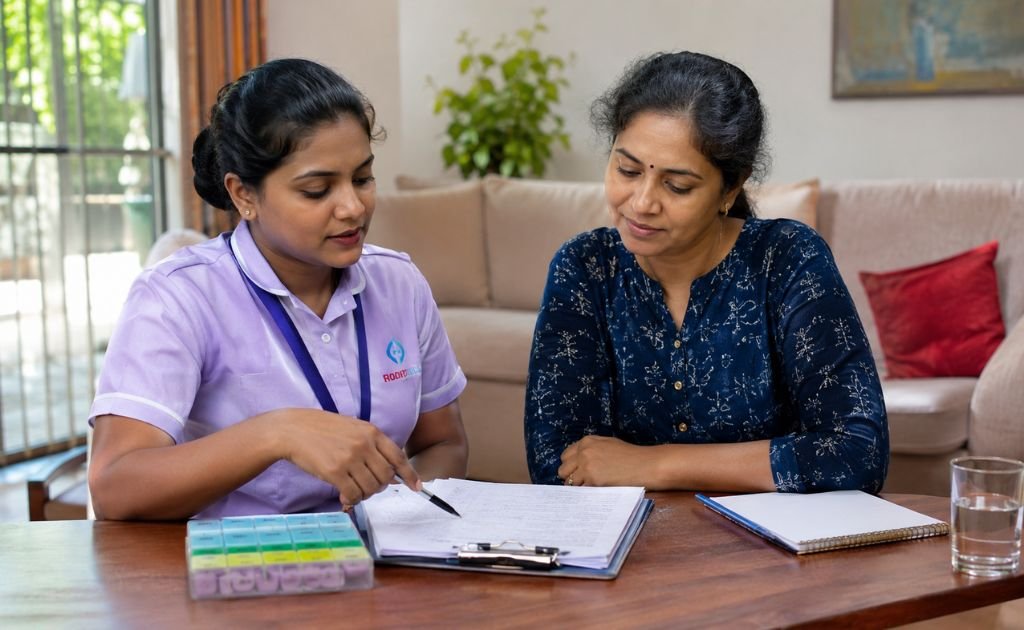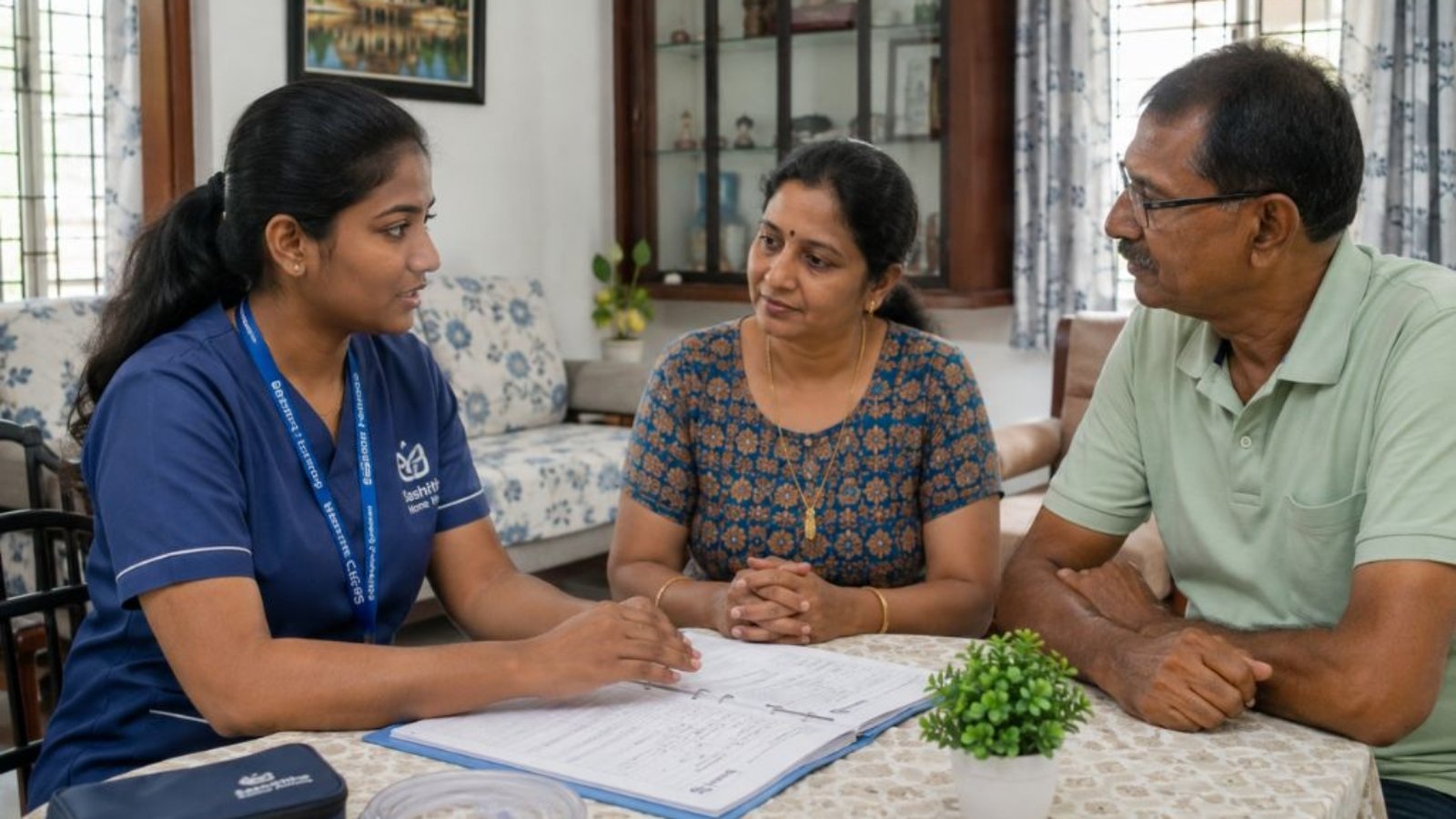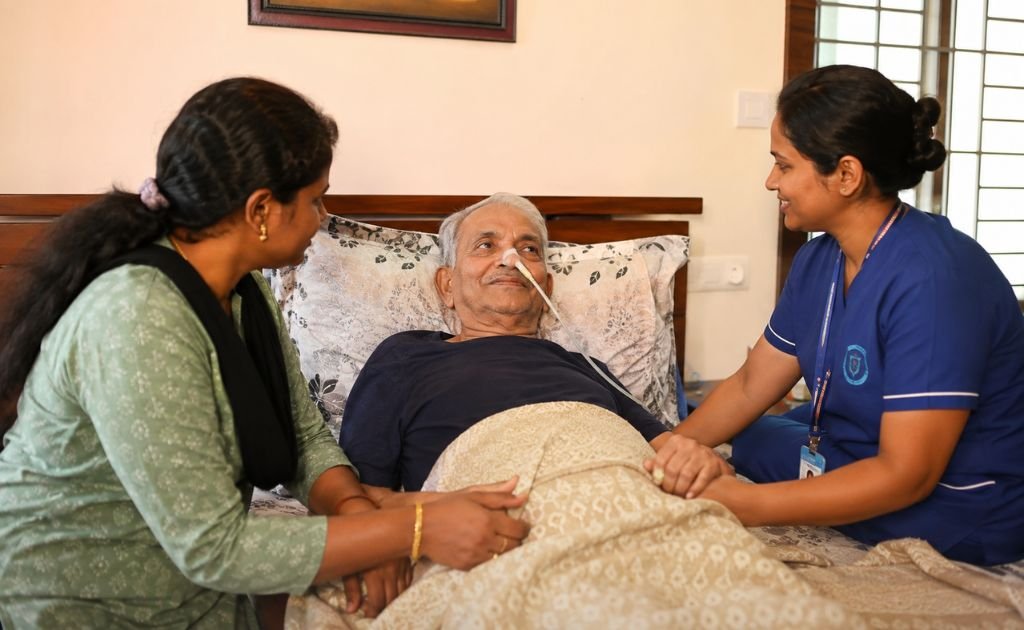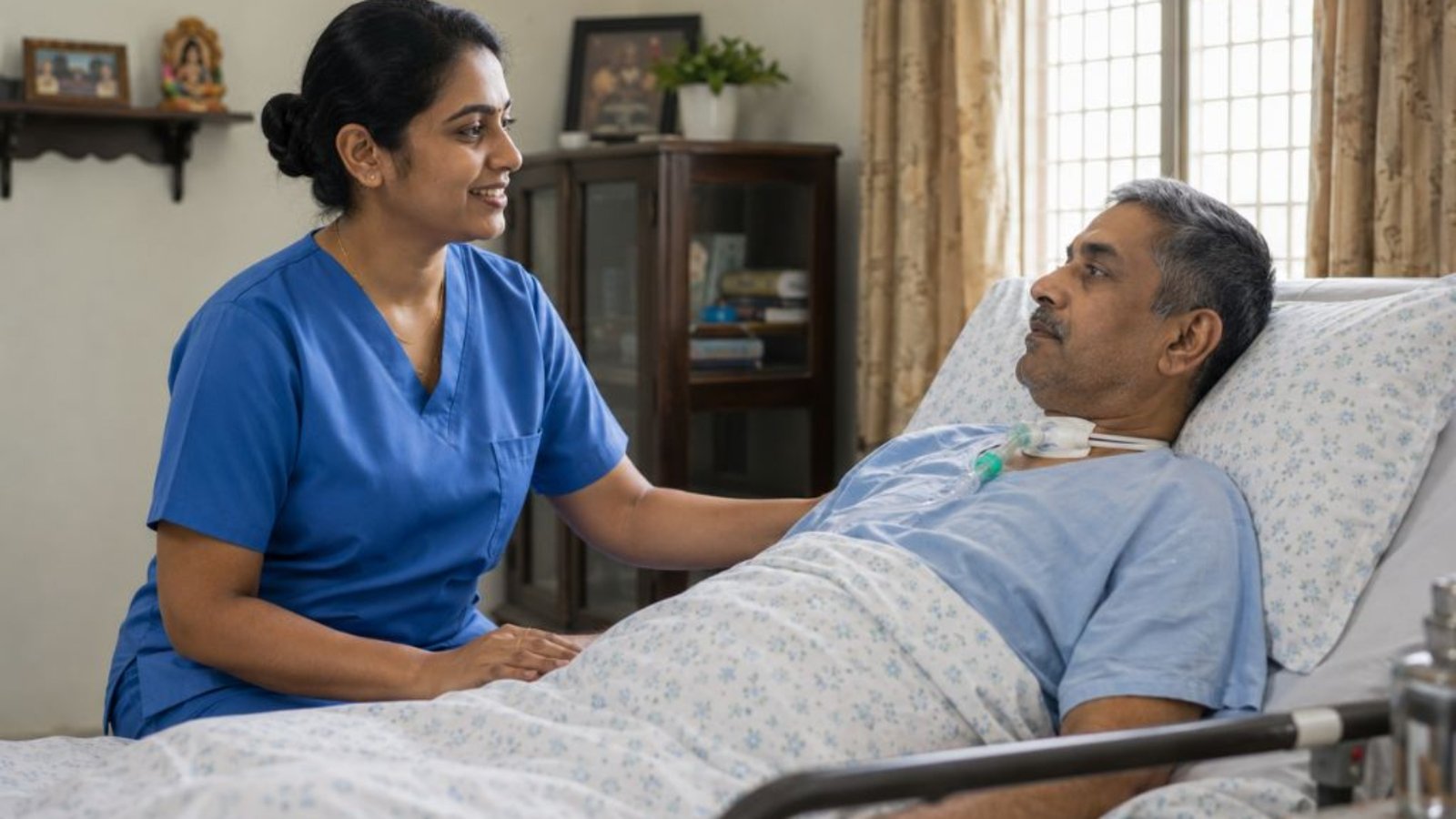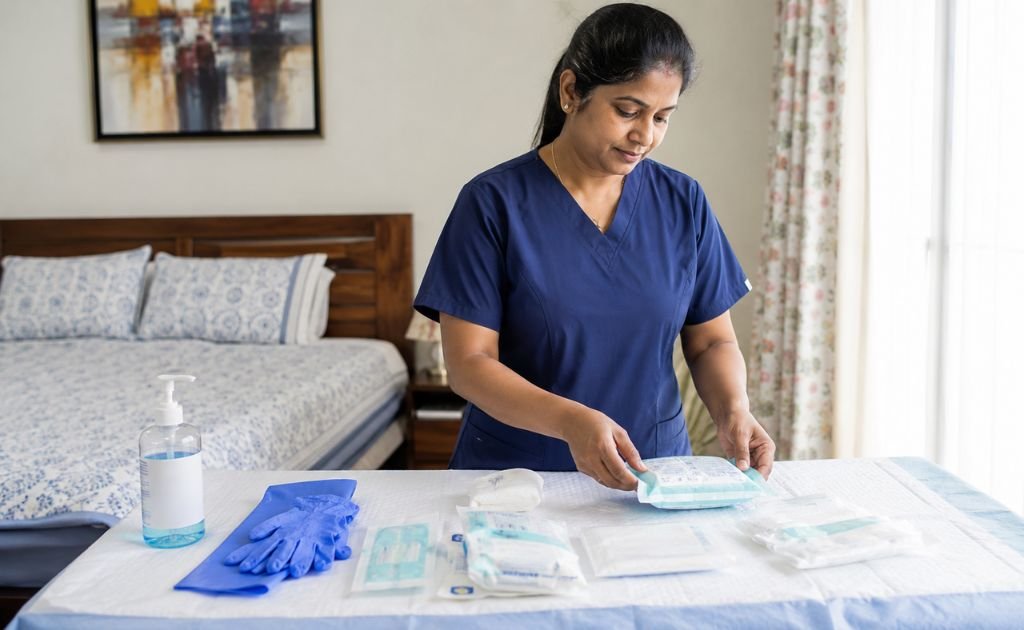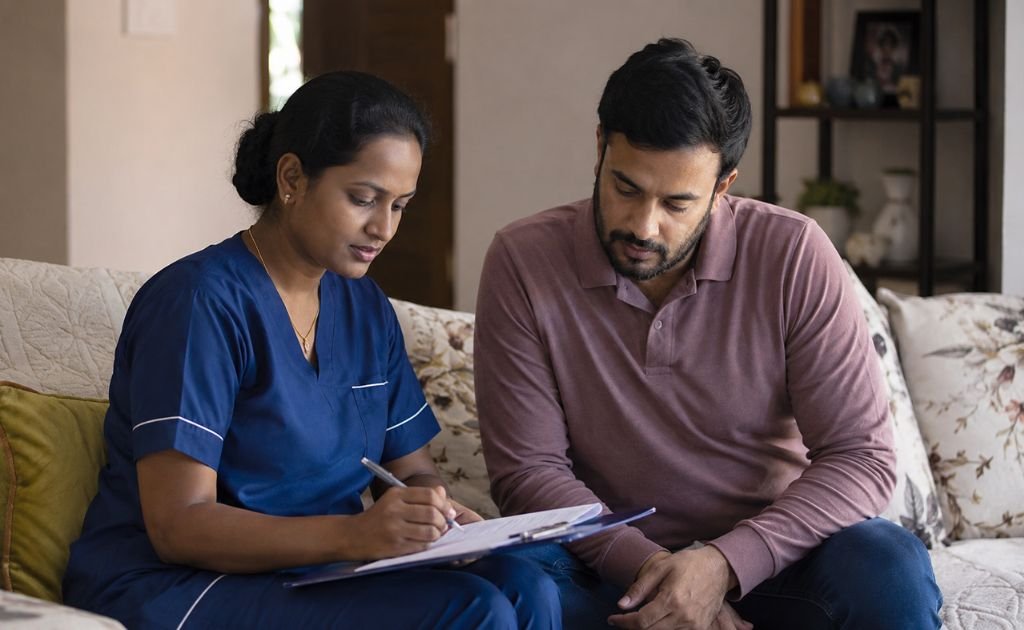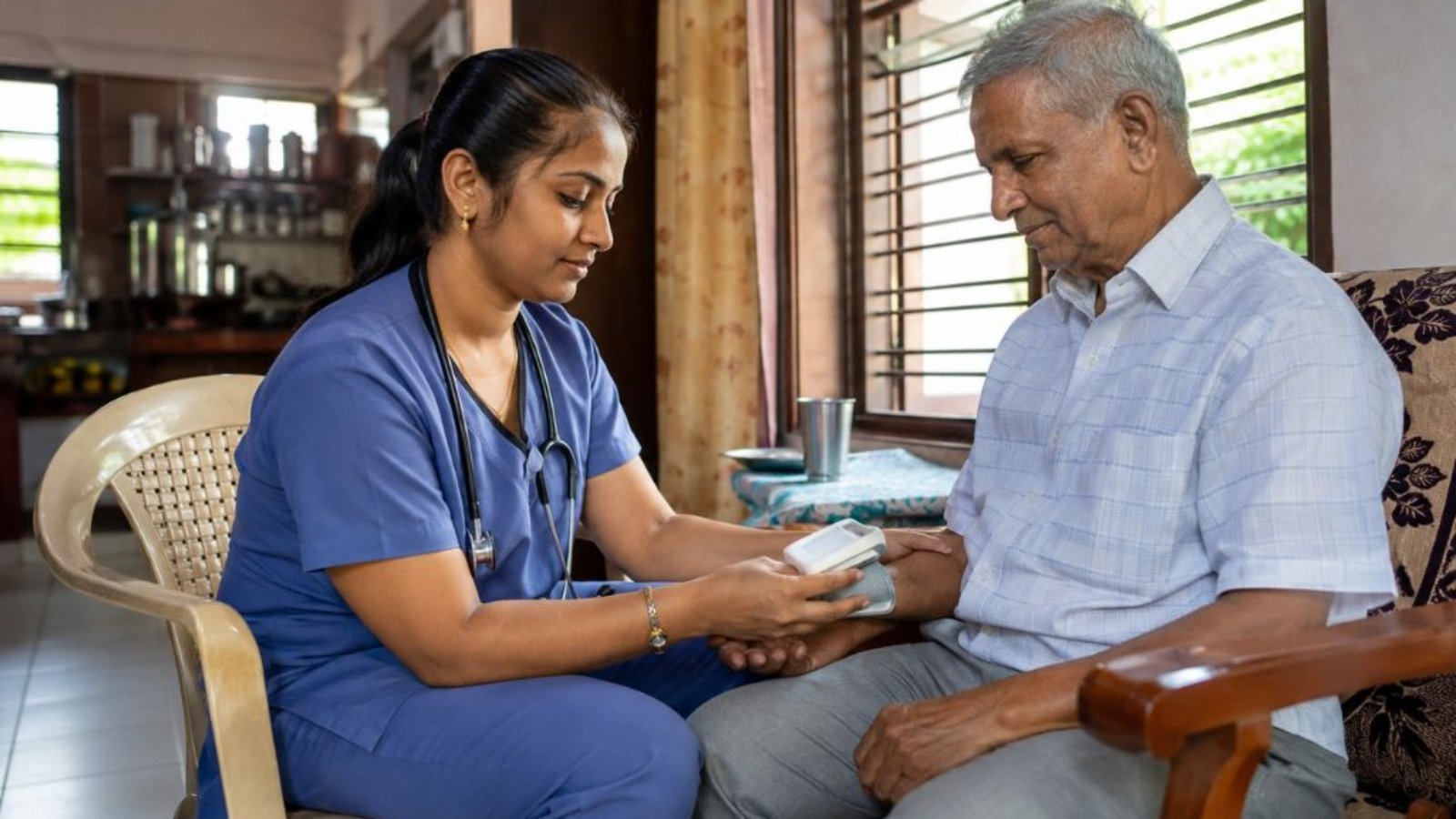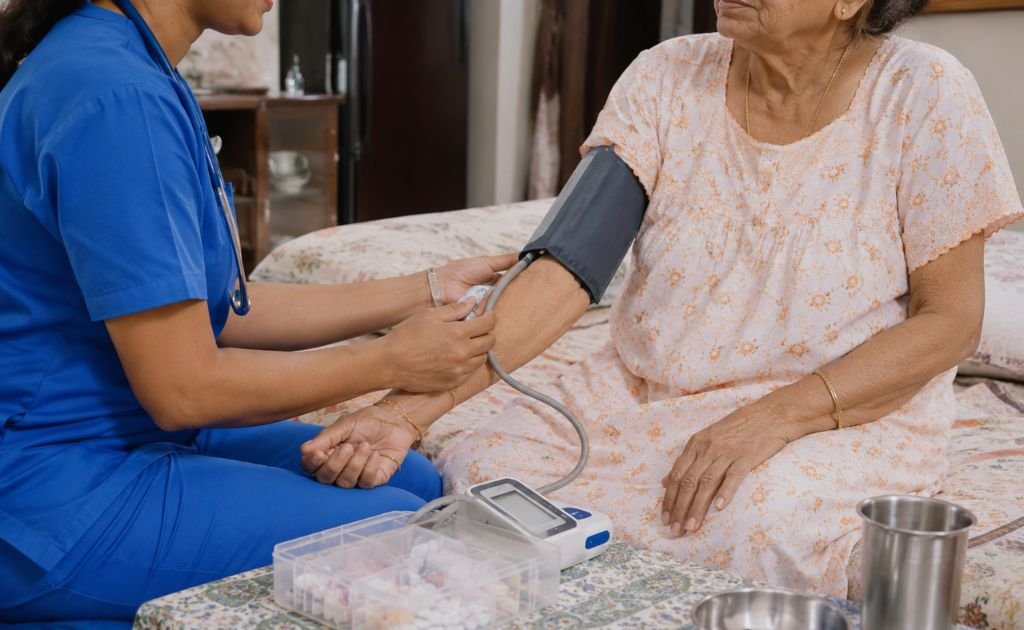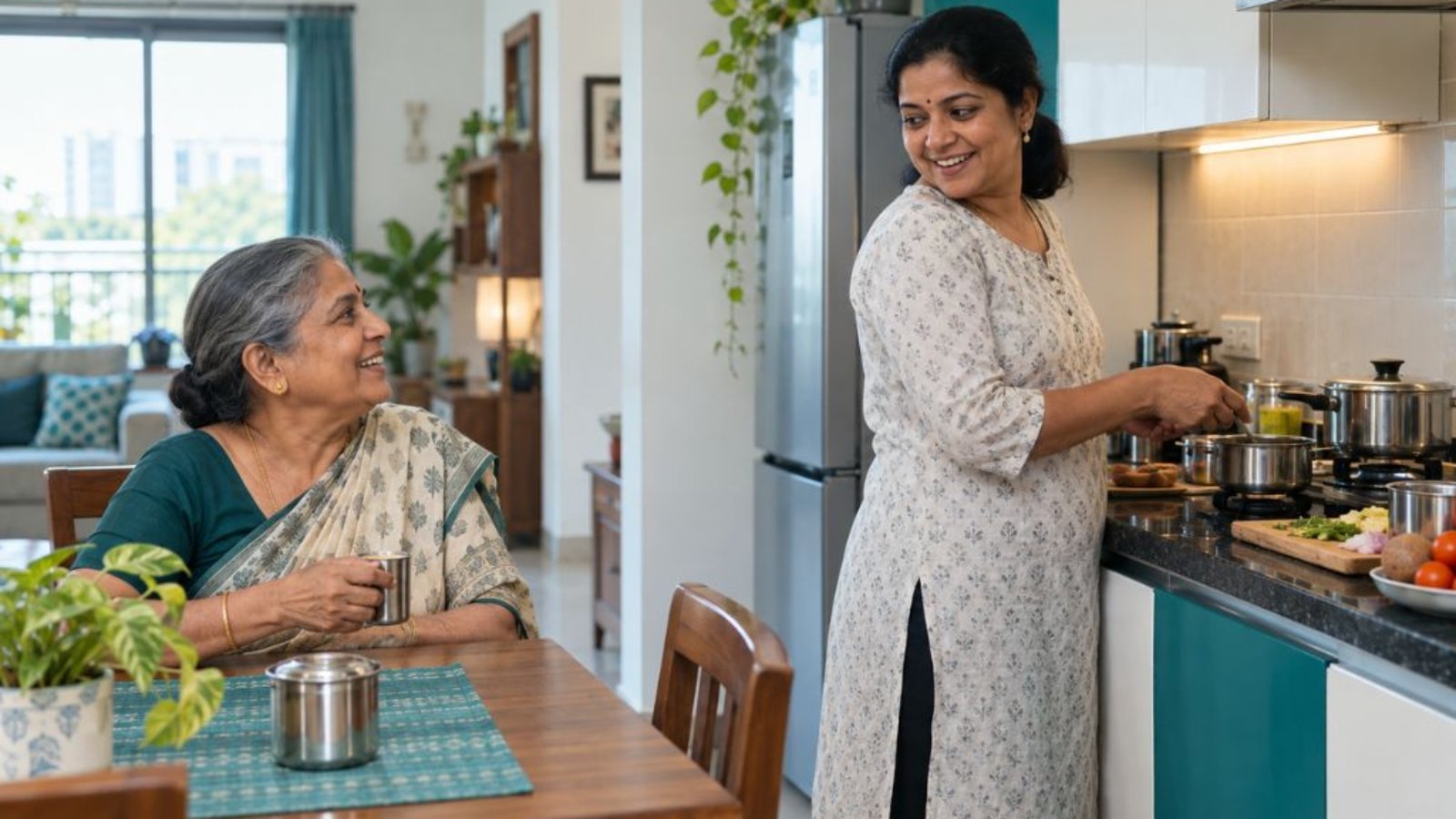
Cook and caretaker preparing a meal while an elderly woman sits at the dining table in a Chennai home

Cook and Caretaker in Chennai: Duties, Cost and How to Choose the Right Support

Picture a common Chennai household. Both adult children work. Their mother, in her late seventies, lives a few streets away in Mylapore. She manages most of the day, but lunch keeps getting skipped, the gas gets left on, and she spends long afternoons alone. The family has looked at a part-time cook and at home nursing, and neither fits. What they want is one dependable person who can prepare her meals and stay with her for part of the day.

That is the gap a cook and caretaker arrangement is meant to fill. This guide explains what the combined role involves, what it should not be expected to cover, how it differs from a caregiver or a home nurse, what shapes the cost in Chennai, and how to decide whether it is the right level of support for your family.

What is a cook and caretaker?

A cook and caretaker (you will also see “cook cum caretaker” or “caretaker cum cook” in Chennai listings) is a single home support worker who combines two jobs: preparing meals, and providing practical, non-clinical day-to-day support to a person at home, most often an older adult.

It helps to separate the three strands of the role, because families often assume all three are included:

  • Cooking responsibilities: planning and preparing everyday meals, keeping the kitchen in order, managing basic groceries.
  • Household assistance: light tasks connected to the person’s daily routine, such as tidying the dining area or keeping the person’s room in order, where this has been agreed.
  • Caretaking responsibilities: companionship, supervision, reminders, help with simple everyday activities, and keeping the family informed.

What one worker can realistically handle depends on their experience, the person’s needs and the hours involved. A cook and caretaker is not a nurse, and the caretaking side of the role is non-medical unless the worker has been specifically trained and the provider confirms it.

What does a cook and caretaker usually do?

Cook and Caretaker serving a freshly prepared lunch to an elderly man at the dining table

The table below shows what families in Chennai typically arrange. Treat it as a starting point for your own written list of duties.

AreaTypical support
CookingPreparing breakfast, lunch and dinner to the household’s taste; basic kitchen hygiene; simple grocery lists
Meal supportServing meals on time, sitting with the person while they eat, encouraging fluids, simple help with eating where appropriate
Daily routineReminders for meals, rest and routine activities; keeping the day predictable
Elder supportCompany and conversation, a watchful presence, noticing when something seems off and telling the family
Household supportLight tasks linked to the person’s care, such as washing up or keeping their room tidy, where agreed in advance
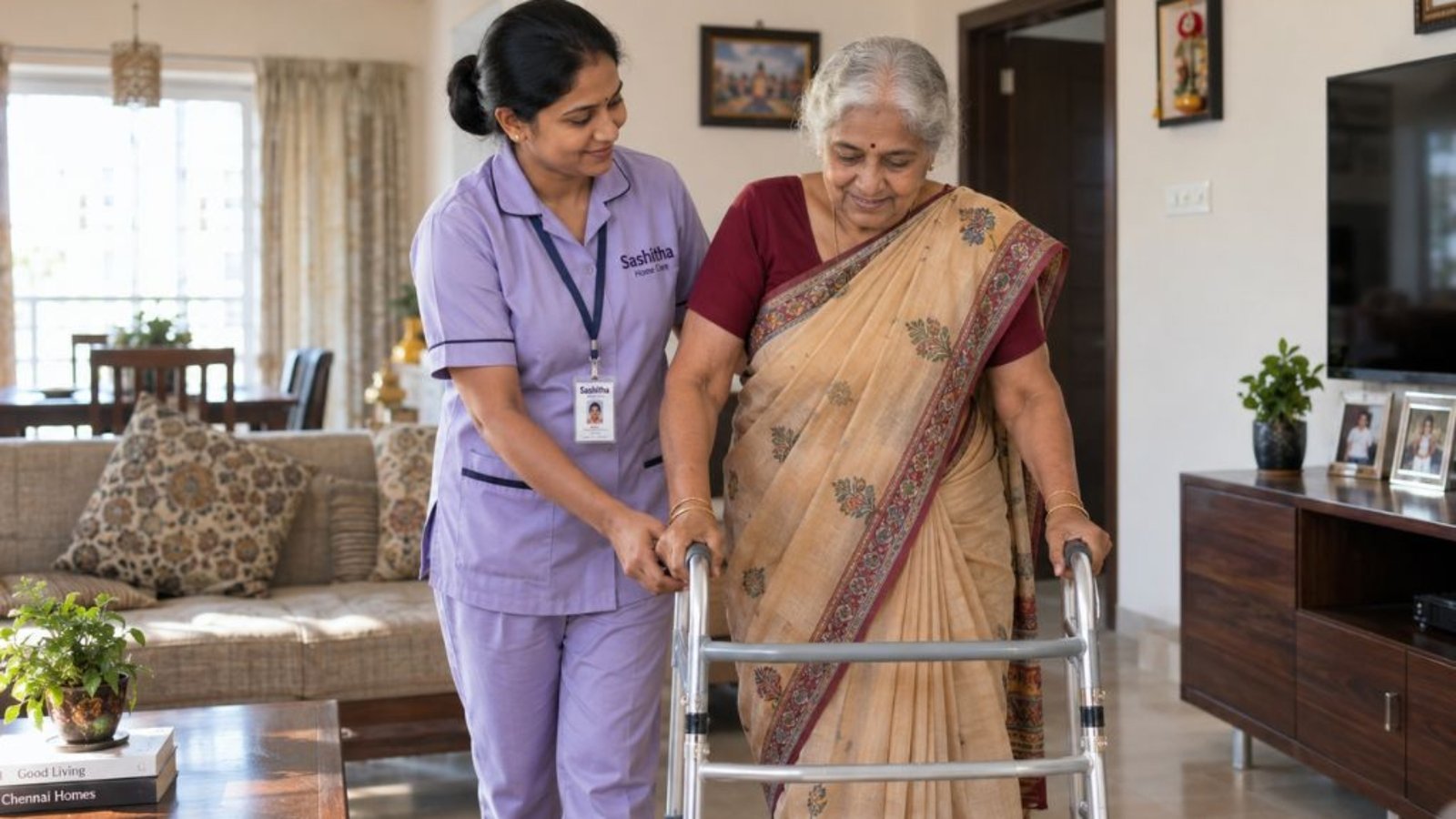
MobilityStanding by while the person walks around the home, help with getting up from a chair, only where safe and within the worker’s ability
ErrandsSmall errands such as collecting groceries or a pharmacy order, where agreed

What may be included depends on the individual worker and what you agree at the start. What should not be assumed is any of the following: bathing and toileting assistance, lifting or transferring someone who cannot bear their own weight, managing medicines beyond a simple reminder, dressing wounds, giving injections, or handling any medical equipment. If your parent needs help of that kind, you are looking at a different role, covered below.

Cook vs caretaker vs caregiver vs home nurse

This is the distinction most families get wrong at the enquiry stage.

NeedCookCook + caretakerCaregiver / home attendantHome nurse
Meal preparationYesYesSometimes, usually only for the person being cared forNo
Companionship and supervisionNoYesYesPartly, alongside clinical duties
Meal and medicine remindersNoYesYesYes
Bathing, dressing, toiletingNoNot usuallyYesYes, when part of the care plan
Safe transfers and repositioningNoNoYes, if trainedYes
Vital signs monitoringNoNoBasic, if trainedYes
Injections, wound care, catheter or feeding-tube careNoNoNoYes
Post-surgery or chronic disease nursingNoNoNoYes

Clinical tasks such as injections, wound dressing, catheter care, feeding-tube care, tracheostomy care, IV therapy or oxygen management should be handled by trained healthcare professionals. If your family member needs any of these, or their condition changes often, the right starting point is a conversation about home nursing services in Chennai rather than a domestic worker, however capable.

Between the two extremes sits the home attendant. If the main need is personal care, such as bathing, toileting, help moving around and feeding someone who cannot manage alone, a trained female attender for a patient is the more appropriate role, and cooking for the rest of the household is usually arranged separately.

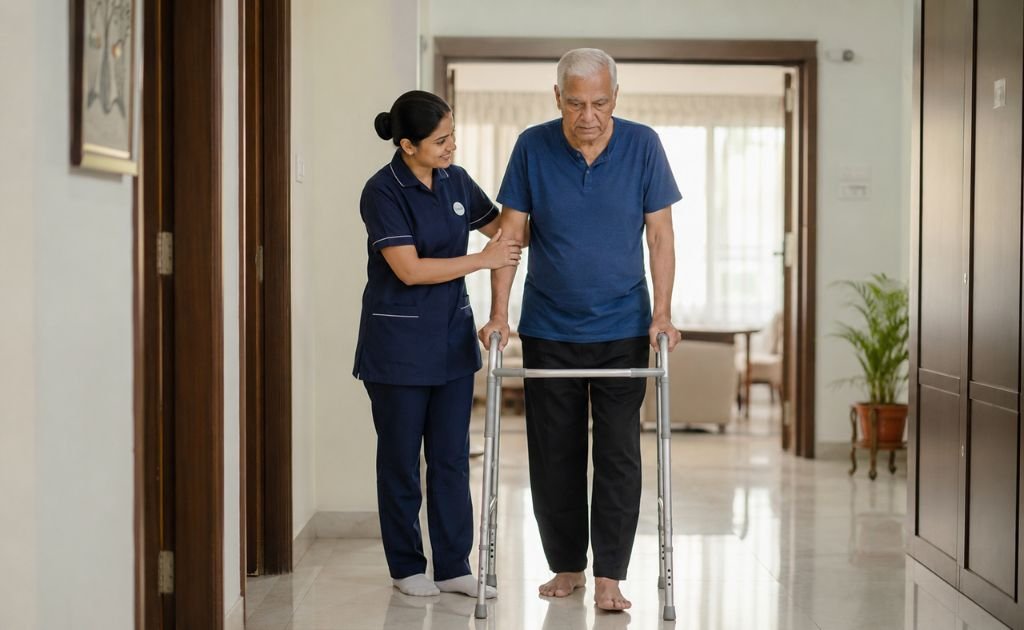
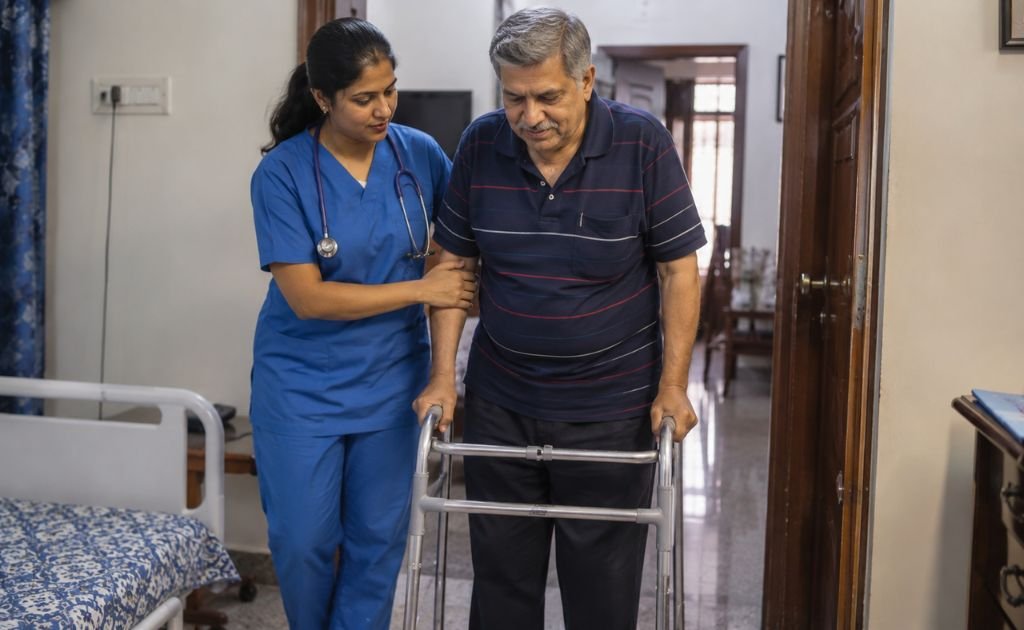
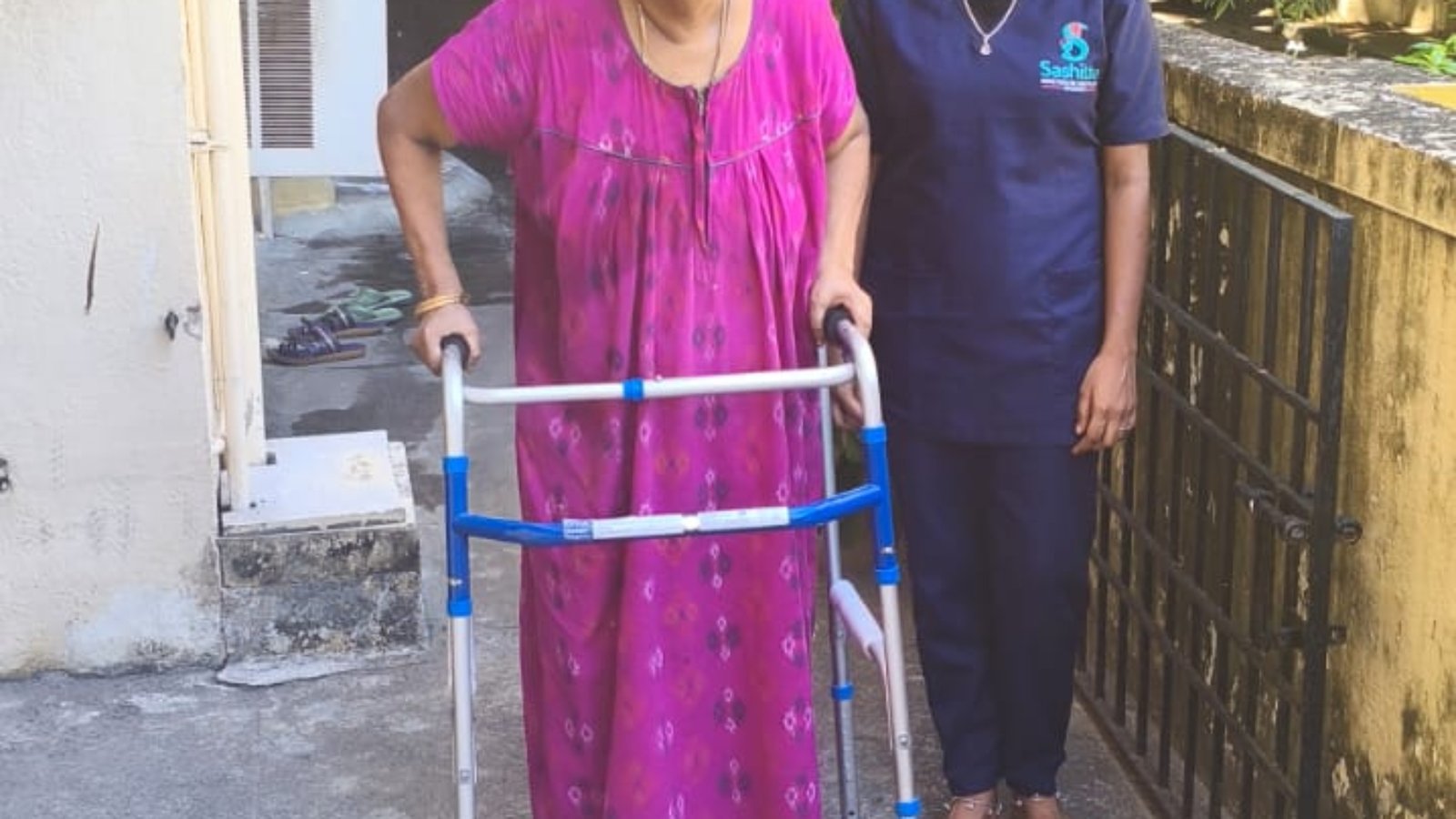
Cook cum Caretaker walking beside an elderly woman at home for daily support and company

Who benefits from a cook and caretaker?

The arrangement works best when the person is largely independent but should not be alone all day, and when meals are the thing that keeps slipping. Typical situations in Chennai households include:

  • An elderly parent living alone in Anna Nagar or Adyar, whose children are in another city and want someone present for lunch and the afternoon.
  • A senior living with a working family, fine in the evenings but unsupervised from nine to six.
  • A couple in their eighties who manage personal care themselves but find cooking three meals a day tiring or unsafe.
  • A household that already has a home nurse for a few hours of clinical care and needs someone for meals and general presence the rest of the day.

It is not the right fit for everyone. Someone with advanced dementia, a high fall risk, incontinence, a recent stroke or a condition that needs monitoring will usually need a trained attendant or nurse, at least for part of the day. Needs also change: the World Health Organization’s work on healthy ageing and long-term care describes an older person’s day-to-day ability as the product of their own capacity and the environment around them, which is why the right level of support is the one that matches the person now, not last year.

Cook and caretaker for elderly parents: what good support looks like

The difference between an adequate arrangement and a good one comes down to small, practical things.

Familiar food, on time. An older person served the rasam and vegetables they have eaten all their life, at the hour they are used to, tends to eat better. Ask the cook to follow the household’s recipes, not their own.

A steady routine. Breakfast, a mid-morning drink, lunch, rest, an evening snack. Predictability reduces anxiety and helps with appetite.

Real company, not background presence. A caretaker who sits for ten minutes over coffee or walks with them to the balcony is doing part of the job. Long stretches of silence in another room are not.

Noticing and reporting. Skipped meals, unusual drowsiness, a change in walking, a fall that “was nothing”. The caretaker should tell the family the same day. What to do about it is for the family and the treating doctor to decide.

Supporting independence. Let the person do what they can safely do themselves, including small kitchen tasks if they enjoy them.

What a cook and caretaker should not be asked to do is decide medicine doses, interpret symptoms or manage a condition. Keep those with the doctor.

Live-in, full-time or part-time: which arrangement fits?

Part-time. A few hours a day, often late morning to mid-afternoon. Suits families who mainly need lunch prepared and company during the hours everyone is out.

Full-time. A 10 to 12-hour day. Suits households where the person needs a steady presence through the whole working day, with three meals and a settled routine.

Live-in or 24-hour. Consider this only if nights are a real concern, for example if the person wakes and wanders, or lives entirely alone. Many Chennai listings advertise a “live-in cook cum caretaker”, but one person cannot stay alert around the clock. If night supervision is a genuine need, a provider will normally structure it as shifts, and if the night need is medical it moves into nursing territory.

The right schedule depends on the person’s needs, the household routine, how many people the cook is feeding, mobility, how much supervision is needed, whether nights matter, and whether nursing care is arranged separately. It is fine to start part-time and extend.

How much does a cook and caretaker cost in Chennai?

There is no reliable single “Chennai rate” for this role. Most numbers online come from individual job advertisements on classifieds and job portals, where a family sets whatever salary it chooses, or from directories that mix cooks, maids and caretakers together. None of those is a market benchmark, and a professional home-care provider prices differently from a direct domestic hire.

What genuinely moves the cost:

  • Hours per day and whether the arrangement is part-time, full-time or 24-hour.
  • How much cooking is involved: one elderly person’s meals is very different from a family of six.
  • Level of daily support: company and reminders cost less than help with mobility or eating.
  • Experience and training, especially in elder care or safe handling.
  • Location within Chennai and the worker’s travel time.
  • Weekends, festivals, holidays and night cover.
  • Replacement and backup: an agency that sends a substitute when the regular person is unwell charges more than a direct hire, and that is usually worth paying for.
  • Whether nursing support is also needed, which is priced separately.

Ask any provider for a written quote that states hours, duties, days off, replacement terms and what is excluded. If you want a sense of how attendant and nursing costs are structured, the site’s guide on how to choose the right elderly care service covers the price bands for those roles and what changes them.

How to choose a cook and caretaker in Chennai: a practical checklist

Before you speak to an agency or a candidate, write down the answers to the following. It takes twenty minutes and prevents most later problems.

About the person

  • What can they do independently, and where do they struggle: walking, stairs, bathing, eating, remembering?
  • What is their daily routine, and which parts must not change?
  • Food: vegetarian or non-vegetarian, regional style, doctor-advised restrictions such as low salt or low sugar.
  • Language: Tamil, Telugu, Hindi, English? A caretaker who cannot chat with your mother is only half useful.

About the role

  • Exact hours and days, including Sundays and festivals.
  • A written list of cooking, caretaking and household duties, with a clear line under what is not included.
  • Who the caretaker calls first in an emergency. Put the treating doctor’s number and the nearest hospital on the fridge.
  • How the caretaker updates you: a daily message, a fixed-time call, a notebook in the kitchen.

About the worker or provider

  • Experience with elderly people specifically, not only cooking.
  • References you can call, and identity and address verification. Ask a provider what checks it actually carries out rather than accepting a general “verified” label.
  • Any training relevant to the duties you need, and who confirms it.
  • What happens when the caretaker is sick or on leave, and how quickly a replacement arrives.
  • Trial period and notice terms.

The boundary that matters most

  • Confirm, in writing, that the role is non-medical support and that any nursing need will be arranged separately. This protects the worker as much as your family.

A note on food safety in the kitchen

Because the role centres on cooking for someone more vulnerable to stomach infections, the basics matter more than usual. The World Health Organization sums them up as five keys to safer food: keep hands, surfaces and utensils clean; keep raw and cooked food separate; cook thoroughly; keep food at safe temperatures, which in a Chennai kitchen means refrigerating leftovers promptly and reheating them properly; and use safe water and fresh ingredients. A caretaker who does this without being reminded is worth keeping.

Cook and caretaker support in Mylapore, Anna Nagar and across Chennai

Families looking for a cook and caretaker in Mylapore or Anna Nagar are usually in one of two situations: an elderly parent living alone in the family home, or a working couple with a senior at home during the day. What changes by area is practical: the worker’s travel time, whether relatives or neighbours are close enough to be a backup, and which hospital is nearest for the emergency plan.

Sashitha Home Health Care is based in Mylapore and provides home care across Chennai, including Anna Nagar, T Nagar, RA Puram, Besant Nagar, Vadapalani, Ramapuram, Ashok Nagar and Perungudi. Its core services are elder care, geriatric care, home nursing and caretaker and attender support. Its caretakers and attenders focus on personal care and daily support rather than cooking for the household, so if you need meal preparation included, say so at the enquiry stage and the team can tell you what can be arranged and what should be handled separately.

If you are not sure which role you need, start there. Sashitha will help you work out whether a caretaker, an attendant, broader elderly care services in Chennai, or structured geriatric care at home for an older adult with ongoing conditions is the right fit, before you commit to anything.

Frequently asked questions

What does a cook and caretaker do?

They prepare the household’s or the elderly person’s meals and provide non-medical day-to-day support: company, supervision, reminders, help with simple activities and keeping the family informed. Exact duties should be agreed in writing before they start.

Is a cook and caretaker the same as a caregiver?

No. A caregiver or home attendant is trained for personal care such as bathing, toileting and helping someone move safely, and does not usually cook for the household. A cook and caretaker is primarily a cooking and companionship role.

Can a cook and caretaker look after an elderly person?

Yes, if the person is largely independent and mainly needs meals, company and a watchful presence. If they need help with personal care, mobility or a medical condition, a trained attendant or home nurse is the safer choice.

Is a cook and caretaker the same as a home nurse?

No. A home nurse is a qualified healthcare professional who can manage wounds, injections, catheters, feeding tubes and post-surgery care. A cook and caretaker should never be expected to perform clinical tasks.

How much does a cook and caretaker cost in Chennai?

It depends on hours, the amount of cooking, the level of support, experience, location and whether backup cover is included. Salaries quoted on job portals are set by individual families and are not a reliable benchmark, so ask for a written quote that lists exactly what is included.

Can I get a part-time cook and caretaker in Chennai?

Yes. Part-time arrangements, usually covering lunch and the afternoon, are common in Chennai and are a sensible way to start before extending to full-time if needed.

When does an elderly person need a home nurse instead?

When there are clinical needs: wound care, injections, catheter or tube care, monitoring after surgery or a stroke, or a condition that changes quickly. Confirm with the treating doctor if you are unsure.

Getting the right help in place

Most families searching for a cook and caretaker are really after peace of mind: someone in the house at lunchtime, a parent who is eating properly, and a phone call if something is wrong. Define the duties clearly, be honest about what the person needs, keep clinical care with clinical staff, and the arrangement can run smoothly for years.

If you would like help working out which level of support fits your family, talk to the Sashitha team.
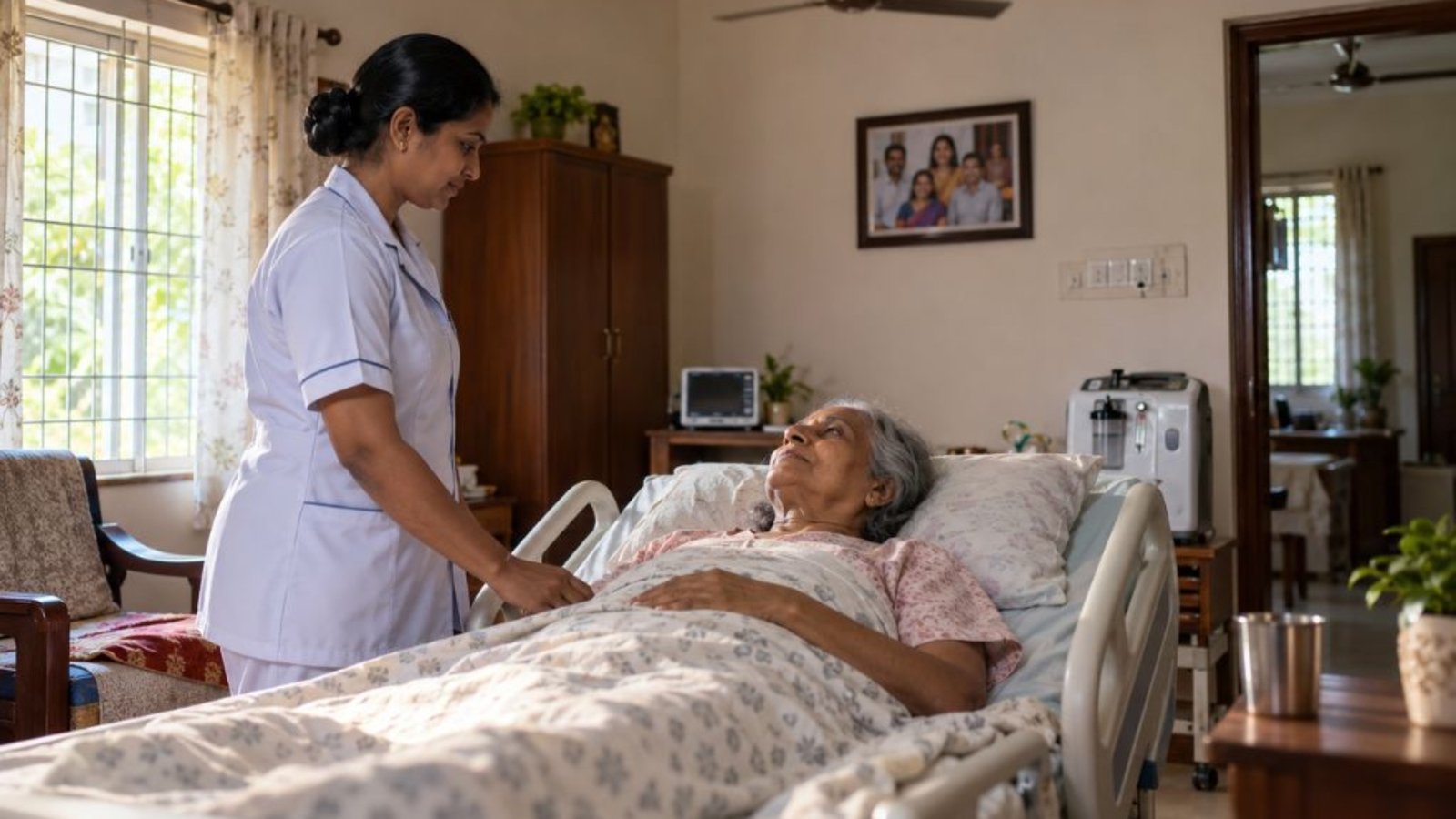
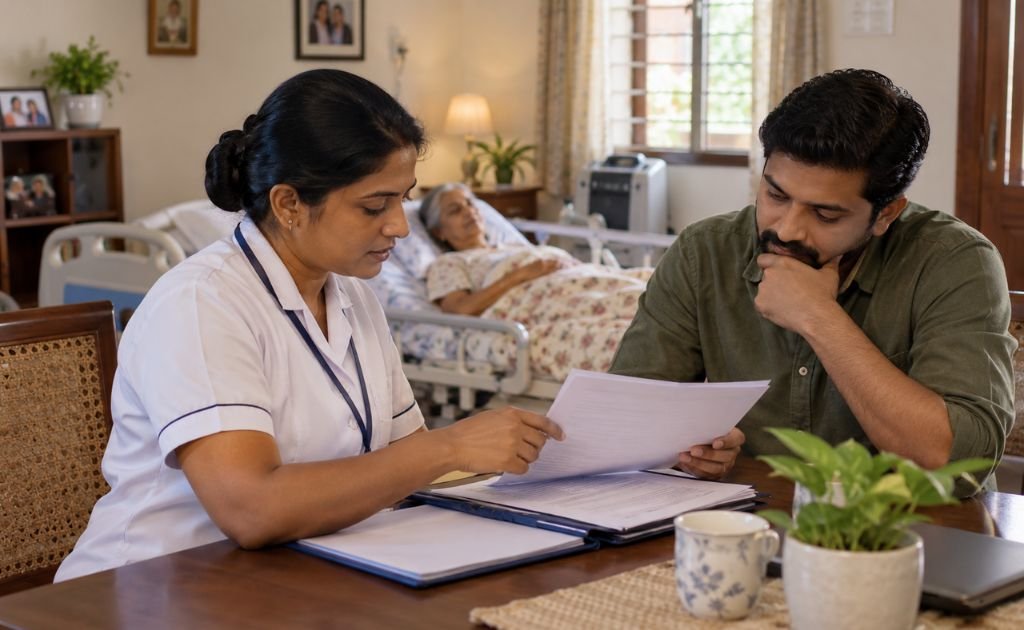
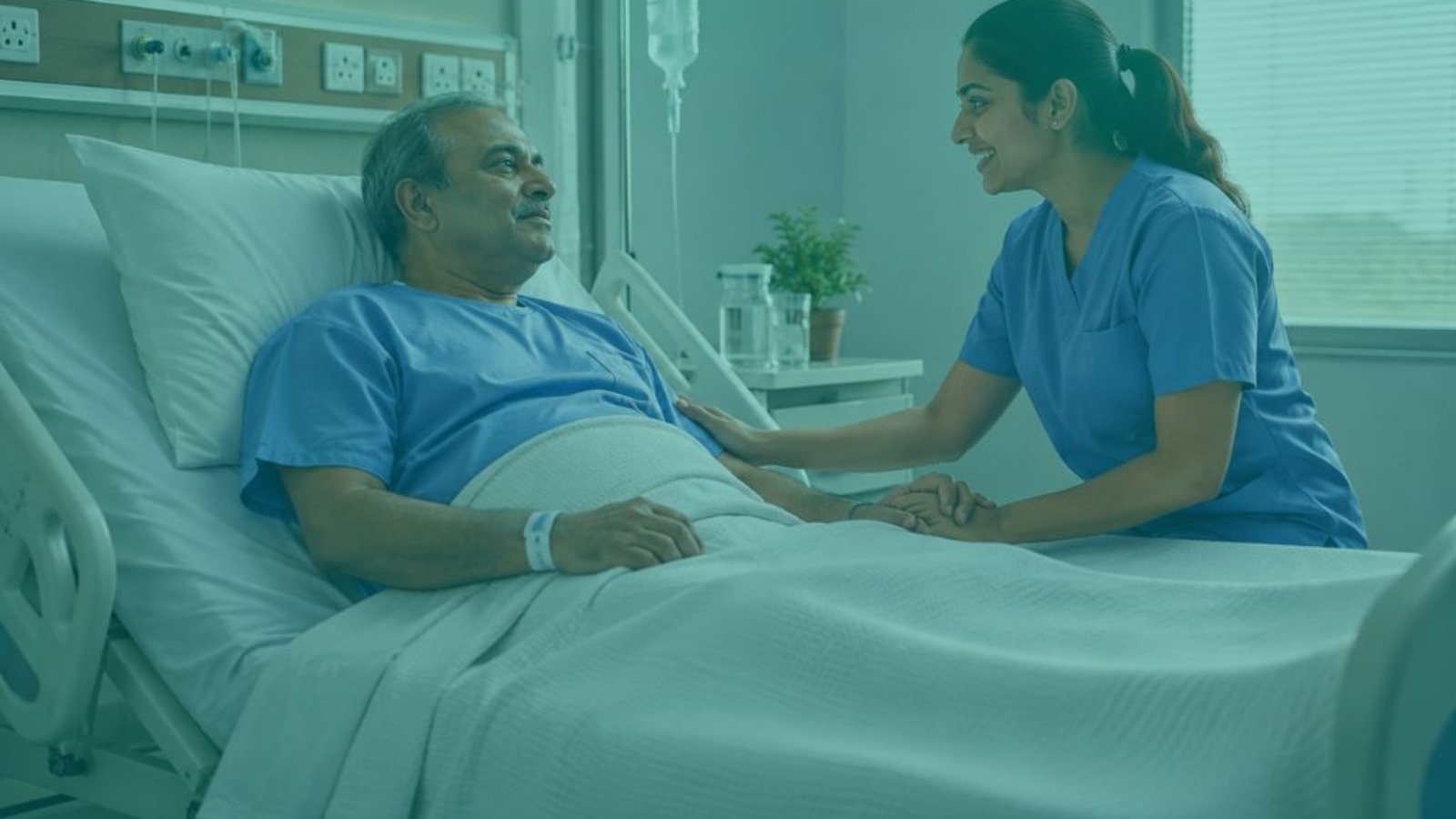
Nurse caring for an elderly patient in a home hospital bed in a Chennai home, with oxygen and monitoring equipment in the background

Critical Care at Home in Chennai: Is It Right for Your Patient, and What Does It Involve?

The conversation usually starts in a hospital corridor. The doctor says the worst is over, the patient no longer needs everything an ICU offers, and the family could think about taking them home with proper nursing support. Relief comes first. Then the questions: Can we really manage this at home? What would “proper support” mean? Who watches them at night? What if something goes wrong?

Critical care at home is the arrangement families in Chennai are usually looking at in that moment. It means providing a higher level of nursing, monitoring and equipment at home than routine home nursing offers, for a patient who is clinically stable enough to leave the hospital but still medically complex. It may be appropriate for selected patients, after assessment by the treating team. It is not appropriate for everyone, and it is not a hospital ICU relocated to a bedroom.

This guide explains what critical care at home actually involves, who it may suit, when a patient should remain in hospital, how post-ICU step-down care works, what drives the cost in Chennai, and how a family can evaluate a provider before agreeing to anything.

What is critical care at home?

Critical care at home is intensive, structured nursing and monitoring delivered in the patient’s own home for someone who is medically stable but still dependent on skilled care. Typical features include:

  • A nurse with critical-care or ICU experience, usually on 12-hour or 24-hour cover rather than short visits
  • Closer, more structured observation of the patient’s condition than ordinary home nursing
  • Medical equipment matched to the patient’s needs, which can range from a hospital bed and pulse oximeter to oxygen support or, for a small number of patients, ventilatory support
  • A written care plan from the treating doctor, and a clear route back to that doctor or to a hospital if the patient’s condition changes

The word “critical” refers to the complexity of the patient’s needs, not to an emergency in progress. A patient who is actively unstable belongs in a hospital. Critical care at home is for the stage after stabilisation, when the main requirements are skilled nursing, monitoring, equipment and continuity.

How is critical care at home different from regular home nursing?

Families often hear “home nurse”, “attender”, “caretaker” and “ICU nurse” used interchangeably by agencies, relatives and even hospital staff. They are not the same thing, and the difference matters when a medically complex patient is involved.

Caregiver vs home nurse vs critical care at home

FeatureCaregiver / attendantHome nursingCritical care at home
Personal care (bathing, feeding, hygiene)Yes, depending on roleYesYes, as appropriate
Clinical nursing (injections, IV lines, wound care, tubes)NoYesHigher-complexity nursing where required
Patient monitoringBasic observationAs clinically requiredCloser, more structured monitoring
Medical equipmentLimited, condition-dependentCondition-dependentPotentially advanced
Patient complexityGenerally lowerModerate / variedHigher
Medical supervisionNot necessarilyAs requiredMore structured, closely coordinated with the treating doctor

Treat this table as a way of thinking, not a rulebook. There is no single legal definition of “critical care at home” in India, and the actual scope depends on the patient’s condition, the provider’s care model and the healthcare professionals involved. What it should help you avoid is the most common mistake: hiring an attendant or a general home nurse for a patient who actually needs intensive nursing care at home with someone experienced in reading early signs of deterioration.

Who may be suitable for critical care at home?

Suitability is a clinical decision made by the treating team, and it rests on one thing above all: stability. Broadly, the patients for whom home critical care may be considered include:

  • People completing the acute phase of a serious illness who still need skilled nursing and close observation, often described as post-ICU or step-down care
  • Patients recovering from major surgery who need more than routine wound care and mobilisation
  • Patients who are stable on oxygen support, or in selected cases on non-invasive or long-term ventilatory support, whose treatment is not expected to change frequently
  • Long-term bedridden patients with tracheostomy, feeding tube or catheter needs that require nursing rather than a hospital bed
  • People with advanced or life-limiting illness whose treating team has agreed a comfort-focused plan that can be delivered at home

These are categories, not a checklist. Two patients with the same diagnosis can need completely different setups. The questions that matter are whether the patient’s condition is predictable, whether the required nursing skill is available, whether the home can safely hold the equipment, and whether there is an agreed plan for what happens if things change.

When should the patient stay in hospital?

An honest provider will tell you when home care is not the right option. Hospital or ICU care usually remains necessary when a patient:

  • Is still being actively stabilised, or has a condition that is changing quickly
  • Needs treatments that are being adjusted frequently and require an intensivist’s presence
  • Requires interventions or procedures that cannot be performed at home
  • Needs immediate access to advanced diagnostics, imaging or specialist teams
  • Depends on multiple life-support systems at once
  • Would be going home to a setting without a reliable caregiver, adequate space, hygiene or emergency access

None of these is a rule you should apply on your own. The treating doctor determines suitability. If the hospital team is hesitant about discharge, that hesitation is information, not an obstacle to negotiate around.

What does critical care at home involve day to day?

The daily shape of care depends on the patient, but most home critical care arrangements in Chennai are built from the same components.

Nursing and monitoring

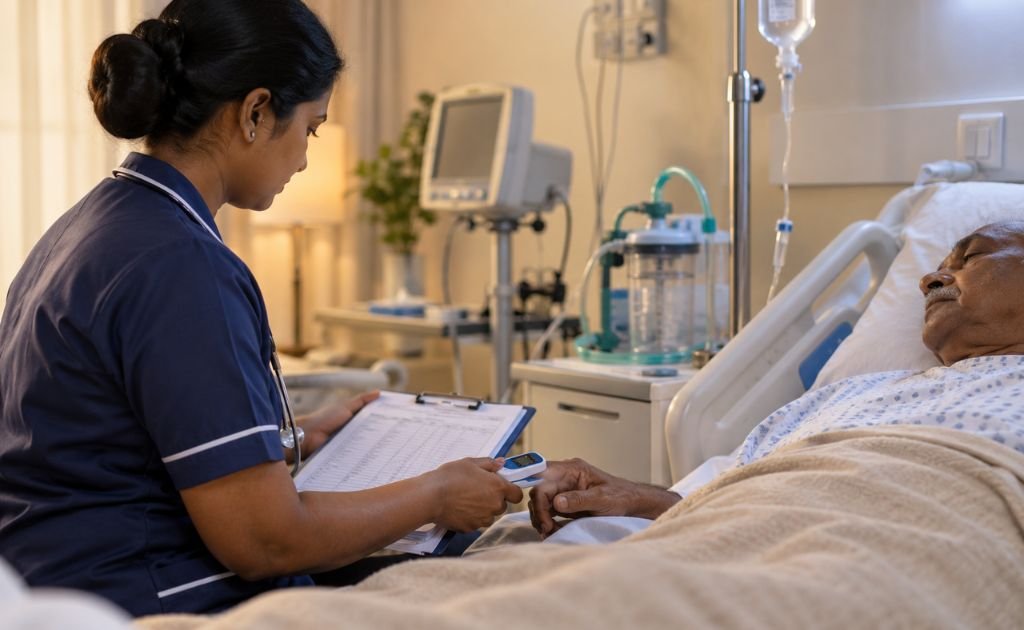
The core of the arrangement is a critical care nurse at home, present for the agreed shift pattern, who follows the care plan, checks and records vital signs, watches oxygen levels, manages medicines as prescribed by the doctor, and, most importantly, recognises early changes and knows who to call. Patient monitoring at home is about clinical observation and documentation, not just a screen with numbers on it. The frequency and type of monitoring are set by the treating team, not by the agency.

Breathing, feeding and skin care

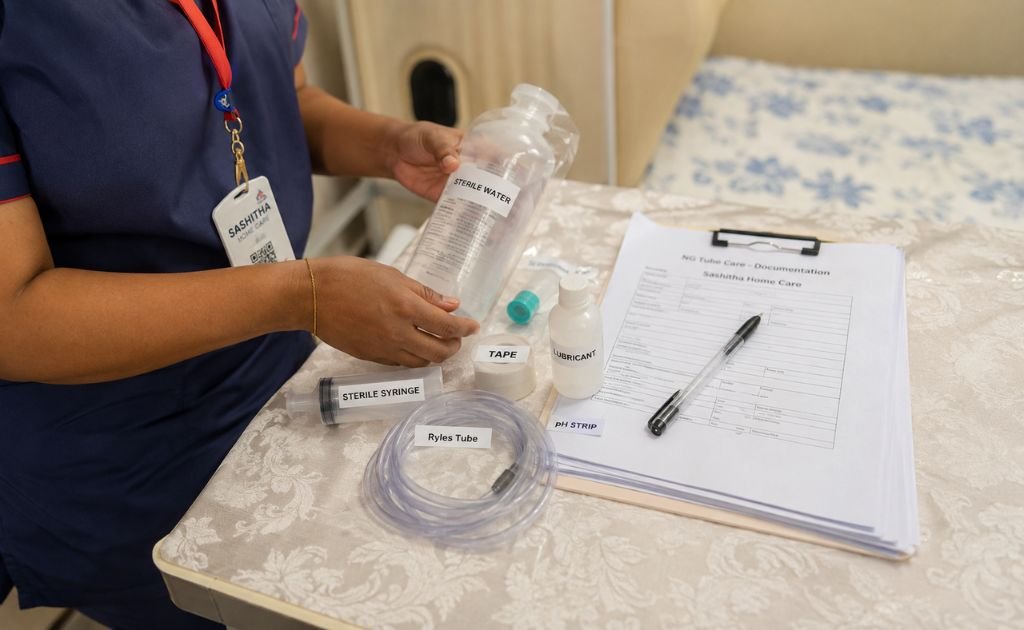
Depending on the patient, this can include oxygen support, care of a tracheostomy tube and suctioning, support for a patient on non-invasive or home ventilation under the doctor’s plan, tube feeding through a Ryles (nasogastric) or PEG tube, catheter care, wound dressing, and regular repositioning with skin checks, at the interval the nursing plan specifies, to prevent pressure sores. Families with a tracheostomy patient will find a fuller picture in Sashitha’s guide to home care for tracheostomy patients, which covers suctioning, warning signs and the ventilator-dependent situation in detail.

Rehabilitation and daily needs

Once the patient is settled, physiotherapy, gentle mobilisation, hygiene, nutrition and sleep become the work of recovery. Many people who have been through intensive care experience weakness, confusion or low mood afterwards, something clinicians describe as post-intensive care syndrome; the Society of Critical Care Medicine’s overview of post-intensive care syndrome is a useful read for families who want to understand what recovery can look like.

Critical care nurse checking a patient's oxygen saturation with a pulse oximeter at home while recording observations

What equipment may be needed?

Equipment is decided by the patient’s medical needs and the treating doctor’s discharge plan, not by what a provider has in stock. Examples that families in Chennai commonly encounter include:

  • Hospital bed with adjustable back-rest and side rails, often with an air mattress for pressure-sore prevention
  • Oxygen equipment such as a concentrator, with a cylinder as backup during power cuts
  • Pulse oximeter for oxygen saturation and pulse
  • Patient monitor for patients whose doctor wants more continuous observation
  • Suction apparatus for patients who cannot clear their own secretions
  • Infusion equipment where IV medicines or fluids are part of the plan
  • BiPAP/CPAP or ventilator only for patients whose treating team has specifically planned home ventilatory support

Not every patient needs most of this, and no patient should have equipment prescribed by an agency. Ask the hospital for a written equipment list before discharge, and clarify who supplies, installs, maintains and removes each item. Sashitha offers medical equipment for rent in Chennai on daily, weekly and monthly plans; confirm availability of the specific items on your list when you enquire.

Who may be part of the care team?

The exact team varies with the patient and the care model. Roles that may be involved include:

  • Treating doctor or intensivist at the hospital, who sets the care plan and remains the reference point for clinical decisions
  • Critical care nurse with ICU experience, for patients who need higher-complexity nursing and closer monitoring
  • Home nurse for patients whose needs have reduced, or to share a 24-hour rota
  • Visiting physician for periodic review at home where the treating team agrees; Sashitha arranges doctor home visits in Chennai across several specialities
  • Physiotherapist for chest physiotherapy, mobilisation and rehabilitation
  • Respiratory specialist or technician where oxygen or ventilatory equipment is involved
  • Family caregiver, who is part of the team whether or not anyone says so

Do not assume a provider supplies all of these automatically. Ask who exactly will be at the bedside, who supervises them, and who speaks to the hospital doctor when a question arises.

Post-ICU and step-down care at home

“Step-down” is the stage between intensive care and independence. In a hospital it might happen in a high-dependency ward. Increasingly in Chennai, when the treating team agrees, it happens at home. Post ICU care at home works best when it is planned as a transition rather than treated as a discharge.

Before leaving the hospital

  • Medical assessment: the treating team confirms the patient is stable enough for home care and documents what could change that
  • Discharge planning: a discharge summary, current medication list, and clear follow-up appointments
  • Nursing requirement: what level of nurse, how many hours, and for roughly how long
  • Equipment requirement: the written list described above
  • Home planning: which room, power backup, access for a stretcher or wheelchair
  • Emergency contacts: the hospital’s number, the treating doctor’s contact route, and the nearest emergency department

The World Health Organization treats the move between care settings as one of the riskiest moments in a patient’s journey; its technical series on transitions of care explains why communication and handover failures at discharge cause so much avoidable harm. The practical lesson for families is simple: get everything in writing, and make sure the home nursing team sees it before the patient arrives.

The first days at home

The first 48 to 72 hours are when most problems surface, usually because something in the handover was missed. A good transition includes the equipment being installed and tested before the patient arrives, a formal handover between the hospital nurses and the home nursing team, the care plan being walked through with the family, and someone confirming that every medicine in the house matches the discharge summary.

Ongoing care and reassessment

From there, care settles into observation, nursing support, communication with the treating team and periodic reassessment. Needs change in both directions. Some patients improve and can move from critical care nursing to a general home nurse or a trained attendant, which reduces cost. Others need the plan revisited. The provider should be able to tell you, without being asked, when either of these is happening.

How to prepare the home before discharge

A short checklist families in Chennai can work through in the days before discharge:

  1. Choose a room close to a bathroom, with space to move around the bed on both sides
  2. Arrange power backup (inverter or UPS) for oxygen and monitoring equipment; confirm how long it lasts
  3. Have the equipment delivered, installed and tested before the patient comes home
  4. Keep the discharge summary, medication list and doctor’s contact details in one folder by the bed
  5. Save the hospital emergency number and the nearest emergency department’s address; check ambulance access to your building, including lifts
  6. Agree a nursing shift pattern (12-hour or 24-hour) and confirm who covers the nurse’s off-days
  7. Decide which family member is the single point of contact for the nursing team
  8. Stock the first week’s consumables (gloves, dressings, suction catheters, feeds) as advised by the hospital
  9. Remove loose rugs and clutter from the path between the bed and the door
  10. If you are coordinating from another city or abroad, agree how and how often you will receive updates

Johns Hopkins Medicine’s plain-language guide to what to ask before hospital discharge is a good companion to this list.

Home care nurse reviewing a discharge care plan with a family member beside a patient's home-care bed

How much does critical care at home cost in Chennai?

There is no single price for critical care at home in Chennai, and a figure quoted before anyone has assessed the patient should be treated with caution. The cost is built from several parts, and the most useful thing a family can do is insist on seeing them separately.

Factors that influence the cost

  • Level of care: a critical care or ICU-trained nurse costs more per shift than a general home nurse, who costs more than a trained attendant
  • Hours and shifts: 24-hour cover, especially with two nurses on rotation, costs substantially more than a single 12-hour shift
  • Patient dependency: ventilatory support, tracheostomy, tube feeding and immobility all increase the nursing workload
  • Equipment: rented separately; a hospital bed and oxygen concentrator cost far less than a ventilator or patient monitor
  • Specialist involvement: doctor home visits, physiotherapy and respiratory support are usually charged per visit
  • Duration: monthly packages are typically cheaper per day than daily billing
  • Consumables and medicines: gloves, dressings, feeds, suction catheters and medicines are almost always billed at actuals
  • Location and complexity: travel distance for shift nurses and the overall complexity of the plan

When you receive a quote, ask for it in four lines: nursing or service charges, equipment rental, consumables and medicines, and doctor or specialist visits. For current indicative rate ranges for general, 24-hour and ICU-trained nurses, see Sashitha’s guide to home nurse cost in Chennai, which also explains the difference between live-in and shift-based pricing.

How to choose a critical care at home provider in Chennai

Because this is healthcare, not housekeeping, the provider’s answers matter more than their brochure. Use this checklist:

  • Clinical assessment first. A serious provider assesses the patient (ideally at the hospital) and speaks to the treating team before quoting
  • Nurse profile. Ask what qualification and ICU experience the assigned nurse has, and whether you can meet or speak to them before discharge
  • Supervision. Who supervises the nurse, and how often does that person review the patient?
  • Escalation plan. What exactly happens if the patient deteriorates at 2 a.m.? Who is called first, and which hospital is the patient taken to?
  • Backup cover. What happens when the nurse is sick or on leave?
  • Equipment responsibility. Who installs, maintains and replaces equipment, and how fast?
  • Documentation. Are vital signs and events recorded in a chart the family and doctor can see?
  • Communication. How are family updates handled, especially for relatives outside Chennai?
  • Transparent pricing. Is the quote itemised, and what triggers a change in price?
  • Honesty about limits. Does the provider ever say “this patient should not come home yet”? If they never do, be careful

Questions families should ask before starting care

  1. Who will provide the nursing care, and what is their qualification and critical-care experience?
  2. What is the written care plan, and who prepared it?
  3. What equipment is needed, who supplies it, and who is responsible if it fails?
  4. Who coordinates with our treating doctor, and how often?
  5. What happens if the patient’s condition changes? Walk me through it step by step
  6. What backup arrangements exist for nurse absence and equipment failure?
  7. How and when will the family receive updates?
  8. What exactly is included in the quoted cost, and what is billed separately?
  9. When would you recommend stepping care down, or moving the patient back to hospital?

How Sashitha Home Care can help

Sashitha Home Health Care is a Chennai-based home healthcare provider, headquartered in Mylapore, with more than fifteen years of experience in nursing and care at home. For families arranging care after a serious illness or hospital stay, Sashitha’s home nursing service in Chennai covers ICU care at home with ventilator and oxygen management, tracheostomy and catheter care, post-surgical care, physiotherapy and rehabilitation, and palliative care, delivered by qualified nurses on 12-hour or 24-hour arrangements. Doctor home visits and medical equipment rental are available alongside nursing, and the team serves neighbourhoods across Chennai including Mylapore, Anna Nagar, T. Nagar, Ashok Nagar, Besant Nagar, R.A. Puram, Ramapuram, Vadapalani and Perungudi.

The right starting point is a conversation about your patient’s discharge plan, not a price list. If the treating team considers home care appropriate, Sashitha can help you work out what level of nursing, equipment and support the plan actually requires.

Frequently asked questions

What is critical care at home?

Critical care at home is intensive, structured nursing, monitoring and equipment support provided in the patient’s home for someone who is medically stable but still dependent on skilled care, typically after an ICU or hospital stay. It is arranged under a treating doctor’s care plan and is suitable only for selected patients.

Is critical care at home the same as a hospital ICU?

No. A hospital ICU has intensivists, advanced diagnostics and the ability to intervene immediately. Critical care at home provides skilled nursing and monitoring for patients who no longer need those things continuously. If a patient’s condition becomes unstable, hospital care may be required again.

Who decides whether a patient is suitable for critical care at home?

The treating medical team. A home healthcare provider can assess the practical requirements, but the clinical decision that a patient is stable enough to go home rests with the hospital doctors.

What is post-ICU or step-down care at home?

It is the stage of care between intensive care and recovery, when the patient no longer needs an ICU but still needs skilled nursing, monitoring and often equipment. At home, it is planned as a transition: discharge planning at the hospital, handover to the home nursing team, and ongoing reassessment.

What is the difference between a critical care nurse and a home nurse?

A critical care nurse has ICU experience and is used to monitoring complex patients, managing airway and ventilatory equipment, and recognising early deterioration. A general home nurse provides clinical nursing such as wound care, injections and medication for patients with more predictable needs. An attendant or caregiver provides personal care, not clinical nursing.

Can a patient on a ventilator be cared for at home?

In selected cases, yes, when the treating team has specifically planned long-term or non-invasive home ventilation and the patient is stable. It is the most demanding form of home care and needs a nurse experienced with ventilators, reliable power backup and a clear equipment-failure and emergency plan. It is not appropriate for patients whose ventilation needs are still changing.

What happens if the patient’s condition worsens at home?

The nurse follows the escalation plan agreed before discharge: contacting the treating doctor or provider’s supervising clinician, and arranging emergency transfer to hospital where needed. Families should confirm this plan, including which hospital and how the ambulance is arranged, before care begins. Home care does not replace emergency services.

How much does critical care at home cost in Chennai?

It depends on the level of nursing, the number of hours and shifts, the patient’s dependency, equipment, specialist visits, duration and consumables. Ask for an itemised quote that separates nursing charges, equipment rental, consumables and doctor visits. Indicative nurse rate ranges for Chennai are covered in Sashitha’s home nurse cost guide.

What should families check before choosing a provider?

Whether the provider assesses the patient before quoting, the qualification and ICU experience of the assigned nurse, who supervises the care, what the escalation and backup plans are, who is responsible for equipment, how the family is updated, and whether the quote is itemised.

Making the decision

Critical care at home in Chennai can be a good option for the right patient: someone the treating team considers stable, whose needs are predictable, and whose family can arrange skilled nursing, suitable equipment and a clear plan for when things change. It is not a way to leave hospital early, and it is not equivalent to an ICU. The decision framework is simple even if the situation is not: confirm suitability with the doctors, understand exactly what care will involve, prepare the home before discharge, insist on an itemised cost, and choose a provider who is willing to tell you what they cannot do.

If your family is at that point now, Sashitha’s team can talk through your patient’s discharge plan and what it would take to support them at home.

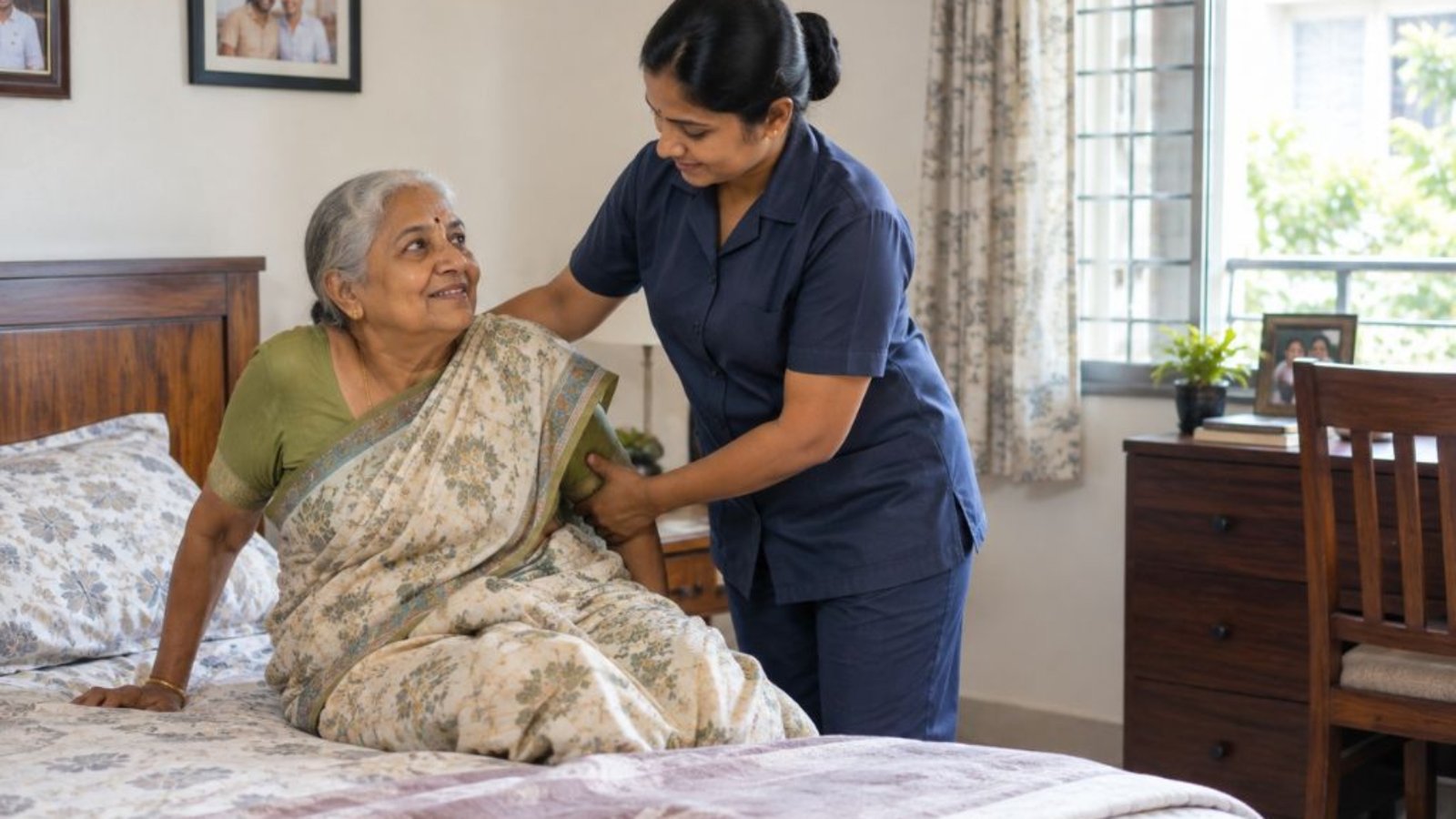
Female attender helping an elderly woman sit up in bed at home in Chennai

Female Attender for Patient in Chennai: What She Does, What She Doesn’t, and How to Hire the Right One

A female attender for a patient is a trained woman who comes to your home to help with the physical, day-to-day side of care – bathing, dressing, toileting, moving safely, eating, drinking, and simply being there – for a patient who can’t manage alone. Families in Chennai usually look for one when a mother, wife, grandmother or daughter comes home from hospital, becomes bedridden, or reaches an age where personal care from a stranger is far easier to accept from another woman.

If that’s the situation you’re in, this guide is for you. It explains, in plain terms, what a female attender for a patient in Chennai actually does, what is outside her role, how to tell whether you need a nurse instead, how 12-hour and 24-hour cover really work, what it costs and why, and what to check before you let anyone into the house. Read it once and you’ll know exactly what to ask for.

If you need someone today rather than a guide, Sashitha’s urgent female caretaker service page explains how same-day arrangements work. Otherwise, start here.

What is a female patient attender?

In Chennai you’ll hear the same role called an attender, attendant, caretaker, caregiver, home attendant or simply aaya. Providers tend to say female patient attendant or female caregiver; families say attender. They all mean the same thing: a woman trained in personal care and safe handling who supports a patient’s daily living, but who is not a nurse and does not perform clinical procedures.

That distinction matters more than the label. An attender’s training is in hygiene, lifting and positioning, feeding, observation and companionship. A home nurse holds a nursing qualification and can do injections, dressings, tube and catheter care. Some patients need one, some need the other, and many need a nurse for a short daily window plus an attender for the rest of the day. We’ll come back to this – it’s the decision that saves families the most money and the most worry.

Who usually needs a female attender at home

  • An elderly mother or grandmother who can no longer bathe, dress or move around safely on her own, and who – understandably – would rather have a woman help her with those things.
  • A woman recovering from surgery (hip or knee replacement, abdominal or gynaecological surgery, a fracture) who needs help with hygiene and mobility for a few weeks.
  • A bedridden patient of either gender who needs turning, cleaning, feeding and constant supervision, where the family prefers a female carer.
  • A new mother after a difficult delivery or C-section who needs rest and support (Sashitha handles this through its mother-and-baby care rather than general patient attendance).
  • A patient with dementia or confusion who is physically mobile but cannot be left alone safely.
  • Anyone whose family simply cannot be present – a son in Bengaluru, a daughter in Dubai, a working couple who can cover evenings but not the day.

The common thread is not the diagnosis. It’s that someone needs hands-on daily support, and a female attender is the right fit for the patient’s comfort and dignity.

What a female patient attender does at home

Personal hygiene and dignity

Sponge or shower baths, oral care, hair washing, changing clothes, adult-diaper changes and toileting support. A good attender does this in a way that keeps the patient covered, warm and in control – asking before touching, explaining each step, closing the door. For many women patients this is the single biggest reason a female attender is requested, and it’s fair to ask a provider how their attenders are trained to handle it.

Mobility, transfers and repositioning

best female patient attender in chennai

Helping the patient sit up, get out of bed, walk to the bathroom, use a walker or wheelchair, and get into a chair or car safely. For bedridden patients, repositioning roughly every two hours, keeping skin clean and dry, and noticing early redness on the hips, heels or tailbone – then telling the family or nurse. Falls are the danger here: the World Health Organization notes that adults over 60 suffer the greatest number of fatal falls, and most happen at home.

Meals, fluids and medication reminders

Serving meals in a safe position, feeding a patient who can’t feed herself, keeping fluids going through a Chennai summer, and reminding the patient to take medicines the doctor has prescribed. The word is reminding: an attender can prompt, hand over a pre-sorted dose and note that it was taken. She does not decide doses, give injections or manage insulin – those are nursing tasks (more below).

Supervision, company and family updates

Being present so the patient is never alone, conversation, a walk to the balcony or the temple, help with the phone or TV, keeping the day’s routine going, and a daily update to the family – what was eaten, how the night went, anything new. Some arrangements include light housework directly related to the patient (her laundry, her room, the bathroom she uses) and accompanying her to appointments.

What a female attender does not do

This is the part competitors’ pages leave out, and it’s the part that keeps your patient safe. A female attender does not:

  • give injections, insulin or IV medicines
  • clean or dress surgical wounds or treat pressure sores
  • insert, change or manage a urinary catheter or Ryles (feeding) tube
  • suction a tracheostomy or manage oxygen settings
  • adjust medication doses or decide what to give when
  • interpret blood pressure, sugar or oxygen readings and act on them
  • replace a doctor’s follow-up or a physiotherapist’s programme
  • do general housework for the whole family, cooking for everyone, or childcare (unless agreed separately)

If any item in the first six lines is part of your patient’s care, you need a home nurse involved – either for a daily visit or for the full shift.

Female attender vs home nurse: which one does your patient need?

Female attender / caregiverHome nurse (ANM / GNM / B.Sc)Skilled / critical-care nurse
Bathing, dressing, toileting, diaper changeYesYesYes
Mobility support, transfers, repositioningYesYesYes
Feeding and hydrationYesYesYes
Companionship and supervisionYesYesYes
Medication remindersYesYesYes
Giving injections, insulin, IV medicinesNoYesYes
Wound dressing, pressure-sore treatmentNoYesYes
Catheter, Ryles tube, tracheostomy careNoYesYes
Recording vitals and escalating to a doctorBasic observation onlyYesYes
Ventilator / ICU-level care at homeNoNoYes

Signs you need a nurse, not an attender

  • The discharge summary mentions a wound that needs dressing, a catheter, a feeding tube, oxygen or injections.
  • The patient has uncontrolled diabetes with insulin, a stroke with swallowing difficulty, or a tracheostomy.
  • There are pressure sores already present.
  • The doctor has said “nursing care” rather than “someone to help at home”.

When that’s the case, Sashitha’s home nursing in Chennai and skilled nursing pages describe what a nurse can take on, and our guides to stroke patient care at home and Ryles tube care at home go deeper. Many families pair a nurse for a short morning visit with a female attender for the remaining hours – clinical care where it’s needed, without paying nursing rates for companionship.

12-hour vs 24-hour female attender: how to decide

12-hour (day or night) cover suits a patient who needs help through the active part of the day but sleeps through the night, or the reverse – a patient who is fine by day with family around but wakes, wanders or needs turning at night. It’s also the right starting point after most surgeries, where the need reduces week by week.

24-hour cover is for a patient who cannot safely be left alone at any point: advanced dementia, bedridden with pressure-sore risk, the first days after a major discharge, or a patient who needs repositioning and toileting help through the night.

Ask yourself three questions:

  1. Does the patient need physical help between midnight and 6 am, or just someone present?
  2. Is there a family member who can reliably cover the other twelve hours, every day, including weekends?
  3. Will the need reduce in two to four weeks, or is this long-term?

How 24-hour care is actually staffed

This is the question to put to every provider: is 24-hour care one live-in attender, or two attenders on 12-hour shifts? One live-in woman is cheaper and works when the patient sleeps most of the night – she needs rest hours, a weekly day off (and someone to cover it), a place to sleep and meals. Two rotating attenders cost more but are the correct model when active care is needed at 3 am. A provider that quotes “24-hour” without saying which one is leaving the hard part for later.

How to choose a female patient attendant in Chennai

Ten questions to ask before you hire

  1. Will someone assess the patient at home first? Quoting without seeing the patient means guessing at the level of care.
  2. What training does the attender have, and in what? Look for personal-care and safe-handling training. If a provider says “medically trained”, ask exactly what that means – it should not mean she’ll do nursing tasks.
  3. What verification is done? Identity documents, address, references and police verification. Ask to see it – not just to be told it exists.
  4. Who supervises her? Is there a nursing supervisor or coordinator who checks in, or is she on her own?
  5. What happens if she’s unwell or on leave? Ask for the replacement time in hours. This single question tells you more about a provider than any brochure.
  6. Can I request a specific language or background? A Tamil-speaking attender, a vegetarian household, an older or younger carer – all reasonable requests.
  7. How will you update the family? Daily WhatsApp, a written log, a weekly call – agree the format before day one.
  8. What’s the emergency process? Who does she call first, which hospital, and is there a doctor or nurse she can escalate to?
  9. Can we start with a short trial? A few days before committing to a month is a fair ask.
  10. What exactly is included in the rate, and what’s extra? Diapers, gloves, food for a live-in attender, festival days, transport, GST.

Get the scope of duties (including what she will not do), hours, rate, replacement guarantee and notice period in writing. Most problems in home care come from unclear expectations, not from bad people.

Agency or direct hire?

Hiring a woman directly through a neighbour or a WhatsApp group is cheaper per month. It also means no verification, no replacement when she’s sick, no supervisor to call when something goes wrong, and no accountability if the patient is hurt. A provider costs more and, in return, carries those risks for you. For a short, low-dependency need direct hire can work; for a bedridden or vulnerable patient, or a family managing from another city, the provider route is usually the safer one.

What a female patient attendant costs in Chennai

There is no single price, because “attender” covers a 6-hour companion visit and a live-in carer for a bedridden patient. What moves the number:

  • Hours and shift. Across the Chennai market, a non-clinical patient attendant generally runs ₹700–₹1,500 per day depending on shift length, with 12-hour cover typically landing around ₹15,000–₹25,000 per month and 24-hour live-in cover higher. Sashitha’s home nurse cost guide for Chennai sets these against nursing rates so you can see the difference clearly. Those are market ranges, not a Sashitha price list.
  • One person or two. Two 12-hour shifts cost more than one live-in attender.
  • Patient dependency. A fully bedridden patient needing two-hourly turning is priced above a mobile patient who needs supervision.
  • Duration. Monthly packages are usually cheaper per day than short daily bookings, but daily is normal after surgery.
  • Nursing requirement. If any clinical task is involved, part of the cost becomes nursing cost.
  • Extras. Consumables (diapers, gloves, wipes), equipment rental (hospital bed, air mattress, commode chair), food for a live-in attender, and doctor visits are usually billed separately. Ask.

The most cost-effective long-term structure is often a nurse for a short daily window plus a female attender for the rest of the day.

What to tell the provider before they send someone

female patient attendant costs in Chennai

Having this ready means the right person is matched the first time, rather than after an awkward first week:

  • Patient’s age, gender and weight (it affects safe lifting)
  • Diagnosis or reason for care, and the latest discharge summary or doctor’s note
  • Mobility: walks alone / walks with support / wheelchair / bedridden
  • Help needed with bathing, toileting, dressing, feeding – and how much
  • Diaper use, catheter, feeding tube, oxygen, wounds – anything clinical (this decides attender vs nurse)
  • Medicines: what, when, and who currently manages them
  • Night needs: sleeps through / wakes / needs turning or toileting
  • Shift wanted: hours, days, start date, expected duration
  • Language preference and any household rules (vegetarian, footwear, prayer times)
  • Where a live-in attender would sleep and eat
  • Who the family contact is, and the emergency plan (hospital, doctor, nearest relative)
  • Anything the patient finds distressing or comforting

Send this by WhatsApp before the assessment call. It shortens everything that follows.

How Sashitha Home Care can help

Sashitha Home Health Care India Pvt Ltd is based at Santhome, Mylapore, and provides home-based care across Chennai, including Mylapore, R A Puram, Alwarpet, T Nagar, Ashok Nagar, Anna Nagar, Besant Nagar, Vadapalani, Ramapuram and Perungudi.

For families looking for a female attender, the team provides:

  • A female caretaker service covering daily living assistance (bathing, dressing, personal care), mobility support, medication reminders and help with appointments, with care plans built around the treating doctor’s recommendations.
  • Short-term, 12-hour and 24-hour options, including night cover and live-in arrangements, for elderly, post-hospitalisation and bedridden patients.
  • Background-checked attenders, with Tamil, English and Hindi speakers available.
  • Home nursing alongside the attender when the patient’s care includes clinical tasks – through the home nursing and post-surgery care teams – so families don’t have to choose between the wrong two options.
  • A home assessment first, so the attender sent matches the patient’s actual needs, and regular updates to the family.
  • Replacement support if the assigned attender is unavailable.

If your patient is an elderly parent and you’re still working out the level of care overall, our guide to choosing an elderly care service in Chennai walks through that wider decision.

Frequently asked questions

What does a female patient attendant do?

She supports the patient’s daily living: bathing, dressing, toileting, diaper changes, moving and repositioning, feeding, fluids, medication reminders, supervision and companionship, plus daily updates to the family. She does not perform clinical procedures.

What is the difference between a female attender and a home nurse?

An attender provides personal and daily-living care. A home nurse holds a nursing qualification and can give injections, dress wounds, manage catheters and feeding tubes, and record and escalate vitals. If the patient’s care includes any of those, a nurse is needed – sometimes only for a daily visit alongside the attender.

Can a female attender give medicines?

She can remind the patient and hand over medicines that the doctor has prescribed and that have been pre-sorted, and note that they were taken. She should not give injections, insulin or IV medicines, or change doses.

Can I hire a female attender for a bedridden patient?

Yes. An attender can handle repositioning, hygiene, diaper changes, feeding and skin checks for a bedridden patient. Pressure-sore treatment, catheter or tube care and other clinical tasks need a nurse – often arranged together.

Can a female attender stay 12 hours, or overnight, or 24 hours?

Yes. 12-hour day or night shifts, and 24-hour cover, are all standard in Chennai. Ask whether 24-hour cover means one live-in attender or two on rotating shifts, and what rest and weekly-off arrangements apply.

Can a female attender help after surgery or after delivery?

Yes, for the non-clinical side: hygiene, mobility, meals, rest and supervision. Wound care and injections stay with a nurse. Post-delivery support is usually arranged through mother-and-baby care rather than general patient attendance.

How much does a female patient attendant cost in Chennai?

Market rates for a non-clinical attendant are broadly ₹700–₹1,500 per day, with 12-hour monthly cover around ₹15,000–₹25,000 and 24-hour cover higher. Dependency level, one-vs-two attenders and consumables change the figure; a home assessment is the only way to get an accurate quote.

Are female attenders background verified?

Reputable providers verify identity, address and references and carry out police verification. Ask to see the documents rather than accepting the phrase “background checked”.

What should I check before hiring?

Home assessment before quoting, training in personal care and safe handling, verification documents, who supervises, replacement time in hours, emergency process, family-update routine, trial period, and a written scope of duties with what is and isn’t included in the rate.

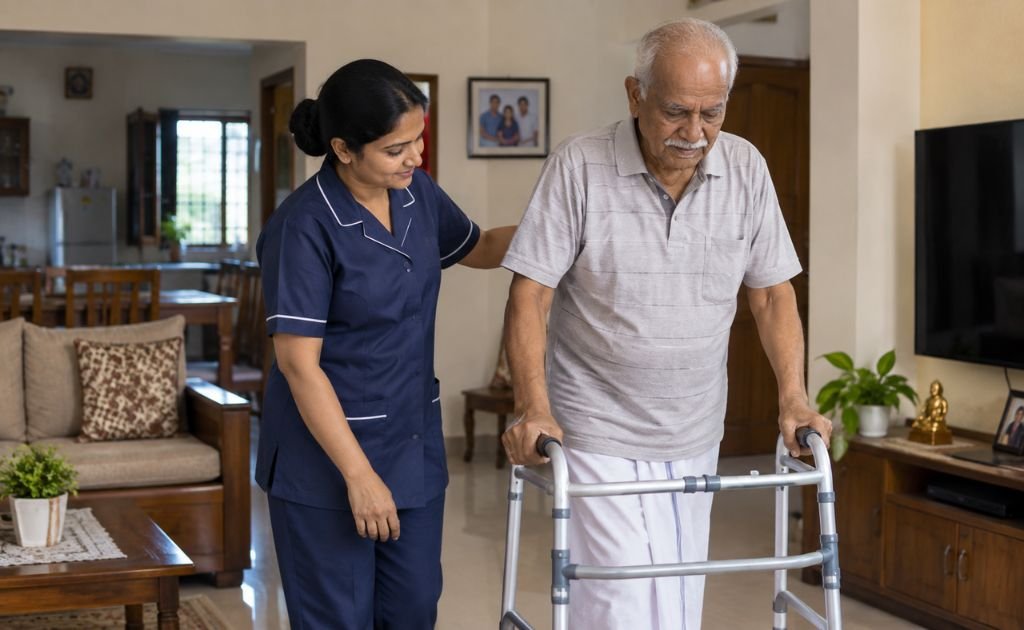
Caregiver supporting an elderly woman walking with a frame at home in Chennai

Elderly Care Service in Chennai: How to Work Out What Your Parent Actually Needs

Elderly care is practical support that helps an older person manage the parts of daily life that have become difficult – washing, moving safely around the house, eating well, taking medicines on time, and simply not being alone for long stretches. It ranges from a few hours of help a day to round-the-clock nursing, and the right level depends entirely on the person.

That last point is where most families get stuck. Searching for an elderly care service in Chennai brings up dozens of providers, but very few of them help you answer the first question: how much help does my mother or father really need, and from whom? Get that wrong and you either pay for clinical skills nobody uses, or you hire a companion for someone who needs a nurse.

This guide is written for the family member doing the deciding. It explains what elderly care at home includes, when professional support is worth considering, how to judge the level of support required, who does what (a caregiver and a home nurse are not the same person), the types of care you can arrange in Chennai, what drives the cost, and what to check before anyone walks through your parent’s door.

What elderly care means (and what it doesn’t)

Elderly care – you’ll also see it called elder care, senior care or, in a clinical setting, geriatric care – is support with the everyday activities a person can no longer manage alone, delivered either at home or in a residential facility. The National Institute on Aging describes long-term care as services designed to meet a person’s health or personal care needs when everyday activities become hard to do independently, and notes that the need can arrive suddenly after a stroke or fall, or build up gradually over years.

Two things elderly care is not:

  • It is not medical treatment. A caregiver supports daily life. Diagnosis, prescriptions and changes to treatment stay with the treating doctor.
  • It is not one product. “Elder care” covers everything from a companion who visits in the afternoon to an ICU-trained nurse living in the house. The label on a provider’s website tells you very little until you know which level they mean.

What elderly care at home includes

Most families in Chennai who search for elderly care are looking for help at home rather than a move to a facility. Here is what a well-run home care arrangement typically covers. Not every family needs every item – the point of a care plan is to choose.

Personal care and hygiene

Help with bathing, dressing, grooming, oral care and toileting, done in a way that protects the older person’s dignity. For many parents this is the hardest help to accept, and it is often the reason families bring in a trained outsider rather than doing it themselves.

Mobility and fall prevention

Support with getting out of bed, walking to the bathroom, using stairs, and transfers to and from a chair or wheelchair. This matters more than it sounds: the World Health Organization reports that adults over 60 suffer the highest number of fatal falls, and a single fall at home in Chennai’s typical two-storey house or a slippery bathroom can end a parent’s independence. A good caregiver also spots the loose rug, the dark corridor and the missing grab bar.

Meals, hydration and medication reminders

Home caregiver helping an elderly man organise his daily medicines and water at home in Chennai

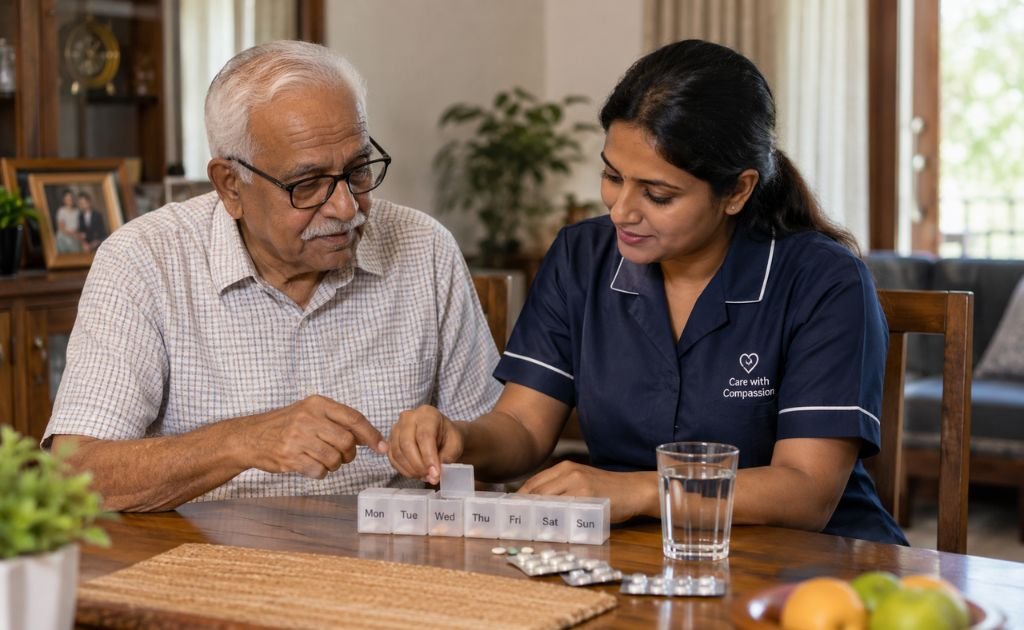
Preparing or serving meals that suit the person’s dietary needs, making sure they drink enough through a Chennai summer, and reminding them to take medicines at the right time. Note the word reminding: a caregiver can prompt and hand over prescribed medicines; giving injections or managing IV lines is nursing work (more on that below).

Companionship, routine and family communication

Conversation, a walk to the temple or the park, help with the phone or the TV remote, keeping a daily routine going, and – often the part families value most – a regular update to the son in Bengaluru or the daughter in Dubai about how the day went, what was eaten and whether anything seemed off.

Some arrangements also include light household tasks directly related to the older person (their laundry, their room), accompanying them to appointments, and basic observation – noticing a new cough, a swollen ankle or unusual confusion and telling the family.

When should a family consider professional elderly care?

There is rarely a single moment. More often it’s an accumulation – a fall that was “nothing”, a fridge with expired food, a missed dose, a phone call where your father sounded confused at 4 pm. A useful way to decide is to ask four questions:

  1. Safety: has anything happened in the last three months that could have ended badly – a fall, a burn, a wandering episode, a medicine taken twice?
  2. Daily living: is your parent struggling with any of the six activities listed in the next section?
  3. Health: is there a new diagnosis, a recent hospital stay, or a condition that needs monitoring the family can’t provide?
  4. The carer: is the person currently providing care – often a spouse in their seventies, or a daughter juggling a job – close to burning out?

A “yes” to any one of these is enough to start a conversation with a provider, even if only for a few hours a week. For a fuller list of the warning signs families tend to notice first, read our article on the signs your parents might need professional elder care.

How to tell what level of support your parent needs

A simple way to assess: the six daily activities

Healthcare professionals often use “activities of daily living” (ADLs) to judge how much support someone needs. WHO’s Integrated Care for Older People (ICOPE) guidance for health workers is built on the same principle: assess the individual person’s capacities, identify their support needs, and only then build a personalised care plan. You can do a simple version of that assessment yourself. Sit down and honestly ask, for each one, whether your parent can do it alone, with a little help, or not at all:

  1. Bathing
  2. Dressing
  3. Using the toilet
  4. Moving around the home and getting in and out of bed
  5. Eating (not cooking – actually eating)
  6. Continence

If the answer is “alone” for all six, your parent probably needs companionship, safety supervision and help with shopping, cooking or transport rather than hands-on care. If two or more are “with help” or “not at all”, daily hands-on support is likely. If there is also a wound, a catheter, a feeding tube, oxygen, injections or a recent hospital discharge, nursing is in the picture.

When a doctor’s assessment should come first

Some changes look like “getting old” but need a medical opinion before you decide on care: sudden confusion or memory loss, repeated falls, unexplained weight loss, new incontinence, or a decline that happened over weeks rather than years. In those cases, ask the treating doctor what level of support they recommend and for how long. A discharge summary or a physician’s note is also the most useful document you can hand to a care provider – it stops guesswork on both sides.

Caregiver, home attendant, home nurse or geriatric care: who does what

This is the distinction that saves families the most money and the most worry. In Chennai the terms are used loosely – “caretaker”, “attender”, “ayah”, “nurse” – so judge by what the person is actually trained and permitted to do, not the label.

Caregiver / home attendantTrained home nurse (ANM / GNM / B.Sc)Skilled or critical-care nurseGeriatric care (structured)
Bathing, dressing, toileting, feedingYesYesYesYes (via caregiver)
Mobility support, fall prevention, companionshipYesYesYesYes
Medication reminders and handing over prescribed medicinesYesYesYesYes
Injections, IV lines, sterile wound dressingNoYesYesThrough nurse
Catheter, feeding-tube, tracheostomy careNoYesYesThrough nurse
Ventilator / ICU-level support at homeNoNoYesNo
Monitoring vitals and escalating to a doctorBasic observation onlyYesYesYes
Coordinated care plan across multiple conditionsNoPartlyPartlyYes – the defining feature

Caregiver / home attendant. Trained in personal care, safe lifting, hygiene and basic observation. The right choice when the need is daily-living support, supervision and company. This is the most common request in Chennai and often the most affordable.

Trained home nurse. Holds a nursing qualification and, in Tamil Nadu, a registration with the Tamil Nadu Nurses and Midwives Council. Needed when there are clinical tasks – dressings, injections, tube or catheter care, post-surgical monitoring. Our separate guide explains home nurse costs in Chennai and how to read a nursing quote.

Skilled / critical-care nurse. ICU experience; required for tracheostomy, ventilator or complex oncology care at home. If this is your situation, our guide to home care for tracheostomy patients goes into detail.

Geriatric care. Less a job title, more an approach: a coordinated plan for an older person with several overlapping conditions (say, diabetes, arthritis and early dementia), combining caregiver support, periodic nursing, medication management and doctor coordination. Sashitha describes its version on the geriatric care at home page.

A combination is often the sensible answer. A parent recovering from a hip replacement might need a nurse for an hour each morning and a caregiver for the rest of the day – far cheaper than a 24-hour nurse and no less safe.

Types of elderly care you can arrange in Chennai

Part-time and full-day care

A caregiver for a defined block – typically 4 to 12 hours – covering the morning routine, meals and the afternoon. Suits parents who are mostly independent but shouldn’t be alone all day, and families where someone is home in the evenings. Most providers in Chennai, including Sashitha, offer plans from a few hours a day upward.

Overnight care

Cover through the night for a parent who wakes confused, is at risk of getting up alone, or needs repositioning to prevent pressure sores. Often the arrangement that lets a caregiving son or daughter sleep for the first time in months.

Live-in and 24-hour care (one person or two?)

Continuous cover is right when the person cannot safely be left alone at any point – advanced dementia with wandering, bedridden with pressure-sore risk, or the first days after a major discharge. Ask every provider one question: is 24-hour care one live-in person or two people on 12-hour shifts? One live-in caregiver is cheaper and works when the parent sleeps through the night; two rotating staff cost more and are the correct model when active care is needed at 3 am. Also confirm rest hours, the weekly off, who covers it, and where a live-in caregiver will sleep and eat – sort this out before day one, not day nine.

Temporary and post-hospitalisation care

Short-term care for one to four weeks after surgery, a stroke or an infection, or while the regular family caregiver travels. Daily or weekly billing is normal. Many families start with a short arrangement precisely to see whether the caregiver is the right fit before committing to a month. Our guides on post-surgery recovery and stroke patient care at home in Chennai cover these situations in depth.

Elderly care at home vs other options in Chennai

Care at homeOld-age home / senior livingAssisted living / care facilityHospital
Familiar surroundings and routineYesNoNoNo
One-to-one attentionYesSharedSharedShared
Flexibility (hours, level, start/stop)HighLowMediumN/A
Suitable for clinical needsYes, with a nurseUsually notSome facilitiesYes
Family involvement day to dayHighLimitedLimitedLimited
Social contact with peersDepends on family and caregiverBuilt inBuilt inNo
Typical cost patternScales with hours and levelMonthly feeHigher monthly feeDaily, high
Best fitMost seniors who want to stay home; NRI families arranging care remotelySeniors who are lonely at home and mobile enough to enjoy communitySeniors needing supervision plus some clinical supportAcute illness only

Home care is not automatically better – a parent who is isolated and mobile may thrive in a good senior community – but for most Chennai families the deciding factor is that the parent wants to stay in the house they know, near the temple, the market and the neighbours they’ve had for forty years. Sashitha also lists old age home services if that route suits your family better.

How to choose an elderly care service in Chennai: a practical checklist

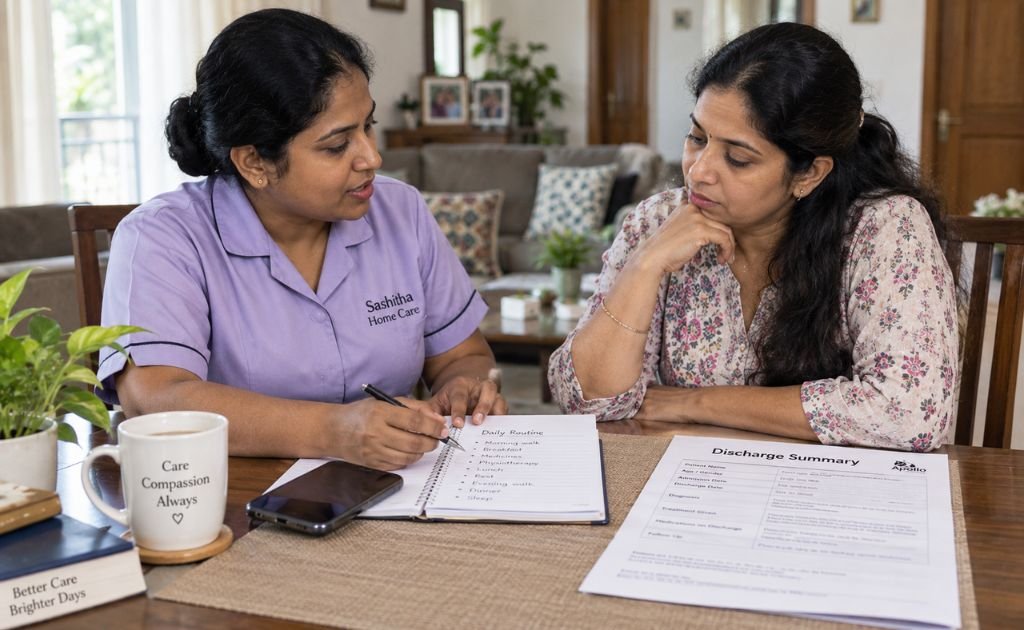
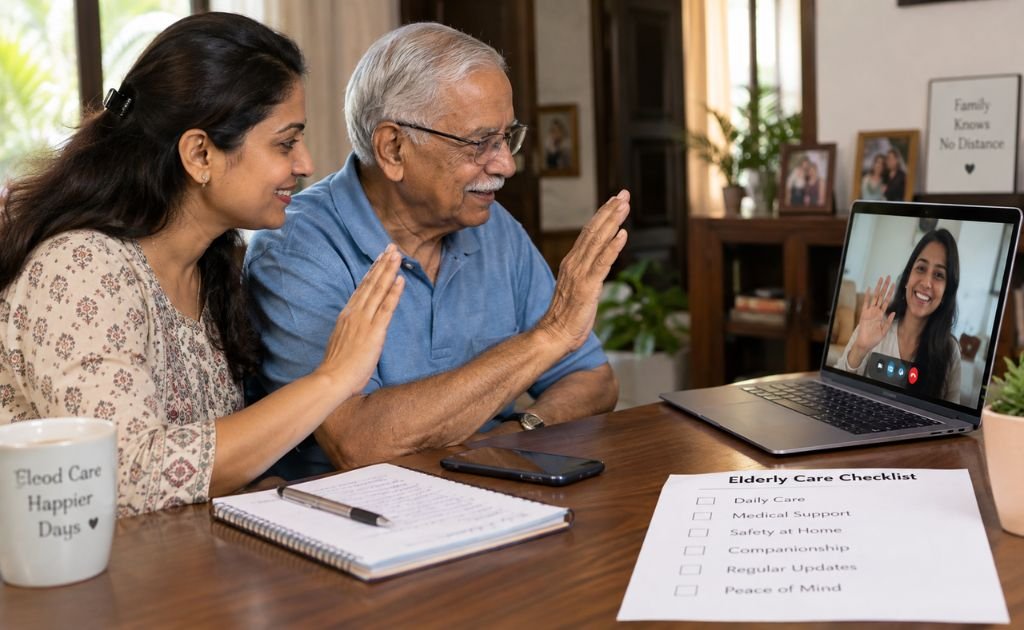
Family in Chennai discussing an elder care plan with a relative on a video call

Before the first call

  • Write down the six ADLs above and your honest answers.
  • Gather the latest prescriptions, discharge summary and doctor’s advice.
  • Decide the hours you actually need, not the hours you’re afraid you might need.
  • Note any preferences that matter: Tamil-speaking, female caregiver, vegetarian cooking, comfortable with a dog in the house. These are reasonable requests, not awkward ones.

Questions to ask the provider

  1. Will someone assess my parent at home before quoting? A provider that quotes over the phone without seeing the person is guessing.
  2. What training does the caregiver have, and can I see it? For nurses, ask for the council registration number.
  3. Is background and police verification done? For anyone alone in a home with a vulnerable person, yes is the only acceptable answer.
  4. Who supervises the caregiver? Is there a nursing supervisor or care manager reviewing the plan, or is the person on their own?
  5. What happens if the caregiver is unwell or goes on leave? Ask for the replacement time in hours. This is the most revealing question you can ask.
  6. How will you keep the family informed? Daily WhatsApp update, written log, weekly call – agree the format.
  7. What is the emergency process? Who does the caregiver call first, which hospital, and does the provider have a doctor to escalate to?
  8. Can I start short-term? A one-week trial before a monthly commitment is a fair request.
  9. What exactly is included, and what is billed extra? Consumables, equipment rental, food for live-in staff, festival allowances, GST.
  10. Can the plan change? Care needs move – up after a fall, down after recovery. The plan should move with them.

What should be in writing

The scope of duties (including what the caregiver will not do), hours, rate, replacement guarantee, notice period, and the family’s emergency contacts. Most disputes in home care are about expectations, not competence – a written scope prevents most of them.

Arranging care from outside Chennai or abroad

A large share of Chennai’s elderly parents have children in Bengaluru, Hyderabad, the Gulf, the US or the UK. If that’s you: insist on a home assessment you can join by video call, ask for a named point of contact rather than a helpline, agree a fixed update routine, nominate a local relative or neighbour as the on-ground contact for emergencies, and set up a small standing arrangement for consumables so nobody is waiting on a bank transfer at 2 am. Providers with a physical Chennai office and staff who will pick up the phone matter far more when you’re 8,000 km away.

What elderly care costs in Chennai (and what changes the price)

Prices vary widely because “elderly care” covers so many levels. Rather than a fixed price list – which no honest provider can give without assessing the person – here is what moves the number, with the market ranges published in our Chennai home nurse cost guide for reference:

  • Level of care. A caregiver or attendant costs meaningfully less than a qualified nurse. Across Chennai, a 12-hour attendant typically runs in the ₹15,000–₹25,000 per month band; a 24-hour live-in attendant roughly ₹25,000–₹45,000; a trained nurse on 24-hour cover ₹35,000–₹70,000; critical-care nursing higher still.
  • Hours. Twelve hours is not half the price of twenty-four. Round-the-clock cover done properly is a step change, not a doubling.
  • One person or two. Two rotating shifts cost more than one live-in caregiver and are sometimes the only safe option.
  • Duration. Monthly packages usually work out cheaper per day than daily billing, but short-term daily arrangements are normal after surgery.
  • Medical complexity. Dementia care, bedridden care and post-ICU care sit at the upper end because the work is continuous and skilled.
  • Extras. Adult diapers, dressings, nutrition supplements, hospital-bed or air-mattress rental, food for live-in staff and doctor visits are usually billed separately. Ask.
  • Insurance. Standard Indian health policies are built around hospitalisation and rarely cover a long-term caregiver. Check for a domiciliary or home-healthcare rider and get the answer in writing.

The most cost-effective structure for long-term care is often a nurse for a short daily window plus a caregiver for the remaining hours. It gives the clinical care that matters without paying nursing rates for companionship.

How Sashitha Home Care supports elderly people in Chennai

Sashitha Home Health Care India Pvt Ltd is based at Santhome, Mylapore, and provides home-based care across Chennai, including Mylapore, R A Puram, Alwarpet, T Nagar, Ashok Nagar, Anna Nagar, Besant Nagar, Vadapalani, Ramapuram and Perungudi.

For elderly people the team provides:

  • Caregiver and attendant support with daily activities, mobility, hygiene, meals, medication reminders and companionship, with a female caretaker option where families prefer it.
  • Geriatric care at home – a coordinated plan covering health monitoring, fall prevention, medication assistance and personal care for seniors with several conditions, including experience supporting people with dementia and Alzheimer’s.
  • Home nursing and skilled nursing for clinical needs – wound care, injections, catheter and tube care, post-surgery monitoring.
  • Flexible schedules from a few hours a day to overnight and live-in cover, with staff who are background-checked and trained.
  • A home assessment first, so the care plan and the quotation reflect the actual person rather than a phone description, and regular updates so the family stays informed.

The team’s approach is to work out the right level of support before recommending anything – which, if you’ve read this far, is exactly the process this article has walked you through.

Frequently asked questions

What is included in elderly care at home?

Typically: help with bathing, dressing, toileting and grooming; mobility support and fall prevention; meal support and hydration; medication reminders; companionship; accompanying to appointments; and regular updates to the family. Clinical tasks such as injections or wound dressing are added through a home nurse when the doctor advises them.

What is the difference between a caregiver and a home nurse?

A caregiver (or attendant) supports daily living and safety. A home nurse holds a nursing qualification and can perform clinical tasks – injections, IV therapy, sterile dressings, catheter and tube care, and vital-signs monitoring with escalation to a doctor. Many families use both: a nurse for a short daily window and a caregiver for the rest.

How do I know what level of care my parent needs?

Assess the six activities of daily living (bathing, dressing, toileting, mobility, eating, continence). If most are managed alone, companionship and supervision may be enough. If two or more need help, daily hands-on care is likely. Any wound, tube, catheter, oxygen or recent discharge means nursing should be discussed with the treating doctor.

Is 24-hour elderly care available at home in Chennai?

Yes. It is delivered either as one live-in caregiver (suitable when the person sleeps through the night) or as two people on 12-hour shifts (needed when active care is required at night). Always confirm which model a quotation refers to, and what the rest and weekly-off arrangements are.

How much does elderly care cost in Chennai?

It depends on the level of care and hours. Across the Chennai market, a 12-hour attendant is typically in the ₹15,000–₹25,000 per month range, a 24-hour live-in attendant roughly ₹25,000–₹45,000, and a trained nurse on 24-hour cover ₹35,000–₹70,000, with consumables and equipment usually extra. A home assessment is the only way to get an accurate figure for your parent.

Can elderly care be arranged after hospital discharge?

Yes, and it is one of the most common requests. Short-term arrangements of one to four weeks after surgery, a stroke or an infection are normal, and can be extended or reduced as recovery progresses.

Can I arrange care for my parents in Chennai if I live abroad?

Yes. Ask to join the home assessment by video, get a named point of contact, agree a fixed update routine, and nominate a local relative or neighbour as the on-ground emergency contact. Providers with a physical Chennai office are easier to work with remotely.

What should I check before hiring an elderly caregiver in Chennai?

Home assessment before quoting, training certificates (and council registration for nurses), background and police verification, who supervises the caregiver, replacement time if they are unwell, the emergency process, the family-update routine, and a written scope of duties with what is and isn’t included in the rate.

A last word for the person reading this at 11 pm

Nobody arrives at this decision feeling ready. What helps is breaking it into the four questions this guide covers: what level of help is needed, who is qualified to give it, how many hours, and what to check before you commit. Answer those and the choice of provider becomes much simpler.

If you’d like to talk it through, the Sashitha team is at +91 91760 00011 and will start with a conversation about your parent, not a price list. Government support for older people’s health also exists in India through the National Programme for Health Care of the Elderly, which is worth knowing about alongside private care – particularly for families managing long-term conditions on a budget.

Home nurse supporting a stroke survivor at home in Chennai while a family member looks on

Stroke Patient Care at Home in Chennai: A Practical Guide for Families

A stroke can change a family’s routine overnight. One week, your father is walking to the Mylapore market on his own; the next, you are standing at a hospital discharge desk with a file of prescriptions, a list of exercises, and a quiet question nobody has fully answered: how are we going to manage this at home?

This guide explains what stroke patient care at home in Chennai actually involves – what a trained home nurse does, how daily care is organized, where rehabilitation fits in, what home nursing realistically costs, and the warning signs that mean you should seek emergency help.

Home care after a stroke is not a replacement for medical treatment or rehabilitation. It is the support system that makes recovery at home safer and more sustainable – for the stroke survivor and for the family carrying the daily load. The right level of support depends on the person’s medical and functional needs, so treat everything below as a starting point for a conversation with the treating doctor, not a substitute for one.

What Does Stroke Patient Care at Home Involve?

Stroke patient care at home combines nursing support, help with mobility and personal care, medication support as prescribed, feeding and swallowing assistance where appropriate, skin care to prevent pressure sores, coordination with physiotherapists and doctors, and ongoing monitoring of the patient’s condition. It also supports family caregivers. The right mix is individualized – some patients need short daily visits, while others need 12-hour or 24-hour nursing care.

Every stroke is different, so every home-care plan should be too. The sections below walk through each element in detail.

What Happens After a Stroke?

A stroke happens when blood supply to part of the brain is interrupted. Depending on which part of the brain is affected and how severely, a stroke survivor may experience weakness or paralysis on one side of the body, difficulty speaking or understanding language, trouble swallowing, poor balance, changes in memory and thinking, and changes in mood.

Recovery varies enormously from person to person. According to the NHS, some people recover in days or weeks, while for others it takes months or years. Rehabilitation typically begins in hospital, often within the first 48 hours, and continues after discharge (NINDS). What happens at home in the months after discharge plays a major role in how safely that recovery continues.

Stroke is also common in India – studies report roughly 108–172 new strokes per 100,000 people each year (International Journal of Stroke) – so thousands of Chennai families face this situation every year. You are not alone in figuring this out.

Who May Benefit From Home Care After a Stroke?

Not every stroke survivor needs a full-time nurse. Home-care support is usually worth considering when the person:

  • Has just been discharged from hospital and still needs clinical monitoring or procedures at home
  • Has reduced mobility – needs help to walk, transfer from bed to chair, or is bedridden
  • Has swallowing difficulty or is on a modified diet or feeding tube
  • Needs help with bathing, toileting, grooming and other personal care
  • Takes multiple medications on a strict schedule
  • Has communication or memory difficulties that make being alone unsafe
  • Is elderly, lives alone, or lives with an elderly spouse who cannot physically manage the care
  • Has family members who work full-time or live in another city or abroad

For a patient who is walking safely and managing daily activities, a few supportive visits per week may be enough. For a bedridden patient with a feeding tube, structured nursing care becomes much more important.

Home Nurse vs Caregiver (Attendant): What’s the Difference?

Families in Chennai often use “nurse” loosely for anyone hired to help at home. In practice there is a real difference – in training, in what each is allowed to do, and in cost.

NeedHome Nurse (GNM/B.Sc qualified)Caregiver / Attendant
Monitoring vitals and clinical changesYesBasic observation only
Giving medications as prescribedYesReminders only
Ryles tube feeding, catheter, wound careYes, where trainedNo – these are nursing procedures
Help with walking, transfers, positioningYesYes
Bathing, toileting, personal hygieneYesYes
Assisting meals for patients cleared to eatYesYes
Companionship and daily routineYesYes
Escalating problems to doctors/familyYes, with clinical judgmentReports to family

Many families use a practical combination: a qualified nurse for clinical tasks (daily or on shifts) plus an attendant for round-the-clock personal care and supervision. An honest provider will help you match the staffing level to the patient’s actual needs – Sashitha’s skilled nursing team handles the clinical side, including medication administration, wound care and catheter care, while trained attendants support daily living.

Daily Stroke Patient Care at Home: The Core Elements

Medication support

Giving or prompting doses on time as prescribed, keeping an updated medication list, and reporting side effects or missed doses to the treating doctor – never adjusting doses independently.

Mobility and positioning

Help with safe walking, bed-to-chair transfers and comfortable positioning as advised by the physiotherapist and doctors. For bedridden patients, regular position changes are a core daily task.

Personal hygiene

Bathing, grooming, oral care, toileting and continence care – done with dignity and patience. This is often the heaviest daily burden on families, and where professional support helps most immediately.

Feeding

Meal assistance for patients cleared to eat normally, or support for the modified diet or tube feeding plan the treating team has prescribed (more on swallowing below).

Skin care

Daily skin checks and reducing prolonged pressure on vulnerable areas – critical for anyone spending long hours in bed or a chair.

Communication and emotional support

Speaking clearly and unhurriedly, allowing time to respond, keeping the person involved in family life, and maintaining a predictable routine. Recovery is not only physical.

Mobility and Fall Prevention at Home

Falls are one of the most common complications after stroke – research suggests roughly half of stroke survivors fall within the first year, several times the rate of healthy adults (Frontiers, 2022 systematic review). Chennai homes and apartments can be made significantly safer with simple changes recommended by the American Stroke Association:

  • Remove loose rugs, mats and trailing wires from walking paths
  • Ensure good lighting, especially for night-time bathroom trips
  • Add grab bars in the bathroom and consider a showaer chair
  • Keep frequently used items within easy reach
  • Use walking aids only as prescribed, and keep them within reach
  • Never rush transfers – unhurried, supported movement prevents most falls

Transfers for patients with significant weakness require proper technique. If the patient cannot bear weight reliably, ask the physiotherapist or nursing team to demonstrate safe methods rather than improvising – protecting the family caregiver’s back matters too.

Swallowing and Feeding After a Stroke

This is one of the most underestimated parts of stroke care at home. Around half of stroke patients admitted to hospital have some degree of swallowing difficulty (dysphagia) (peer-reviewed research). Unsafe feeding can cause food or liquid to enter the airway (aspiration), which can lead to serious chest infections, malnutrition and dehydration.

For this reason:

  • Swallowing should be assessed by the treating team – usually involving a speech and language therapist – before deciding how the person eats and drinks (NHS guidance on dysphagia)
  • Any modified diet (softened food, thickened fluids) should follow the team’s specific instructions, not general advice
  • Some patients need temporary or longer-term tube feeding, most commonly through a nasogastric (Ryles) tube – a decision made by doctors, with the tube inserted and managed by trained professionals

If your family member has been discharged with a feeding tube, trained nurses can manage feeds, positioning and tube care at home. Sashitha’s detailed guide to Ryles tube insertion and feeding at home in Chennai explains how professional NG-tube care works and why families should never attempt insertion themselves.

Medication Management and Preventing Another Stroke

Nurse and family caregiver reviewing a stroke patient's medication list and home care plan

According to the American Stroke Association, nearly 1 in 4 stroke survivors will have another stroke – and consistent control of blood pressure, cholesterol, blood sugar and other risk factors substantially reduces that risk (ASA: Preventing Another Stroke). In practice, at home this means:

  • Taking every prescribed medicine exactly as directed, without skipped doses
  • Keeping one written, current medication list that travels to every appointment
  • Attending follow-up reviews with the neurologist or physician
  • Reporting side effects, dizziness, unusual bleeding or new symptoms to the doctor promptly – rather than stopping the medicine

A home nurse can administer medications on schedule and keep records the doctor can actually use. Since high blood pressure and diabetes are the biggest drivers of recurrent stroke, ongoing disease management support at home is a meaningful part of long-term stroke care, not an optional extra.

Preventing Pressure Sores in Bedridden Stroke Patients

For a bedridden stroke patient, pressure sores (bed sores) are among the most serious avoidable complications. Prevention principles from MedlinePlus (U.S. National Library of Medicine) include:

  • Regular repositioning – typically every couple of hours in bed, as set out in the patient’s care plan
  • Daily skin inspection, paying attention to the tailbone, hips, heels and elbows
  • Pressure-redistributing surfaces such as an air mattress where clinically appropriate
  • Keeping skin clean and dry, especially with incontinence
  • Adequate nutrition and hydration as medically advised
  • Early escalation – any persistent redness or broken skin should be reported to the nurse or doctor immediately, not watched for days

This is one area where professional bedridden care clearly earns its cost: trained staff reposition correctly, spot early skin changes, and manage hygiene systematically.

Physiotherapy and Rehabilitation at Home

Nurse assisting an elderly stroke survivor with supported walking practice at home

Rehabilitation is the engine of stroke recovery, and home care works best when it supports – never replaces – the rehabilitation plan. Depending on the patient’s needs, the treating team may include physiotherapy (strength, balance, walking), occupational therapy (relearning daily activities like dressing and eating) and speech and language therapy (communication and swallowing). People who participate in structured rehabilitation recover better (American Stroke Association), and research on supported discharge shows that coordinated, professional home-based rehabilitation can genuinely improve outcomes (Cochrane review).

At home, nurses and trained attendants support this by helping the patient practise therapist-directed routines between sessions, ensuring exercises actually happen on the days the therapist doesn’t visit, and reporting progress or setbacks back to the team. Exercises themselves should always follow the individualized plan set by qualified clinicians – well-meaning improvised exercises can do harm.

Speech, Communication and Emotional Wellbeing

Communication changes

Around one in three stroke survivors experiences aphasia – difficulty speaking, understanding, reading or writing (Stroke Association). Aphasia affects language, not intelligence. At home, it helps to speak in short, clear sentences, allow generous time for responses, minimize background noise (switch off the TV during conversations), and use gestures, writing or pictures where they help. A speech and language therapist can guide specific communication strategies.

Mood and emotional health

Roughly one in three stroke survivors develops depression (American Heart Association). Losing independence is hard, and mood changes after stroke are common and treatable – they are not weakness or “attitude”. If your family member seems persistently low, withdrawn, tearful or hopeless, raise it with the treating doctor. And watch the family caregiver’s wellbeing too: caregiver exhaustion is real, and respite support (even a 12-hour shift a few days a week) protects everyone.

Warning Signs That Need Medical Attention

During home care, certain changes should always prompt a call to the treating doctor – or emergency care if severe:

  • New or worsening weakness, numbness or facial droop
  • New difficulty speaking, understanding or swallowing
  • New confusion, drowsiness or reduced responsiveness
  • New vision changes
  • A severe or unusual headache
  • Breathing difficulty, chest pain, or fever with cough
  • Repeated vomiting
  • Signs of infection: fever, burning urination, worsening wounds or skin breakdown
  • Pain, swelling or redness in a leg (report promptly)

When in doubt, contact the doctor. A good home-care provider will have a clear escalation process so concerns reach the family and the treating team quickly.

Emergency: Suspected New Stroke – Act Immediately

If a stroke survivor develops sudden new symptoms, do not wait for the home nurse’s next visit, do not “monitor overnight”, and do not try to manage it at home. Call an ambulance (108 / 112) or get to the nearest emergency department immediately.

Use the BE-FAST check promoted by the American Stroke Association:

  • B – Balance: sudden loss of balance or coordination
  • E – Eyes: sudden blurred, double or lost vision
  • F – Face: one side of the face droops when smiling
  • A – Arms: one arm drifts down when both are raised
  • S – Speech: slurred or strange speech; can’t repeat a simple sentence
  • T – Time: call emergency services immediately

Two points matter enormously. First, minutes matter – emergency stroke treatments are time-critical, which is why the CDC advises calling an ambulance rather than driving. Second, seek emergency care even if the symptoms pass – symptoms that resolve can signal a transient ischaemic attack, which still needs urgent assessment (NHS).

How Many Hours of Home Nursing Does a Stroke Patient Need?

There is no standard answer – the right arrangement depends on mobility, feeding method, continence, medication complexity, tubes or devices, cognitive status, night-time safety and how much family support is realistically available. Common arrangements in Chennai:

  • Nursing visits – for specific procedures (injections, wound care, tube changes) or periodic monitoring
  • 8–12 hour care – daytime nursing or attendant support while family covers nights
  • 24-hour care – for high-dependency patients, via a live-in arrangement or two 12-hour shifts
  • Nurse + attendant combination – often the most cost-effective model: an attendant for continuous personal care with a qualified nurse for daily clinical tasks

A proper needs assessment before starting – rather than defaulting to the most expensive option – is the mark of a trustworthy provider.

Cost of Stroke Patient Care at Home in Chennai

Costs depend on qualification level, hours, and how complex the patient’s needs are. As indicative 2026 Chennai market ranges (from Sashitha’s detailed home nurse cost guide):

Type of careIndicative daily rateIndicative monthly range
Single nursing visit (procedures)₹500 – ₹1,500 per visit
Attendant, 12-hour₹700 – ₹1,100₹15,000 – ₹25,000
Attendant, 24-hour (live-in)₹900 – ₹1,500₹25,000 – ₹45,000
Trained nurse (GNM/B.Sc), 12-hour₹1,000 – ₹1,800₹25,000 – ₹45,000
Trained nurse, 24-hour₹1,500 – ₹2,500₹35,000 – ₹70,000
Critical-care trained nurse, 24-hour₹2,500 – ₹4,500₹65,000 – ₹1,00,000+

Rates are indicative, vary by provider and patient condition, and change over time. Budget separately for consumables (dressings, adult diapers, feeding syringes), equipment rental (hospital bed, air mattress, wheelchair), and physiotherapy sessions, which are usually billed independently. Note that home nursing is typically not covered by health insurance in India, so confirm costs in writing before starting. A stroke patient’s exact quote should always follow an assessment of their actual needs – be cautious of providers who quote a single price before understanding the case.

When Is 24-Hour Nursing Appropriate?

Round-the-clock nursing is usually considered when the patient has high dependency – for example severe mobility limitation or complete bed rest, feeding-tube or tracheostomy care, frequent monitoring needs, significant confusion or cognitive impairment, or night-time safety risks (falls, wandering, choking). For patients with very complex needs, Sashitha’s guide to tracheostomy care at home shows what high-dependency home nursing involves. But 24-hour nursing is not automatic for every stroke patient – the decision should follow an assessment involving the treating doctor, and many families do well with 12-hour care or a nurse-plus-attendant model.

How to Choose a Stroke Home-Care Provider in Chennai

Before committing, ask any provider:

  1. Are your nurses qualified (GNM/B.Sc), and can I verify credentials?
  2. Have your staff cared for stroke or bedridden patients before?
  3. Can you handle the clinical tasks this patient needs – medications, Ryles tube feeding, catheter care, wound care?
  4. How do you coordinate with our doctors and physiotherapist?
  5. Is there a replacement policy if the nurse is absent?
  6. What shift options exist (visits, 12-hour, 24-hour, nurse + attendant)?
  7. Is there a written care plan and daily documentation?
  8. How do you keep the family informed, especially children living abroad?
  9. What is your escalation process if the patient’s condition changes?
  10. Is pricing transparent – what’s included, what’s billed separately?
  11. Do you actually serve our area of Chennai?
  12. Can you share genuine references or reviews?

A provider who answers these directly – and insists on assessing the patient before quoting – is behaving the way good home healthcare should.

Stroke Patient Home Care with Sashitha Home Health Care

Sashitha Home Health Care is a Chennai-based home nursing provider operating from Mylapore (Santhome), supporting families across the city including Mylapore, Alwarpet, R.A. Puram, T. Nagar, Ashok Nagar, Anna Nagar, Vadapalani, Besant Nagar, Perungudi and Ramapuram.

For families caring for a stroke survivor, Sashitha’s home nursing services in Chennai cover the areas this guide describes: skilled nursing with medication administration and wound care, bedridden care with repositioning and skin monitoring, Ryles tube feeding support, catheter and tracheostomy care, personal care, support for physiotherapy routines, and post-hospital discharge care – available as visits, 12-hour shifts or 24-hour care, with attendant and geriatric care options for longer-term support. Care plans are individualized after understanding the patient’s condition, and support is available around the clock.

Talk to us about stroke patient home care in Chennai. Call +91 91760 00011 or send an enquiry through our contact page – we’ll discuss your family member’s needs and help you work out the right level of support, honestly.

Frequently Asked Questions

What does stroke patient care at home involve?

It combines nursing support (medication, monitoring, clinical procedures), help with mobility and personal care, feeding support as prescribed, pressure-sore prevention, rehabilitation coordination and family support – individualized to the patient’s condition and the treating team’s plan.

Can a stroke patient be cared for safely at home?

Often, yes – provided the support level matches the patient’s needs and rehabilitation continues as planned. Research shows coordinated home-based care after early discharge can support good outcomes. The treating doctor should confirm the patient is stable for home care.

Does every stroke patient need a home nurse?

No. Mobile, independent patients may need little help. A nurse matters when there are clinical needs – medications to administer, tubes, wounds, monitoring – while an attendant may be enough for personal care and supervision alone.

What does a home nurse do for a stroke patient?

Monitors vitals and condition changes, gives medications as prescribed, manages Ryles tube feeding, catheters and wound care where needed, assists safe mobility and hygiene, keeps care records, and escalates concerns to the family and treating doctor.

Can stroke rehabilitation be done at home?

Yes – physiotherapy, occupational therapy and speech therapy can all be delivered at home under an individualized plan from qualified therapists. Home nurses and caregivers support the routine between sessions; they do not replace therapists.

How many hours of home nursing does a stroke patient need?

Anywhere from occasional visits to 24-hour care, depending on mobility, feeding method, medication needs, cognition and family availability. Many families use 12-hour care or a nurse-plus-attendant combination. A needs assessment should decide this, not a standard package.

How much does stroke patient home care cost in Chennai?

Indicatively (2026): attendants roughly ₹15,000–₹45,000 per month, qualified nurses roughly ₹25,000–₹70,000 depending on 12 vs 24-hour cover, critical-care nursing higher. Consumables and equipment are usually extra; exact quotes should follow an assessment.

Can a bedridden stroke patient receive home nursing?

Yes. Bedridden care is a core part of home nursing – regular repositioning, daily skin checks, pressure-sore prevention, hygiene and continence care, feeding support and monitoring, under the treating doctor’s plan.

Can home nurses help with feeding or Ryles tube care?

Trained nurses can manage prescribed tube feeds, positioning and tube care at home. Tube insertion and feeding decisions belong to the treating team; families should never attempt insertion themselves.

How can I prevent falls for a stroke patient at home?

Remove loose rugs and clutter, improve lighting, add bathroom grab bars, keep essentials within reach, use prescribed walking aids, and support transfers without rushing. Ask the physiotherapist to review the home and demonstrate safe techniques.

When should a stroke patient be taken to emergency care?

Immediately, if any sudden new symptom appears – facial droop, arm weakness, slurred speech, loss of balance, vision changes, severe headache or reduced consciousness. Call 108/112 without waiting, even if symptoms seem to pass.

Does Sashitha Home Health Care provide stroke patient care in Chennai?

Yes – through its home nursing services: skilled nursing, bedridden care, Ryles tube feeding support, personal care, and 12-hour or 24-hour arrangements across its Chennai service areas, with plans individualized after an assessment. Call +91 91760 00011 to discuss your situation.

Home nurse discussing Ryles tube care plan with a patient and family member in Chennai

Ryles Tube Insertion at Home in Chennai

When a doctor advises a Ryles tube for a family member – after a stroke, a surgery, or an illness that makes swallowing unsafe – the practical questions arrive quickly. Who will insert it? Must the patient travel to a hospital every time it needs attention?

For Chennai families caring for an elderly, bedridden, or recovering patient, that journey is often the hardest part. A trained home nurse can carry out selected procedures at the bedside, within the plan set by the treating doctor. This guide explains what Ryles tube insertion at home involves, why professional handling matters, what it may cost in Chennai, and how to arrange the right support – without turning tube care into a do-it-yourself exercise.

What Is Ryles Tube Insertion at Home?

Ryles tube insertion at home is a clinical nursing procedure in which a trained nurse passes a Ryles (nasogastric) tube through the patient’s nose into the stomach at the patient’s residence, on a doctor’s advice, to support feeding and medication when swallowing is unsafe. Correct tube position must be confirmed using accepted clinical methods before the tube is used.

What Is a Ryles Tube?

A Ryles tube (often written Ryle’s tube, or “RT”) is the name commonly used in India for a type of nasogastric (NG) tube – a thin, flexible tube passing through the nose, down the food pipe, into the stomach. In everyday clinical language, “Ryles tube”, “NG tube”, and “nasal feeding tube” are used almost interchangeably, although tubes vary in material and design. An NG tube may be used for:

  • Feeding – delivering prescribed liquid nutrition (enteral feeding) directly to the stomach
  • Medication – giving prescribed medicines when swallowing is not possible
  • Gastric decompression – draining stomach contents where a doctor has advised it

The purpose, tube type, and duration of use are decided by the treating medical team – not by the nursing agency or the family.

Who May Need a Ryles Tube?

A doctor may recommend a Ryles/NG tube when a patient cannot eat or drink safely by mouth. Common situations include:

  • Stroke recovery, where swallowing is temporarily or persistently affected
  • Neurological conditions such as advanced Parkinson’s disease or dementia that impair safe swallowing
  • Post-surgical recovery, when oral intake must be paused or supplemented
  • Reduced consciousness or severe weakness in bedridden patients
  • Any condition requiring enteral feeding as judged by the treating team

Whether a patient needs a tube – and when it can come out – is always the treating doctor’s decision; the home nursing team carries out the plan the doctor sets.

Why Professional Ryles Tube Insertion at Home Matters

A nasogastric tube looks simple; the risk lies in where the tip ends up. If a tube is misplaced – most seriously into the airway or lungs – and then used for feeding or medicine, the consequences can be severe. NHS England treats feeding through a misplaced NG tube as a “Never Event”: an incident so serious it should never happen, and one that has caused deaths where checks were skipped or done informally.

That is why professional handling is not a luxury. A trained nurse brings:

  • Assessment first – confirming the doctor’s instructions and the patient’s suitability
  • Correct, gentle technique – insertion to clinical protocol
  • Placement confirmation – the tube is never used until its position is verified
  • Securement and documentation – checks recorded for the treating team
  • Monitoring and escalation – knowing what is normal and when the patient needs a doctor

The single most important message on this page: never attempt to insert, reinsert, or replace a Ryles tube yourself. If a tube comes out, contact your nursing provider or doctor.

How Professional Home Insertion Works – A High-Level View

Nurse reviewing NG tube care supplies and documentation during a home visit

Families often feel calmer knowing the shape of the visit. Here is the process at a high level – deliberately not a how-to guide.

  1. Care assessment. The nurse reviews the doctor’s prescription or discharge notes and the patient’s condition.
  2. Preparation. The appropriate tube and prescribed supplies are readied, with attention to hygiene and comfort.
  3. Professional insertion. The nurse performs the procedure to clinical training and protocol.
  4. Placement confirmation. The tube’s position is confirmed by an accepted clinical method before any use.
  5. Securement and documentation. The tube is secured, the external marking noted, details recorded.
  6. Family guidance. The family learns what to observe, which warning signs matter, and whom to call.

How Is Tube Placement Confirmed? The Safety Check That Matters Most

Before a newly inserted Ryles/NG tube is used for feeding or medication, its position must be confirmed by a competency-assessed professional. NHS patient-safety guidance sets out two checks, and they are not interchangeable:

  • Gastric aspirate pH testing — the first-line check. Fluid is drawn from the tube and tested. The safe range is pH 1 to 5.5.
  • X-ray — the second-line check. Used when a safe pH reading cannot be obtained, or when the clinical situation requires it. It is not used routinely for every patient.

Just as important is what is not acceptable. NHS guidance instructs staff not to use the “whoosh test” or “bubble test” — pushing air through the tube and listening over the stomach — and not to rely on blue litmus paper or on the appearance of the aspirate.

This is not a theoretical risk. In England, a misplaced naso- or oro-gastric tube that is not detected before a feed is given is classified as a Never Event — the category reserved for wholly preventable incidents of serious harm. It is the clearest reason this is not a procedure to attempt at home without a trained professional.

What Happens After Insertion?

Ongoing care follows the patient’s individual plan: the tube is kept secured and its external marking observed for movement; feeding and medicines are given strictly per the clinician’s plan; position is re-checked in the situations the care plan specifies (for example after vomiting); observations are documented; and the family knows whom to contact if anything looks wrong.

Ryles Tube Feeding at Home

Many families need more than a one-time insertion visit – they need help running safe tube feeding day after day. Professional support for Ryles tube feeding at home typically includes:

  • Following the schedule and quantities prescribed by the doctor or dietitian – never improvised
  • Safe, hygienic use of the tube during feeds and medication rounds
  • Monitoring feed tolerance – discomfort, bloating, reflux
  • Tube-care routines that keep the tube clean and running
  • Prompt communication with the family and treating team when anything changes

Exact feed volumes, formulas, and timings belong to the patient’s individual clinical plan, so this page publishes no generic instructions.

Ryles Tube Change & Replacement at Home

A common belief – repeated on many websites – is that every Ryles tube must be changed on a fixed “2–4 week” schedule. This is not accurate as a universal rule. How long a tube can stay in depends on:

  • Tube material — short-term PVC tubes are typically replaced after around 7–10 days, while long-term polyurethane tubes can remain for several weeks to around three months. These intervals come from the national nursing guidance on NG tube care and from the manufacturer’s instructions for the specific tube — always follow the interval specified for the tube your patient actually has.
  • Manufacturer’s instructions for the specific tube
  • The treating clinician’s plan for the individual patient

A tube may need earlier attention if dislodged, blocked, or damaged – and after any replacement, placement must be confirmed again before use. Ask the treating doctor what schedule applies to your patient’s tube. Whatever the schedule, replacement is a clinical procedure – performed by a trained professional, never by family members.

Ryles Tube Removal at Home

When the treating team decides the tube is no longer needed – for example, once swallowing recovers after a stroke – removal can often be done at home by a trained nurse, on the clinician’s instruction. Pulling out a tube without medical advice can interrupt essential nutrition and set recovery back. Removal starts with a conversation with the doctor, not with the tube.

Nasogastric (NG) Tube Care by Trained Nurses

Families searching for NG tube care at home in Chennai usually need the same core service: trained nursing support for a nasogastric tube. Ongoing professional care covers tube security and nostril comfort, hygiene around feeds and medicines, monitoring for early trouble, keeping the tube clear, and structured escalation to the treating doctor when anything is abnormal. Whether your discharge summary says “Ryles tube”, “RT”, “NG tube”, or “nasal feeding tube”, describe the patient’s situation when you enquire.

Home Nursing Care for Ryles Tube Patients

Nurse and family caregiver planning ongoing home nursing care for an elderly patient

The tube is rarely the whole story. Most patients who need one are also elderly, bedridden, post-surgical, or living with the after-effects of a stroke – so the right level of nursing depends on the patient’s overall condition, not just the tube:

  • A one-time nursing visit for a stable patient needing a specific procedure
  • Daily or 12-hour nursing for feeding support, medication, and daytime monitoring
  • 24-hour skilled nursing for bedridden or post-ICU patients, of which tube care is one part

Sashitha’s skilled nursing care at home covers medication administration, IV therapy, wound care, and catheter and ostomy care, alongside post-surgery care at home and geriatric care at home. A short assessment conversation – not a guess – matches the nursing level to the patient.

What Problems Need Medical Attention?

Contact the treating doctor or your nursing provider promptly if:

  • The tube comes out, or the external marking has clearly moved
  • There is coughing, choking, or breathlessness during or after feeds
  • There is repeated vomiting or retching, especially if the tube may have shifted
  • The tube appears blocked and feeds will not pass
  • There is significant bleeding from the nose or tube
  • There is redness, swelling, or skin damage around the nostril
  • The patient shows feed intolerance – bloating, distress, refusal

If the patient has severe difficulty breathing, turns pale or blue, or becomes unresponsive, treat it as a medical emergency and seek urgent hospital care immediately. Do not attempt to fix, reinsert, or use the tube – get help.

Ryles Tube Insertion at Home Cost in Chennai

Published rate cards from Chennai home healthcare providers put a single nurse visit for a clinical procedure in the ₹500–₹1,500 range — Helpee lists ₹650–₹1,100 and Apollo HomeCare ₹1,500 plus consumables. These are market figures, not Sashitha’s rates. For the wider picture on home nursing pricing across the city, see our guide to home nurse cost in Chennai.

What shapes the actual quote:

FactorWhy it matters
One-time visit vs ongoing careA single visit is priced differently from daily or 24-hour nursing
Nurse qualificationRegistered-nurse procedures cost more than attendant-level care
Patient complexityBedridden or post-ICU patients need more skilled time
MaterialsTube and consumables may be billed separately or per prescription
Location & timingDistance within Chennai and urgency can affect the charge
Related proceduresCombined visits (e.g., tube care plus wound dressing) are quoted together

For a broader picture of rates, see Sashitha’s guide to home nurse cost in Chennai, then call for an exact quotation.

How to Choose a Home Nurse for Ryles Tube Care

Before booking any provider – including Sashitha – ask:

  1. Is the assigned nurse qualified and registered (e.g., GNM/B.Sc nursing)?
  2. Is the nurse specifically trained in NG/Ryles tube procedures?
  3. How will placement be confirmed before use? (Never an informal air or “whoosh” test.)
  4. Will the nurse coordinate with the treating doctor and follow the written care plan?
  5. Do we need a one-time visit or ongoing nursing – and can the service scale up?
  6. Is a replacement nurse available if needed?
  7. Is the quote for a single visit or a package, and what does it include?
  8. What is the protocol if the tube comes out or blocks between visits?
  9. What documentation will we receive?
  10. What should the family do in an emergency?

A professional service will welcome these questions. Hesitation is itself an answer.

Ryles Tube Care Across Chennai

Home nursing removes the hardest part of tube care: repeated travel with a frail or bedridden patient. Sashitha provides home nursing services in Chennai across Mylapore, R.A. Puram, T. Nagar, Anna Nagar, Ashok Nagar, Besant Nagar, Vadapalani, Ramapuram, and Perungudi – one-time procedure visits and ongoing arrangements, coordinated with the treating doctor. See all home care services in Chennai.

Ryles Tube Support in Mylapore

Sashitha is based in Santhome, Mylapore – so for families in Mylapore, Santhome, R.A. Puram, and nearby areas, arranging an assessment is especially convenient. The dedicated home nursing in Mylapore service covers skilled nursing for elderly and recovering patients; enquire about Ryles/NG tube support and the team will confirm a nurse with appropriate tube-care training.

Why Consider Sashitha Home Health Care?

  • Chennai-based, Mylapore-rooted: a local team at 8/13, Rosary Church Road, Santhome, Mylapore
  • Skilled nursing at home: medication administration, IV therapy, wound care, catheter and ostomy care, post-surgical nursing, chronic disease support
  • Device-care experience: nurses experienced with clinical devices including catheters and feeding tubes. Because competency requirements differ by procedure, the team confirms the assigned nurse’s training for your patient’s specific tube-care plan before booking.
  • Care built around the patient: geriatric care, post-surgery care, customised care plans, 24×7 support
  • Transparent about fit: the team confirms nurse availability and the specific training your patient’s tube care requires before booking

One honest note: because every patient’s tube, condition, and doctor’s plan differ, always confirm during your enquiry that the assigned nurse has the appropriate training for the Ryles/NG tube care your patient’s plan requires. A good provider will confirm this in writing.

How to Book a Home Nursing Visit

  1. Call or WhatsApp +91 91760 00011, or use the contact Sashitha Home Health Care page
  2. Describe the requirement – insertion, replacement, feeding support, or ongoing care
  3. Share your location and preferred timing within Chennai
  4. Keep the doctor’s prescription or discharge summary ready
  5. Confirm nurse availability and competency for the specific procedure
  6. Receive your quotation and schedule the visit

Need a trained home nurse for Ryles/NG tube care in Chennai? Contact Sashitha Home Health Care to discuss your patient’s requirements and confirm the right nursing support. Call +91 91760 00011 or request a home nursing assessment.

Frequently Asked Questions

What is Ryles tube insertion at home?

A clinical procedure in which a trained nurse inserts a Ryles (nasogastric) tube through the nose into the stomach at home, on a doctor’s advice, confirming its position by accepted methods before any use.

Is Ryles tube insertion at home safe?

It can be, when performed by a trained nurse who follows clinical protocol and confirms placement before use. It is never safe as a DIY procedure – misplaced tubes can cause serious harm.

Who can perform Ryles tube insertion at home?

Only a trained healthcare professional – typically a registered nurse with NG-tube training – under the patient’s medical plan. Family members should never insert, reinsert, or replace a tube.

What is the difference between a Ryles tube and an NG tube?

A Ryles tube is the common Indian/British name for a type of nasogastric (NG) tube. In everyday use the terms overlap, though tubes vary in material and design.

Does a Ryles tube need to be changed every 2–4 weeks?

No universal schedule applies. Timing depends on tube material (PVC tubes are changed after days; polyurethane tubes can last months), the manufacturer’s instructions, and the clinician’s plan. A blocked or dislodged tube needs attention sooner.

Can Ryles tube feeding be managed at home?

Yes – home tube feeding under professional supervision is established practice. A trained nurse follows the prescribed plan, maintains the tube, monitors tolerance, and escalates concerns.

What should I do if the Ryles tube comes out?

Do not try to reinsert it. Put nothing down the tube and contact your nursing provider or doctor promptly. If the patient has breathing difficulty, seek emergency care immediately.

How is tube placement confirmed?

Gastric aspirate pH testing is the first-line check, with a safe range of pH 1 to 5.5. X-ray is used as a second-line check when a safe pH reading cannot be obtained. Both are performed by competency-assessed professionals. Informal “whoosh” or bubble air tests are unreliable and are explicitly rejected by NHS patient-safety guidance.

How much does Ryles tube insertion at home cost in Chennai?

Single procedure visits in Chennai generally fall around ₹500–₹1,500 depending on nurse qualification, patient complexity, materials, and location. Contact Sashitha for an exact quotation.

Can I book Ryles tube care for an elderly or bedridden patient?

Yes. Tube care is commonly part of home nursing for elderly, bedridden, stroke, and post-surgery patients – from one-time visits to 24-hour skilled nursing.

Is Ryles tube nursing available in Mylapore?

Sashitha is based in Santhome, Mylapore, and serves Mylapore and nearby areas. Describe the tube-care requirement when enquiring so the team can assign an appropriately trained nurse.

When should I seek urgent medical help?

For severe breathing difficulty, choking during feeds, unresponsiveness, or significant bleeding. For a displaced or blocked tube without emergency signs, contact your doctor or nursing provider promptly instead of attempting fixes at home.

A note on this article

This guide is general educational information for families and does not replace advice from the patient’s doctor or treating healthcare team. Ryle’s tube requirements vary between patients. Always follow the individual care plan given by the qualified healthcare professionals responsible for the patient, and contact them directly with any clinical question or concern.

Home nurse sitting with an adult patient in a bright home living area

Home Care for Tracheostomy Patients: What Families in Chennai Need to Know

Being told that your father, mother or husband can come home with a tracheostomy is a strange mix of relief and dread. Relief because the hospital stay is ending. Dread because in the ward there was always a nurse a few steps away, and at home there is you.

Most families leave with a discharge summary, a bag of supplies and a follow-up date, and are expected to work out the rest. Here is the direct answer, before anything else.

Home care for tracheostomy patients

Yes, many people with a tracheostomy are cared for safely at home. Home care for tracheostomy patients means carrying out the patient’s individual care plan day to day – keeping the tube and the skin around it clean, managing secretions, keeping the air moist, watching for early warning signs, and knowing exactly when to call for help.

What that looks like in practice varies enormously from one patient to another. A person who is alert, walking about and producing very little mucus needs a completely different level of support from someone who is bedridden, ventilator-dependent and needs suctioning through the night. Both are “tracheostomy patients”. Their days look nothing alike.

That is why most articles on this subject are only partly useful to you. Below is what home care for tracheostomy patients actually involves day to day, how to work out how much nursing support your patient needs, what to watch for, when to stop reading and call an ambulance, and how to judge a home nursing provider properly.

What tracheostomy care at home involves: the daily picture

Every care plan is individual, but the areas of care are fairly consistent. This is the shape of a normal day.

Area of careWhat it means day to dayUsually handled by
Tube and stoma careKeeping the tube and the skin around the opening clean, as instructedTrained nurse, or a family member specifically trained by the clinical team
Managing secretionsClearing mucus, including suctioning where it has been prescribedTrained nurse or formally trained family member – never an untrained person
HumidificationKeeping the air moist, because the nose is bypassedSet up by the clinical team, maintained daily at home
ObservationWatching breathing, secretions, temperature, the stoma site and comfortEveryone involved in the patient’s care
Equipment checksMaking sure suction, oxygen or humidification equipment is clean, working and chargedNurse and family together
Positioning and skin careRepositioning, pressure area care, comfortNurse or attendant
Nutrition and hydrationFeeding by mouth or by tube, as instructedDepends on the care plan
MedicationGiving prescribed medicines and keeping an accurate recordNurse, or a trained family member
Communication supportHelping the patient make themselves understoodMostly family
CoordinationFollow-up appointments, supplies, reporting changes to the doctorFamily, supported by the nurse

You will notice this article describes what each of these involves, but does not tell you how to perform them. That is deliberate. Suctioning, tube changes and cuff management are procedures that have to be taught hands-on, by clinicians who can watch you do it and confirm you have got it right. Reading about a procedure is not training in it, and this is not the topic to learn from a website.

Families almost always ask the same thing first: what will I actually be doing all day? The honest answer is that home care for tracheostomy patients is not one big frightening task. It is a lot of small ones, repeated at fairly predictable times. Once the rhythm settles, most families find the day more manageable than they feared on the drive back from the hospital.

Mornings: the busiest stretch of the day

Mornings are usually the busiest stretch. Secretions build up overnight, so the first hour tends to involve clearing the airway, checking the skin around the stoma, changing dressings and ties if it is the day for it, refilling the humidifier, and giving the morning medicines and feeds. It is also when a nurse takes a set of baseline observations, so that any change from yesterday gets noticed at eight in the morning rather than at midnight.

Midday: watchful rather than busy

The middle of the day is lighter and mostly watchful: suctioning as and when the patient needs it rather than by the clock, keeping humidification going, repositioning to protect pressure areas, feeds and medicines at their appointed times, and short spells of sitting up or walking if the treating team has cleared it. This is also the best window for chest physiotherapy, family visits, and anything that needs the patient at their most alert.

Nights: where tracheostomy care at home is won or lost

Nights are where tracheostomy care at home is won or lost. Secretions often thicken after dark, patients become restless, and equipment alarms do not wait until morning. A household where somebody is genuinely awake and trained overnight copes. A household where one exhausted relative dozes beside the bed with one ear open does not, at least not for long. If you take nothing else from this page, look honestly at your nights before deciding how much nursing support to arrange.

Suctioning at home: what families should expect

Suctioning is the part of trach care at home that worries families most, and the part most often misunderstood. It is not done to a timetable. It is done when the patient needs it: when you can hear secretions rattling, when breathing sounds wetter or more laboured, when the patient signals for it, or when a cough has not quite cleared the tube.

How often that turns out to be is the single most useful thing you can tell a nurse or a provider. Some patients need it two or three times a day. Others need it every hour or two, including overnight, particularly in the first weeks after a tracheostomy is formed or during a chest infection. The equipment is the same in both cases. The amount of human help required is not remotely the same.

Watch the character of the secretions as much as the quantity. Thick, sticky secretions often mean the air is not moist enough or the patient is not taking enough fluid, and both are worth raising with the treating team before they turn into a blocked tube. A change in colour or smell is a different matter altogether, and belongs in the warning signs further down this page.

We are not going to explain the technique here, and you should be wary of any website that does. Suction depth, pressure settings, catheter size and how long each pass should last are prescribed for the individual patient, and getting them wrong causes harm. Ask the ward to teach you hands-on before discharge, and ask them to stand and watch you do it twice.

Preparing your home before discharge: a tracheostomy home care checklist

Most of the panic in the first week comes from things that could have been sorted out before the patient came home. If you still have a few days, use them. The aim is a room where everything needed at three in the morning is within arm’s reach of the bed, and nothing has to be hunted for.

What families usually need in place before a tracheostomy patient is discharged:

  • A bed the patient can be sat upright in, ideally a hospital bed with a pressure-relieving mattress for someone bedridden, positioned so a nurse can reach both sides.
  • A working suction machine with spare catheters, and a backup means of suction. A manual or foot-operated unit is worth having in a city with power cuts.
  • Humidification equipment as prescribed, with a supply of the sterile water or saline it needs.
  • Spare tracheostomy tubes in the sizes the treating team specifies, usually including one a size smaller, kept together in a clearly marked box that never leaves the room.
  • Dressings, ties or tapes, gloves, hand sanitiser, and a lidded bin for clinical waste.
  • A pulse oximeter, a thermometer, and a written observation chart or notebook that stays by the bed.
  • Oxygen if it has been prescribed, with the supplier’s number saved in more than one phone.
  • An inverter, UPS or generator arrangement if the patient depends on any powered equipment.
  • Feeding supplies and prescribed nutrition if the patient is tube fed.
  • The written emergency plan, the discharge summary and the treating team’s numbers, printed and taped up somewhere visible rather than saved on one person’s phone.

Two practical points that families in Chennai raise often. Keep a running list of consumables and reorder well before you are down to the last few, because suction catheters and specialist dressings are not always on the shelf at the nearest pharmacy. And decide early who the second trained pair of hands in the family will be. One person cannot cover a tracheostomy patient indefinitely, however willing they are.

Why two tracheostomy patients need completely different care

This is the part that makes every generic guide frustrating, and it is worth understanding before you speak to any provider. Four things drive almost all of the difference.

1. Whether the patient is breathing on their own

A patient breathing independently through the tracheostomy needs observation, cleaning and secretion management. A ventilator-dependent patient needs all of that plus continuous equipment monitoring, an alarm response plan, backup power and a nurse who is genuinely experienced with ventilators. These are different services at different prices, and it is worth being blunt with a provider about which one you need.

2. How much the patient produces in secretions

Secretion load is the single biggest driver of how often someone needs attention. A patient needing suctioning twice a day can be managed with a day nurse and a trained family member. A patient needing it every hour, including overnight, cannot be managed by one exhausted relative, and pretending otherwise is how families end up back in casualty at 3 am.

3. Whether the tracheostomy is new or long-established

The first weeks after a tracheostomy is formed are the most demanding, and the period when families are least practised. Someone who has lived with a tracheostomy for two years, whose stoma is well healed and whose routine is settled, often needs far less. If you are arranging care for a fresh discharge, plan for the first month to be the heaviest and reassess after that rather than committing to a long arrangement on day one.

4. Everything else going on

Most tracheostomy patients cared for at home in Chennai are recovering from a long ICU stay, a stroke, head and neck cancer, or a severe respiratory illness. Limited mobility, tube feeding, diabetes, pressure area risk and cognitive change all add to the workload – and none of them are the tracheostomy. Judge the care requirement by the whole patient, not by the tube.

When you ask a provider for a quotation, describe these four things first. A provider who quotes a number before asking about ventilator dependence and secretion load is not assessing your patient; they are reading from a price list.

Home nurse or family caregiver: who does what

Nurse organising medical supplies on a clean surface in a home care area

These boundaries are not fixed. They depend on the care plan and on what the clinical team has actually trained the family to do.

ResponsibilityTrained home nurseFamily caregiver
Suctioning, tube and stoma care, tube feedingYes, within their training and the prescribed planOnly after hands-on training by the clinical team, and only what they have been cleared to do
Structured observation and record-keepingYes, as a routine disciplineYes – and family often notice subtle changes first
Recognising and escalating a clinical changeTrained to assess and escalateShould report anything unusual promptly, without needing to interpret it
Talking to the treating doctorCan report clinically and keep documentationUsually leads decisions and consent
Daily assistance, hygiene, positioningYesYes
Emotional support and familiarityContributesIrreplaceable
Supplies, appointments, logisticsCan support and remindUsually family-led

Families are not passengers in this. Many relatives become genuinely skilled at parts of the routine, and patients usually prefer it that way. The point is simply that the training has to come from clinicians, in person, and has to match what that particular person is competent and comfortable doing. “My brother watched the nurse do it” is not training.

How much nursing support does your patient actually need?

This is where families either overspend or, more dangerously, underprovide. There are broadly three levels.

Nurse visits

A nurse comes once or twice a day for specific tasks – cleaning, dressing, checks – and the family manages the rest. This suits a stable, long-established tracheostomy where the family has been properly trained and the patient needs little attention between visits.

A 12-hour shift

Usually the sensible middle option, and more often the right answer than families assume. A day shift covers the busiest hours. A night shift is what families ask for when secretions are worse overnight, when the patient becomes restless after dark, or simply when the main caregiver has not slept properly in three weeks. Night cover alone transforms a household.

Round-the-clock cover

Necessary when the patient cannot safely be left unattended at any point – ventilator-dependent, needing frequent suctioning, or newly discharged and still unstable.

If you are arranging continuous cover, ask one question that changes everything: is this one nurse or two? A single live-in nurse has to sleep at some point. Two nurses rotating on 12-hour shifts means someone is always awake. For a patient who needs attention at 3 am, that distinction is the whole difference between the arrangement working and not working – and it is the main reason two quotations for “24-hour care” can look so far apart. If you are comparing costs across those options, our guide to home nurse cost in Chennai explains how the two models are priced.

What is usually included – and what families have to arrange themselves

A home nursing engagement normally covers the nursing time and the clinical tasks in the care plan. These are the things that are typically not included, and they add up:

  • Consumables – suction catheters, gloves, dressings, cleaning supplies, and for many patients adult diapers and nutrition supplements. Usually billed at actuals.
  • Equipment, whether rented or bought – suction machine, oxygen concentrator, humidification equipment, pulse oximeter, hospital bed, air mattress.
  • Relief cover on the nurse’s weekly off. Ask whether the replacement is included in your monthly rate or charged extra. For a tracheostomy patient this is not a detail.
  • Food and a place to rest for a live-in nurse.
  • Doctor or physiotherapist home visits, which are almost always separate.
  • Night differentials, festival allowances, registration or deposit, and applicable GST.

Ask for the quotation in writing and ask specifically what is excluded. A provider who volunteers this list before you ask is telling you something useful about how they will behave three months in.

Warning signs that need a call to the treating team

MedlinePlus, from the US National Library of Medicine, advises contacting the healthcare provider for signs including fever or chills; redness, swelling or pain that is getting worse; bleeding or drainage from the opening; too much mucus that is hard to suction or cough up; cough or shortness of breath even after suctioning; nausea or vomiting; and any new or unusual symptoms.

On secretions specifically, Johns Hopkins Medicine notes that they should be white or clear, and that yellow, brown or greenish secretions may be a sign of infection. It also advises calling the surgeon’s office if the stoma area becomes red, swollen, inflamed, warm to the touch or develops a foul odour, or if the patient develops a fever.

The NHS adds a further set of reasons to seek prompt advice: difficulty swallowing, coughing or being sick after eating or drinking, breathing that has become noisy during the day or at night, or pain around the tracheostomy.

None of these are things to leave overnight and see how they look in the morning.

When home care is not a substitute for emergency care

This section matters more than anything else on this page. Home nursing is not an emergency service, and no home setup replaces a hospital.

Call emergency services immediately and follow the patient’s emergency plan if any of these happen:

  • Severe difficulty breathing, or the patient suddenly cannot breathe through the tracheostomy
  • The tube becomes completely blocked and cannot be cleared
  • The tube comes out and cannot be replaced – MedlinePlus advises calling emergency services in this situation
  • Significant bleeding from the tracheostomy
  • Lips, face or skin turning blue or grey
  • Sudden collapse, unresponsiveness, or a marked change in consciousness
  • Any severe or rapidly worsening symptom

In India, the national emergency number is 112 and the ambulance number is 108.

Every tracheostomy patient discharged home should leave hospital with a written emergency plan naming who to call and what to do. If your family does not have one, ask the treating team for it – before discharge if you still can, or at the very next appointment. Ask them to write it down. A verbal explanation given on a busy ward round is not something anyone remembers at two in the morning.

This article gives no emergency procedures, and no untrained person should attempt to reinsert or replace a tracheostomy tube. Those are skills taught in person, by clinicians, to specific people, for a specific patient.

What different situations look like

Coming home with a new tracheostomy

The first few weeks are the most demanding and the least familiar. Most families arranging home care for tracheostomy patients at this stage need trained nursing support at least for a day shift, both for the clinical tasks and because it is when families learn. Ask the nurse to teach you as they go – a good one will. Plan to reassess after the first month rather than locking into a long arrangement while you are still in shock.

A long-established or permanent tracheostomy

Once the stoma is healed and the routine is settled, many families manage with visits or a single shift, with the family covering the rest. The risk here is complacency rather than crisis: supplies run low, observation gets casual, and a slow change goes unnoticed. Keeping a simple daily record is what prevents that.

Ventilator-dependent patients

This is the highest level of home care there is. It needs a nurse genuinely experienced with ventilators, a plan for equipment failure, a plan for power cuts, and realistically continuous cover. Do not accept vague reassurance here. Ask directly what experience the assigned nurse has with ventilated patients at home, and what happens if an alarm sounds and the family is alone.

Elderly and bedridden patients

Very common in Chennai, and the combination that quietly gets hardest. Limited mobility means pressure areas develop silently, several conditions run alongside each other so medication gets complicated, and communication is doubly difficult when speech is gone and hearing or memory is also affected. The family is often elderly too – a wife in her seventies managing overnight care is a situation that needs an honest conversation, not quiet endurance. Where age brings several overlapping conditions, structured geriatric care at home is a better framework than ad-hoc help.

Does health insurance cover tracheostomy home nursing in India?

Usually not, and it catches families out. Standard Indian health insurance is built around hospitalisation. Some policies carry a domiciliary hospitalisation clause that may cover treatment at home where a hospital bed was genuinely unavailable or the patient could not be moved, but the conditions are narrow and it rarely covers a long-term nurse.

A few insurers now sell home healthcare as an add-on rider, and some corporate group policies include it. Call your insurer, ask specifically about “domiciliary hospitalisation” and “home healthcare cover”, and get the answer in writing. Keep every invoice and prescription regardless – medical expenses for a dependent senior citizen may have tax implications worth raising with your chartered accountant.

What tracheostomy home nursing costs in Chennai

Very few providers in Chennai publish rates for tracheostomy nursing specifically, and a figure quoted before anyone has assessed the patient is close to meaningless. What is more useful is knowing what actually moves the price:

  • The nurse’s qualification and clinical exposure. A nurse experienced with tracheostomy and ventilator patients costs more than a general nurse, and considerably more than a non-clinical attendant.
  • Shift pattern – visits, 12 hours, or continuous cover.
  • Whether continuous cover is one live-in nurse or two rotating.
  • Ventilator dependence and secretion load, which together determine the level of nurse required.
  • Night cover, usually priced differently from day cover.
  • Equipment and consumables, normally billed separately.

For the wider picture on what home nursing costs across the city, including how 12-hour and 24-hour arrangements are priced, see our detailed guide to home nurse cost in Chennai. Home care for tracheostomy patients generally sits at the higher end of those ranges because of the skill level involved.

How to choose a home nursing provider for a tracheostomy patient

Price is the easiest thing to compare and it tells you the least. Ask these ten questions instead, and write the answers down.

  1. Do you provide home nursing for tracheostomy patients, and how often do you actually do it?
  2. What are the qualifications of the nurse who would be assigned – and can I see the certificate and council registration number?
  3. What specific experience does that nurse have with tracheostomy patients, and with ventilated patients if that applies to us?
  4. Who supervises the nurse, and how often is the care plan reviewed?
  5. How does the nurse coordinate with our treating doctor, and what gets documented?
  6. If we need continuous cover, is that one live-in nurse or two on rotating shifts?
  7. What happens on the nurse’s weekly off, and how fast can you send a replacement if they fall ill?
  8. What is your escalation process if the patient’s condition changes – and what are your limits? What will you tell us to call an ambulance for?
  9. What exactly is included in the quoted fee, and what is billed separately?
  10. Has the nurse been background-verified, and will you confirm that in writing?

A provider who answers question two with an adjective rather than a document has answered it. You are entitled to see credentials for someone who will be doing clinical work on your relative in your own home.

Home care for tracheostomy patients in Chennai and Mylapore

For a patient who tires easily or depends on equipment, travelling across Chennai for routine care is exhausting and sometimes not sensible at all. Care delivered at home removes that journey while hospital follow-up continues for reviews, tube changes and specialist input as the treating team directs.

What matters practically is coordination. The nurse needs to know what the treating team wants, the treating team needs to hear what is happening at home, and the family needs to know who to call in the middle of the night. Ask any provider how those three things work, and be wary of vague answers.

If you are arranging care in Mylapore, Santhome, R A Puram, T Nagar or nearby, a few local questions are worth settling early. Confirm the provider genuinely serves your area rather than nominally covering it. Ask how quickly a replacement can reach you. And ask whether the same nurse will be assigned consistently – continuity is worth a great deal with a patient whose normal only becomes obvious over time.

Sashitha Home Health Care is based at Santhome in Mylapore, provides tracheostomy nursing care at home across the surrounding areas, and lists tracheostomy and catheter care among its home nursing services in Chennai, alongside skilled nursing in Mylapore covering areas such as oxygen therapy, tube feeding and post-surgical care. Because tracheostomy needs differ so much between patients, families should confirm directly with the team whether the nurse who would be assigned has the specific training and experience their patient’s care plan requires.

Getting the right home care for your tracheostomy patient

Nurse and family member discussing a patient's care plan at home

Everything in this article is general. Your patient is not. Home care for tracheostomy patients only works when it is built around one particular person. The care they need depends on things that only come out in a proper conversation: what the discharge summary says, whether they are on a ventilator, how often they need suctioning, how they are overnight, and who at home can realistically help.

If you are preparing for a discharge or already managing tracheostomy care at home, have the discharge summary to hand and be ready to describe the nights. That one detail tells an experienced nurse more than anything else.

You can reach Sashitha Home Health Care on +91 91760 00011 or through the contact page to discuss your patient’s requirement and confirm what nursing support is available for their care plan. Ask the ten questions above – of us, and of everyone else you are considering.

Frequently asked questions

Can a tracheostomy patient be cared for at home?

Yes, many are. It requires that the treating medical team considers the patient clinically suitable for home management, and that the people providing care have been properly trained. Suitability depends on how stable the patient is, how much support they need, and what help is realistically available at home.

What does tracheostomy care at home involve?

Keeping the tube and stoma clean, managing secretions, humidifying the air, observing breathing and the site for changes, checking equipment, supporting nutrition and communication, and staying in contact with the treating team. The exact routine, frequency and technique come from the patient’s individual care plan.

Does a tracheostomy patient need a home nurse?

Not always. It depends on the complexity of the care plan and whether family members have been trained and can sustain the routine. Patients who are ventilator-dependent, need frequent suctioning, or have recently been discharged usually benefit from trained nursing support, at least for the first weeks.

Who can provide tracheostomy nursing care at home?

Nurses trained in tracheostomy care with genuine experience of such patients. Ask to see qualifications and council registration rather than accepting a general assurance. Family members can take on parts of the routine, but only tasks they have been formally trained and cleared to perform by the clinical team.

Is home nursing available for tracheostomy patients in Mylapore?

Home nursing operates across Mylapore, Santhome and the surrounding areas. Whether tracheostomy-specific nursing is available depends on the provider and on the individual nurse assigned, so confirm directly that the nurse has the relevant training and experience before care begins.

Can a tracheostomy patient get 24-hour nursing care at home?

Continuous cover is offered by some providers, but confirm what is actually meant. A single live-in nurse who has to sleep is a different arrangement from two nurses rotating on 12-hour shifts. For a patient needing attention overnight, that distinction matters. Ask which model any quotation refers to.

How much does tracheostomy home nursing cost in Chennai?

Few providers publish tracheostomy-specific rates. Cost depends on the nurse’s qualification, shift pattern, whether cover is continuous, ventilator dependence, secretion load, night requirements and equipment. Ask for a written quotation for your specific patient and ask what is excluded. Tracheostomy care usually sits at the higher end of general home nursing rates.

Can family members learn routine tracheostomy care?

Often yes, and many do it very well. Training should be hands-on, given by the clinical team around discharge, and matched to what the individual is competent and comfortable doing. Watching someone else do it, or reading instructions online, is not training and should not be treated as such.

What signs of infection should I watch for?

MedlinePlus advises contacting the healthcare provider for fever or chills, worsening redness, swelling or pain, or bleeding or drainage from the opening. Johns Hopkins Medicine notes that secretions should be white or clear, and that yellow, brown or greenish secretions may indicate infection.

When does a tracheostomy patient need emergency help?

Seek emergency help immediately for severe difficulty breathing, a blocked tube that cannot be cleared, a tube that has come out and cannot be replaced, significant bleeding, blue or grey lips or skin, or sudden collapse or unresponsiveness. Call 112 or 108 and follow the patient’s written emergency plan.

Is home care suitable for every tracheostomy patient?

No. Patients who are unstable, need intensive monitoring, or whose home circumstances cannot support safe care may need to stay in hospital or a suitable facility. That is a clinical judgement for the treating team, and it should not be decided on cost grounds.

What should I ask before hiring a home nurse for a tracheostomy patient?

Ask about the nurse’s qualifications and registration, their specific tracheostomy and ventilator experience, who supervises them, how they coordinate with your doctor, shift and continuous-cover options, replacement arrangements, the escalation process, and exactly what the fee includes and excludes.

How do you care for a tracheostomy patient at home each day?

A normal day is built around a repeating routine rather than one big task: clearing secretions when the patient needs it, keeping the tube and the skin around the stoma clean, keeping the air humidified, giving feeds and medicines on time, repositioning to protect pressure areas, and recording observations so that changes are spotted early. Mornings are usually the busiest period and nights are usually the hardest. The exact technique for each task must be taught hands-on by the treating team for that particular patient.

What supplies and equipment are needed for tracheostomy home care?

Most families need a suction machine with spare catheters and a backup means of suction, humidification equipment with sterile water or saline, spare tracheostomy tubes in the sizes the treating team specifies, dressings and ties, gloves, a pulse oximeter and thermometer, an observation record, oxygen if prescribed, a power backup arrangement, feeding supplies if the patient is tube fed, and the written emergency plan kept where everyone can see it.

How often does a tracheostomy patient need suctioning at home?

There is no fixed schedule. Suctioning is done when the patient needs it, which may be two or three times a day for a settled patient or every hour or two, including overnight, for someone with a heavy secretion load, a new tracheostomy or a chest infection. Secretion load is the main thing that determines how much nursing support a household actually needs, so describe it clearly when you speak to a provider.

Is trach care at home safe for an elderly or bedridden patient?

It can be, provided the treating team considers the patient suitable and the care is delivered by people who have been properly trained. Older and bedridden patients usually need more support rather than less, because limited mobility brings pressure area risk, several conditions often run alongside each other, and communication is harder. An honest assessment of who is available at home, especially overnight, matters more than the age of the patient.

Home nurse in scrubs sitting beside an elderly man in his living room at home

Home Nurse Cost in Chennai: What Families Actually Pay in 2026

If a doctor has just told you that your father can be discharged tomorrow but will need nursing support at home, one question usually comes before all the others: what is this going to cost?

Here is the direct answer, before anything else.

Home nurse cost in Chennai:

In Chennai, a trained home nurse generally costs ₹1,000 to ₹2,500 per day, depending on shift length and the nurse’s clinical skill level. A non-clinical patient attendant costs less – usually ₹700 to ₹1,500 per day. On a monthly basis, most families in the city end up somewhere between ₹25,000 and ₹70,000, and critical-care nursing can go above ₹1,00,000.

That is a wide band, and it is wide for a reason. Two agencies can quote you ₹25,000 and ₹65,000 for what sounds like exactly the same request. Most of this article is about why that happens, so that you can read a quote properly instead of simply picking the cheapest one.

Chennai home nursing rates: the current picture

This table is the closest thing to a realistic market map for the city right now.

Type of careTypical daily rateTypical monthly range
Single nurse visit (injection, dressing, catheter change, IV)₹500 – ₹1,500 per visitBilled per visit
Patient attendant / caregiver – 12-hour shift₹700 – ₹1,100₹15,000 – ₹25,000
Patient attendant / caregiver – 24-hour live-in₹900 – ₹1,500₹25,000 – ₹45,000
Trained nurse (GNM / B.Sc Nursing) – 12-hour shift₹1,000 – ₹1,800₹25,000 – ₹45,000
Trained nurse – 24-hour cover₹1,500 – ₹2,500₹35,000 – ₹70,000
Critical care / ICU-trained nurse – 24-hour₹2,500 – ₹4,500₹65,000 – ₹1,00,000+

Two things worth noticing. First, the cheapest 24-hour option and the most expensive one differ by four times. Second, the overlap between a 12-hour nurse and a 24-hour attendant is almost complete – they cost roughly the same, but they are not the same service at all. Getting this distinction right is where families save the most money.

Why the same request gets very different quotes

Four variables account for nearly all of the price spread.

1. Whether you are hiring a nurse or an attendant

This is the single biggest one. A registered nurse can administer injections, manage an IV line, do sterile wound dressing, handle a Ryle’s tube or catheter, and read deteriorating vitals early. An attendant cannot legally or safely do any of that. If your patient only needs help with bathing, feeding, turning and toileting, you are paying a large premium for clinical skills you will never use.

2. The nurse’s qualification and clinical exposure

An ANM-qualified nurse, a GNM diploma nurse and a B.Sc nurse with three years of ICU experience sit at very different points on the scale. A nurse who can manage a tracheostomy, a ventilator or a central line will always cost more – and for those patients, that cost is not optional.

3. Hours and how the shift is structured

Twelve hours is not half the price of twenty-four. Round-the-clock cover done properly needs either two nurses or a live-in nurse plus a relief arrangement, and that is a step change in cost rather than a doubling.

4. Agency-managed versus direct hire

A freelance nurse arranged through a contact will quote less. An agency rate includes credential verification, police verification, supervision, a documented care plan, and – the part families underestimate until they need it – a replacement nurse within hours when someone falls ill or goes home for a family function. When a bedridden patient is involved, the day that replacement does not arrive is an expensive day.

Beyond these four, distance matters a little. A team travelling to Perungudi or Ramapuram may be priced slightly differently from one working in Mylapore or T Nagar, simply because of Chennai’s traffic and the shift-handover timing it affects.

Nurse, caregiver or patient attendant: which one do you actually need?

Families often ask for “a nurse” when they mean “someone to look after amma.” Here is the practical difference.

Patient attendant / caregiverTrained home nurse
Bathing, feeding, toileting, changing positionYesYes
Mobility support, companionship, walking assistanceYesYes
Reminding and handing over prescribed medicinesYesYes
Injections, IV fluids, IM medicationNoYes
Sterile wound dressing, drain and suture careNoYes
Catheter, Ryle’s tube, colostomy managementNoYes
Vitals monitoring and clinical escalationBasic onlyYes
Typical monthly cost, 24-hour₹25,000 – ₹45,000₹35,000 – ₹70,000

There is also a middle path that very few providers mention and that works extremely well for long stretches of care: a nurse for a defined daily window and an attendant for the rest. A stroke patient six weeks past discharge often needs skilled nursing for two hours in the morning – dressing, catheter care, medication – and steady non-clinical support for the other twenty-two. Structured that way, a family can cut their monthly outgo substantially without cutting the clinical care that matters.

Nurse checking an elderly woman's blood pressure at her home in Chennai

12-hour versus 24-hour nursing: what changes

A 12-hour shift, day or night, suits families where someone at home can take the other half. It is the right answer more often than people assume – particularly in the second or third week after surgery, when the patient is mobile enough to manage short periods alone but still needs dressing changes and medication discipline.

Night-only 12-hour cover is worth calling out separately. It is what families ask for when a parent is disoriented after dark, is at risk of getting up alone, or needs turning through the night to prevent bedsores. It usually costs a little more than a day shift for the same hours, and it is often the difference between a caregiving daughter or son sleeping and not sleeping.

Move to 24-hour cover when the patient cannot be left alone at any point: bedridden with pressure-sore risk, oxygen-dependent, advanced dementia with wandering, or in the first days after a major surgery or discharge from ICU.

24-hour nursing care at home cost in Chennai

For continuous, round-the-clock cover in Chennai, expect roughly ₹35,000 to ₹70,000 per month for a trained nurse, and ₹25,000 to ₹45,000 per month if a non-clinical attendant is sufficient. Where the patient needs ICU-level support at home – tracheostomy, ventilator, frequent suctioning – the range moves to ₹65,000 to over ₹1,00,000 per month.

Before you compare two quotes at that level, ask one question that changes everything: is this one person or two?

The two ways “24-hour care” is actually delivered

Model A one live-in nurse. A single nurse stays at your home, sleeps there, and is available around the clock. This is the cheaper of the two, and it is what most low quotations refer to. It works well when the patient sleeps through the night and needs only occasional attention. It is a genuine problem when the patient needs turning every two hours or suctioning at 3 am, because no one can work twenty-four hours a day for weeks. With this model you must confirm, in writing: what rest hours the nurse gets, what the weekly off arrangement is, and who covers that day.

Model B two nurses on 12-hour shifts. Two nurses rotate, so someone is always awake and alert. It costs meaningfully more and it is the correct choice for genuinely dependent or unstable patients. Insist on a handover: a two-minute verbal update and a written log at each shift change is what prevents a missed dose or an unnoticed change in a wound.

If you are being quoted at the bottom of the range for a patient who needs active night care, you are almost certainly being quoted Model A for a Model B situation. That gap is worth clarifying before the first day, not on day nine.

Live-in arrangements: the part families forget to plan for

A live-in nurse needs somewhere to sleep, a place to keep a bag, bathroom access and meals. In a two-bedroom flat in Ashok Nagar or Besant Nagar, this needs a conversation before the nurse arrives, not on the evening of arrival. Most providers expect the family to provide food; some charge a food allowance instead. Clarify it upfront and it will never become a source of friction.

Daily rates or a monthly package?

Daily billing makes sense for short, defined needs – the first ten days after a knee replacement, or cover while the regular caregiver travels. You pay a slight premium per day, but you stop the moment you no longer need it.

Monthly packages generally work out cheaper per day and give you continuity, which matters more than families expect. A nurse who has been with your mother for three weeks notices when something is off. A rotating stranger does not.

One practical suggestion: start on a short daily arrangement for the first week. It gives you a real look at how the patient is recovering and whether the nurse is the right fit, before you commit to a month.

What is included – and what is billed separately

A standard home nursing engagement in Chennai typically covers vital signs monitoring, medication administration as prescribed, wound care and dressing, catheter and tube care, injections and IV therapy where ordered by the treating doctor, mobility and positioning support, personal hygiene assistance, and reporting back to the family and the doctor.

These are the items that are usually not in the base rate. Ask about each one before you sign:

  • Medical consumables – dressings, gloves, syringes, catheters, adult diapers, nutrition supplements. These are typically at actuals and can add several thousand rupees a month for a bedridden patient.
  • Equipment on rent – hospital bed, air mattress, oxygen concentrator, suction machine, wheelchair.
  • The weekly off and relief cover – is the replacement included in your monthly rate, or billed extra?
  • Food and stay for live-in staff, if not provided by the family.
  • Specific procedures that fall outside routine care.
  • Doctor or physiotherapist home visits, which are almost always separate.
  • Festival and holiday allowances, and any night-shift differential.
  • Registration or deposit at the start, and applicable GST.

A provider who volunteers this list without being asked is telling you something useful about how they will behave three months in.

What different situations typically cost

Nurse supporting a patient using a walking frame during recovery at home

Post-surgery recovery at home

After orthopaedic, cardiac or abdominal surgery, most families need skilled nursing for one to four weeks. Often a 12-hour day shift is enough, sometimes only daily visits for dressing and injections. This is usually the least expensive category, because the need is short and clearly defined. Discharge instructions, drain and suture care, and watching for early signs of infection are where a trained nurse earns their fee. Sashitha’s team also handles post-surgery care at home across Chennai on exactly this short-term basis.

Elderly parents needing daily support

This is the most common request in Chennai, and often the least clinical. Where the need is companionship, mobility support, medication discipline and fall prevention, an attendant or caregiver is usually the right and far more affordable choice, with a nurse visiting periodically. The World Health Organization notes that adults over sixty suffer the greatest number of fatal falls worldwide, which is why supervision at home is genuinely preventive care and not a luxury. Where age brings multiple overlapping conditions, structured geriatric care at home is a better framework than ad-hoc help.

Bedridden and long-term chronic care

Bedridden patients – after a stroke, with advanced Parkinson’s, or in the later stages of dementia – are the most expensive category outside critical care, because the need is continuous and long. Two-hourly repositioning, skin checks, tube feeding and bowel and bladder care are unrelenting, and the cost of getting them wrong is high: as the NHS explains, pressure ulcers develop when the same areas of skin bear body weight continuously, and they are far easier to prevent than to heal. Budget for a year rather than a month, and plan the nurse-plus-attendant combination described earlier.

Skilled and critical care at home

Ventilator support, tracheostomy care, dialysis support and complex oncology care at home need an ICU-trained nurse and specific equipment. If this applies to your family, our guide to home care for tracheostomy patients explains what the daily care involves and how to judge a provider. It is expensive, but it is worth comparing against the alternative: a private hospital bed in Chennai costs several thousand rupees a day before any treatment, so extended home-based care is often the cheaper path for a medically stable patient. Skilled nursing at home covers this level of clinical support.

Does health insurance cover home nursing in Chennai?

Usually not, and this catches many families by surprise. Standard Indian health insurance policies are built around hospitalisation. Some policies include a domiciliary hospitalisation clause, which may cover treatment at home when a hospital bed was genuinely unavailable or the patient could not be moved, but the conditions are narrow and it rarely covers a long-term attendant or nurse.

A few insurers now offer home healthcare as an add-on rider, and some corporate group policies include it. Call your insurer, ask specifically about “domiciliary hospitalisation” and “home healthcare cover”, and get the answer in writing. Meanwhile, keep every invoice and prescription: even where insurance does not pay, medical expenses for a dependent senior citizen may have tax implications worth discussing with your chartered accountant.

How to choose a home nursing provider in Chennai

Price is the easiest thing to compare and the least useful. These are the things that actually determine whether the arrangement works.

  • Ask for the nurse’s registration. A qualified nurse in Tamil Nadu holds a registration number with the Tamil Nadu Nurses and Midwives Council. Ask to see it. A provider who hesitates has told you what you need to know.
  • Confirm background and police verification for anyone who will be alone in your home with a vulnerable person.
  • Get the scope of duties in writing. Most disputes are about expectations, not competence – whether cooking, cleaning or shopping is included, for instance.
  • Ask about the replacement guarantee. “How quickly can you send someone if our nurse is unwell?” is the most revealing question you can ask.
  • Ask who supervises. Is there a nursing supervisor reviewing the care plan, or is the nurse left entirely alone?
  • Check language and cultural fit. A Tamil-speaking caregiver often matters enormously for an elderly patient’s comfort, especially with dementia. So does a preference for a female caregiver – a female caretaker service is a reasonable and common request, not an awkward one.
  • Confirm response time to your area. Chennai traffic is real. A provider who reaches Vadapalani in twenty minutes may take much longer to Perungudi.
  • Ask how care is documented. A daily log of vitals, medication and intake is what lets a doctor make good decisions at the next review.

The government’s National Programme for the Health Care of the Elderly sets out India’s public framework for geriatric care, and it is a useful reference point for the standard of long-term care your family is entitled to expect – whether it comes from a public facility or a private provider.

Getting a real number for your situation

Every figure in this article is a range, and ranges only get you so far. The actual cost for your family depends on things that can only be established by talking through the case: what the discharge summary says, how mobile the patient is, whether there is a wound or a catheter, how many hours are genuinely needed, and whether anyone at home can share the load.

Sashitha Home Health Care is based at Santhome, Mylapore, and provides home nursing across Chennai – including Mylapore, T Nagar, Anna Nagar, Ashok Nagar, R A Puram, Besant Nagar, Vadapalani, Ramapuram and Perungudi. Rather than a fixed price list, the team assesses the patient’s requirement first and then puts together a plan and a quotation for that specific situation, which is the only honest way to price care that varies this much.

If you are working out what your family needs and what it will cost, speak to the Sashitha team on +91 91760 00011. A short conversation about the patient’s condition will get you a clearer answer than any table on the internet, including this one.

Frequently asked questions

How much does a home nurse cost per day in Chennai?

A trained home nurse in Chennai typically costs ₹1,000 to ₹1,800 per day for a 12-hour shift and ₹1,500 to ₹2,500 per day for 24-hour cover. A single nurse visit for a procedure such as an injection or dressing change usually costs ₹500 to ₹1,500. Critical-care nurses cost more.

What is the cost of 24-hour nursing care at home in Chennai?

Around ₹35,000 to ₹70,000 per month for a trained nurse, and ₹25,000 to ₹45,000 per month if a non-clinical patient attendant meets the need. ICU-level care at home, such as ventilator or tracheostomy support, generally starts around ₹65,000 and can exceed ₹1,00,000 per month.

Is 24-hour care one nurse or two?

It can be either, and this is the main reason quotes differ so much. A single live-in nurse is cheaper but must sleep at some point. Two nurses on 12-hour shifts cost more and are the correct arrangement for patients who need active care through the night. Always confirm which model a quotation refers to.

What is the difference between a home nurse and a patient attendant?

A nurse holds a formal nursing qualification and can perform clinical tasks – injections, IV therapy, sterile wound dressing, catheter and tube care, and clinical monitoring. An attendant or caregiver supports daily living: bathing, feeding, mobility, positioning and companionship. An attendant costs roughly 30 to 40 per cent less.

Is home nursing cheaper than staying in hospital?

For a medically stable patient who needs ongoing care rather than active treatment, generally yes. A private hospital bed in Chennai runs into several thousand rupees a day before treatment costs, while 24-hour home nursing works out to roughly ₹1,500 to ₹2,500 a day. Home care also lowers the risk of hospital-acquired infection.

Do I have to pay extra for a live-in nurse’s food and accommodation?

Most providers expect the family to provide meals and a place to rest for a live-in nurse. Some charge a food allowance instead. It is not always stated in the base quotation, so ask about it before the nurse arrives.

Does health insurance cover home nursing in India?

Standard health insurance policies usually do not, because they are built around hospitalisation. Some policies have a limited domiciliary hospitalisation clause, and a few insurers offer home healthcare as a paid add-on. Check with your insurer directly and get confirmation in writing.

What does home nursing cost per month for a bedridden patient in Chennai?

Most families budget ₹35,000 to ₹70,000 a month for continuous nursing, plus consumables such as adult diapers, dressings and nutrition supplements, and any equipment rental such as an air mattress or hospital bed. Combining a nurse for clinical tasks with an attendant for the remaining hours is often the most cost-effective long-term structure.

How do I check whether a home nurse is genuinely qualified?

Ask for the nurse’s council registration number and qualification certificate, confirm that background and police verification has been done, and ask who supervises the nurse’s work. A reputable agency will share all three without hesitation.

Can I hire a home nurse for just a few days after surgery?

Yes. Short-term post-surgical nursing is one of the most common requests, and daily or weekly arrangements are normal. Many families start with a week and extend only if recovery is slower than expected.

Patient recovering comfortably at home following expert post surgery recovery tips

15 Post Surgery Recovery Tips for a Safe and Faster Recovery

Looking for post surgery recovery tips that actually help you heal faster? You’re in the right place.

Going home after surgery is only the start of your recovery. The first 2 to 4 weeks are the most important. During this time, your body heals wounds, repairs tissues, rebuilds strength, and fights infection.

Even small mistakes can delay healing. Do not miss your medicines. Change your dressings on time. Avoid lifting heavy objects too soon. Never ignore warning signs.

No matter what type of surgery you had, the right recovery plan helps you heal faster. It also lowers the risk of complications and helps you get back to your daily routine sooner.

In this guide, our nursing team shares 15 practical post surgery recovery tips. These tips come from real patient care experience. They will help you recover safely at home, regain strength, reduce complications, and know when to seek medical help.

Important: This article is for educational purposes only and does not replace your surgeon’s medical advice. Always follow your discharge instructions. Call your surgeon right away if you have severe pain, heavy bleeding, a fever, trouble breathing, or other unusual symptoms. Get emergency medical care if needed.

1. Prepare Your Recovery Space Before You Come Home

Comfortable bedroom setup designed for safe post surgery recovery at home

One of the most important post surgery recovery tips is to prepare your home before leaving the hospital. A well-organized recovery space makes daily tasks easier and safer. It also helps you focus on healing during the first few days.

If possible, choose a recovery room on the ground floor. This helps you avoid climbing stairs too often. Keep everything you need within easy reach. This includes drinking water, prescribed medicines, your mobile phone, a charger, tissues, and emergency contact numbers.

Before you arrive home, make sure you:

  • Remove loose rugs, electrical wires, and other objects that could cause trips or falls.
  • Install night lights between the bedroom and bathroom.
  • Keep clean gauze, dressings, hand sanitizer, prescribed medicines, a digital thermometer, and a pill organizer nearby.
  • If you had hip, knee, or abdominal surgery, install grab bars or use a raised toilet seat for extra support.
  • Place your medication schedule, follow-up appointment dates, your surgeon’s contact number, and emergency warning signs in a visible place for caregivers.

Taking a little time to prepare your home before discharge can make your recovery safer and less stressful. It also helps reduce the risk of accidents during the first 48 hours after surgery.

2. Follow Your Discharge Instructions Exactly

One of the most important post surgery recovery tips is to follow your discharge instructions exactly. Leaving the hospital does not mean you have fully recovered. It simply means your doctor believes you are well enough to continue healing at home.

Your discharge summary explains how to care for yourself after surgery. It includes instructions about your medicines, wound care, diet, physical activity, follow-up appointments, and warning signs to watch for.

Read the instructions before you leave the hospital. If anything is unclear, ask your doctor or nurse to explain it. Once you’re home, keep your discharge papers in a safe place. Make sure both you and your caregiver can find them easily.

Avoid following advice from friends, family, or social media if it differs from your doctor’s instructions. Your recovery plan is designed for your surgery, your health condition, and your medical history.

Following your discharge plan every day can lower the risk of complications. It also helps you recover safely and with greater confidence.

3. Stay Ahead of the PainDon’t Wait Until It Gets Worse

Pain management plays a major role in recovery. Many patients try to “tough it out” by delaying pain medication, but allowing pain to become severe can actually slow down healing.

When pain is properly controlled, you’re more likely to:

  • Walk comfortably
  • Sleep better
  • Breathe deeply
  • Cough effectively
  • Move safely
  • Participate in physiotherapy

Take pain medications exactly as prescribed instead of waiting until the pain becomes unbearable. Once pain reaches a high level, it often takes much longer for medication to become effective.

To avoid missed doses:

  • Set alarms on your phone.
  • Use a weekly pill organiser.
  • Keep an updated medication list, including medicines for diabetes, blood pressure, or heart conditions.

Never increase your medication dosage without consulting your doctor, and avoid combining prescription painkillers with alcohol or over-the-counter medicines unless specifically approved.

Remember, effective pain control isn’t about eliminating every bit of discomfort – it’s about allowing your body to heal while maintaining safe movement and daily activities.

4. Complete Every Course of Medication

As patients begin feeling better, one common mistake is stopping prescribed medications too early.

Antibiotics should always be completed exactly as directed, even if your wound appears to be healing well. Stopping treatment prematurely increases the risk of infection and may contribute to antibiotic resistance.

The same principle applies to:

  • Blood thinners
  • Diabetes medications
  • Blood pressure medicines
  • Anti-inflammatory medications
  • Stomach-protecting medicines
  • Any additional medicines prescribed after surgery

Create a medication schedule and tick off each dose as it’s taken. Family members or caregivers should also verify medication times during the first few days, especially for elderly patients.

Consistency is one of the most important post surgery recovery tips, as medications work best when taken exactly as prescribed.

5. Keep Your Surgical Wound Clean and Protected

Your surgical incision is one of the most vulnerable areas during recovery. Proper wound care significantly reduces the risk of infection and promotes faster healing.

Every time you change your dressing:

Wash Your Hands

Always wash your hands thoroughly with soap and water or use an alcohol-based hand sanitiser before touching the wound or dressing materials.

Remove the Dressing Carefully

If the dressing sticks to the wound, never pull it forcefully. Instead, moisten it slightly with sterile saline if advised by your healthcare provider before gently removing it.

Inspect the Wound

Take a moment to observe:

  • Redness
  • Swelling
  • Warmth
  • Drainage
  • Bleeding
  • Unpleasant odour

Small changes are often easier to treat when identified early.

Clean Only as Directed

Unless instructed otherwise, clean the wound gently with sterile saline or plain water. Avoid applying antiseptics, powders, herbal remedies, or ointments that haven’t been recommended by your surgeon, as these may interfere with healing.

Apply a Fresh Sterile Dressing

Use clean sterile dressings every time. Record the date and time of each dressing change to help monitor healing progress.

If you have surgical drains, keep them free from kinks and monitor drainage according to your doctor’s instructions. Never attempt to remove stitches, staples, or drains yourself.

During hot and humid weather, change your dressing if it becomes damp from sweat. Wear loose, breathable cotton clothing around the surgical area. Keep the room cool and well ventilated to reduce moisture around the wound.

A healthy surgical wound should improve a little each day. Contact your doctor immediately if you notice increased redness, swelling, foul-smelling discharge, worsening pain, or a fever.

6. Know When You Can Shower or Bathe

Many patients worry that showering too soon will damage their surgical wound. The truth is that the right time depends on the type of surgery, the dressing used, and your surgeon’s instructions.

Many modern waterproof dressings allow a short shower after 24–48 hours, while other surgical wounds may need to remain completely dry for several days. Always follow the advice given by your surgeon rather than general recommendations.

When showering:

  • Keep the water lukewarm rather than hot.
  • Avoid directing high-pressure water onto the incision.
  • Wash gently without scrubbing the surgical area.
  • Pat the wound dry with a clean towel instead of rubbing it.
  • Apply a fresh dressing if your healthcare provider has instructed you to do so.

Until your doctor confirms that the wound has healed properly, avoid soaking it in a bathtub, swimming pool, hot tub, or the sea. Prolonged exposure to water softens healing skin and increases the risk of infection.

Protecting your surgical wound during bathing is one of the simplest yet most effective post surgery recovery tips for preventing complications.

7. Eat for Healing: Make Protein Your Priority

Protein-rich healthy foods recommended for faster post surgery recovery

Your body works harder after surgery than most people realise. Every day, it repairs damaged tissue, produces new skin, fights infection, and rebuilds muscle. All of these processes require extra nutrients.

While there is no single “magic food” that speeds recovery overnight, eating a balanced diet rich in protein, vitamins, minerals, and fluids gives your body everything it needs to heal efficiently.

Protein (Tissue Repair)

Protein is the building block of recovery and should be included in every meal.

Good protein sources include:

  • Eggs
  • Dal
  • Sambar
  • Paneer
  • Milk
  • Curd
  • Chicken
  • Fish
  • Sprouts
  • Moong
  • Soy products

Protein supports wound healing, muscle recovery, and immune function.

Vitamin C (Collagen Production)

Vitamin C helps your body produce collagen, which strengthens healing skin and tissues.

Choose foods such as:

  • Guava
  • Oranges
  • Sweet lime
  • Amla
  • Lemon
  • Tomatoes
  • Capsicum

Iron (Replacing Blood Loss)

If you’ve lost blood during surgery, iron-rich foods help restore healthy red blood cells and reduce fatigue.

Include:

  • Spinach (Keerai)
  • Ragi
  • Dates
  • Beans
  • Jaggery
  • Lean red meat (if appropriate)

Fibre and Fluids

Anaesthesia and pain medications often slow digestion.

To prevent constipation, eat:

  • Fresh vegetables
  • Fruits
  • Whole grains
  • Oats
  • Plenty of drinking water
  • Buttermilk
  • Coconut water

Healthy Fats and Zinc

Healthy fats and zinc help strengthen the immune system and support tissue repair.

Good choices include:

  • Nuts
  • Seeds
  • Fish
  • Small amounts of ghee
  • Groundnuts

Foods to Limit During Recovery

During the first few weeks after surgery, try to avoid:

  • Deep-fried foods
  • Excessively spicy meals
  • Sugary snacks
  • Processed foods
  • Alcohol

These foods can interfere with digestion, increase inflammation, and slow the healing process.

If you have diabetes, keep your blood sugar under control. High blood sugar can slow wound healing and increase the risk of infection.

Eating a nutritious diet is one of the most important post surgery recovery tips. Your body needs the right nutrients to heal properly.

8. Stay Hydrated and Prevent Constipation

Constipation is one of the most common problems patients experience after surgery. Anaesthesia, reduced physical activity, pain medications, and changes in diet all slow the digestive system.

Fortunately, it’s usually preventable.

Drink plenty of water throughout the day unless your doctor has advised fluid restrictions.

To keep your bowels moving normally:

  • Eat fibre-rich vegetables and fruits every day.
  • Include whole grains in your meals.
  • Walk around the house several times daily if your surgeon allows.
  • Drink warm water in the morning if comfortable.
  • Ask your doctor whether a stool softener is appropriate if you haven’t had a bowel movement within two or three days.

Avoid ignoring constipation because excessive straining can place pressure on your surgical wound, particularly after abdominal, hernia, pelvic, or colorectal surgery.

Proper hydration also supports circulation, kidney function, medication effectiveness, and overall healing.

9. Move a Little Every Day to Prevent Blood Clots

Rest is important after surgery. However, staying in bed for several days can slow healing and increase the risk of complications.

One of the best post surgery recovery tips is to start gentle movement as soon as your surgeon says it is safe.

Walking improves:

  • Blood circulation
  • Lung function
  • Digestion
  • Muscle strength
  • Joint flexibility
  • Energy levels

It also helps prevent Deep Vein Thrombosis (DVT), a dangerous condition where blood clots develop in the legs.

Start with short walks around your room or home several times each day. As your strength improves, gradually increase both the duration and distance.

If you’re confined to bed, simple ankle pumps and gentle leg movements help maintain circulation.

If prescribed, wear compression stockings exactly as instructed.

However, avoid:

  • Heavy lifting
  • Running
  • Vigorous exercise
  • Climbing excessively
  • Strenuous household work

until your surgeon confirms it’s safe.

Stop immediately and seek urgent medical attention if you notice:

  • Sudden calf pain
  • Swelling in one leg
  • Warmth around the calf
  • Redness
  • Sudden shortness of breath
  • Chest pain

These symptoms could indicate a blood clot and require immediate medical evaluation.

Regular movement is one of the easiest ways to speed recovery while reducing the risk of life-threatening complications.

10. Learn the Warning SignsNever Ignore Them

Every patient should know the warning signs that require immediate medical attention. Recognising complications early often prevents serious illness and hospital readmission.

Contact emergency medical services immediately if you experience:

Chest Pain or Difficulty Breathing

Sudden chest pain, severe breathlessness, or coughing blood may indicate a pulmonary embolism or another medical emergency.

Heavy Bleeding

If blood soaks through your dressing continuously despite applying gentle pressure, seek emergency care immediately.

Surgical Wound Opens

If your incision separates or internal tissues become visible, cover the wound with a clean sterile dressing and go to the nearest emergency department immediately.

Contact your surgeon as soon as possible if you notice:

  • Fever above 101°F (38.3°C)
  • Chills
  • Increasing redness around the wound
  • Thick yellow or green discharge
  • Foul-smelling drainage
  • Increasing swelling
  • Worsening pain
  • Persistent vomiting
  • Difficulty passing urine
  • Confusion
  • Severe constipation with vomiting

A simple rule to remember is this:

Your recovery should gradually improve each day.

Your pain should slowly decrease.

Your energy should slowly increase.

Your wound should look a little better every day.

If any of these are moving in the opposite direction, don’t wait for symptoms to become severe. Contact your surgeon immediately.

Trust your instincts. If something doesn’t feel right, it’s always better to seek medical advice early than to delay treatment.

11. Prioritise Quality Sleep for Faster Healing

Sleep is one of the most powerful yet often overlooked aspects of recovery. While you’re resting, your body repairs damaged tissues, strengthens your immune system, produces healing hormones, and restores energy. Poor sleep, on the other hand, can slow wound healing, increase fatigue, and make pain feel worse.

If pain is keeping you awake, talk to your doctor. They may adjust your pain medicine to help you sleep better.

Here are a few simple ways to improve sleep after surgery:

  • Keep a regular bedtime and wake-up schedule.
  • Take your prescribed pain medication before bedtime if advised by your doctor.
  • Support the surgical area with pillows to reduce pressure and improve comfort.
  • Keep your bedroom cool, quiet, and dark.
  • Avoid caffeine, heavy meals, and excessive screen time before sleeping.

Depending on your surgery, your doctor may recommend sleeping in a particular position. For example, patients recovering from hip replacement, abdominal surgery, or shoulder surgery may need additional pillow support or elevation during sleep.

Short daytime naps are normal during recovery. However, avoid long naps because they can make it harder to sleep at night.

Remember, your body performs much of its healing while you sleep, making quality rest one of the most valuable post surgery recovery tips you can follow.

12. Never Miss Your Follow-Up Appointments

As your pain decreases and your wound begins to heal, it can be tempting to skip follow-up appointments because you “feel fine.” However, many post-surgical complications develop silently before noticeable symptoms appear.

Your follow-up visit allows your surgeon to:

  • Examine your surgical wound.
  • Remove stitches or staples if required.
  • Review blood tests or scan results.
  • Assess your healing progress.
  • Adjust medications if necessary.
  • Identify complications before they become serious.

If your surgery requires rehabilitation, such as orthopaedic, spine, neurological, or major abdominal surgery, your doctor may also recommend physiotherapy.

Starting physiotherapy at the right time helps restore:

  • Joint movement
  • Muscle strength
  • Balance
  • Walking ability
  • Independence in daily activities

Always perform only the exercises recommended by your surgeon or physiotherapist, and increase activity gradually.

Attending every scheduled follow-up appointment gives your healthcare team the opportunity to ensure your recovery is progressing exactly as expected.

13. Remember That Caregivers Need Support Too

Recovery isn’t only challenging for patients – it can also be physically and emotionally demanding for family members who provide care every day.

Caregivers often help with:

  • Medication schedules
  • Dressing changes
  • Meal preparation
  • Personal hygiene
  • Walking assistance
  • Monitoring symptoms
  • Emotional support
  • Hospital visits

Balancing these responsibilities alongside work, family commitments, and household duties can quickly become overwhelming.

To reduce caregiver stress:

  • Share responsibilities among family members whenever possible.
  • Keep a written record of medications, symptoms, and appointments.
  • Take regular breaks to rest and recharge.
  • Ask relatives or friends for assistance when needed.
  • Consider professional nursing support for clinical tasks.

Looking after the caregiver is also part of looking after the patient. A rested, supported caregiver is better able to provide safe, compassionate care throughout the recovery journey.

14. Don’t Ignore Your Emotional Recovery

Physical healing is only one part of recovering after surgery. Many patients experience emotional changes that can be just as challenging.

It’s completely normal to experience:

  • Anxiety
  • Low mood
  • Irritability
  • Frustration
  • Fatigue
  • Lack of motivation

These feelings can result from pain, anaesthesia, temporary loss of independence, disrupted sleep, reduced activity, and concerns about recovery.

Fortunately, emotional wellbeing usually improves as physical recovery progresses.

Simple ways to support emotional recovery include:

  • Following a regular daily routine.
  • Spending time with supportive family and friends.
  • Taking short walks outdoors when approved.
  • Getting fresh air and sunlight.
  • Celebrating small improvements each day.
  • Being patient with your body’s healing process.

If sadness, anxiety, hopelessness, or severe emotional distress continues for several weeks or begins affecting your daily life, speak with your doctor. Mental wellbeing is an important part of recovery and deserves the same attention as physical healing.

Healing isn’t just about the surgical wound – it’s about helping your whole body and mind recover together.

15. Know When Professional Home Nursing Can Make Recovery Easier

Comfortable bedroom setup designed for safe post surgery recovery at home

Many patients recover successfully with support from family members. However, some situations require professional nursing care to ensure a safer and smoother recovery.

Home nursing is especially beneficial if the patient:

  • Is elderly.
  • Lives alone.
  • Has undergone major surgery.
  • Has limited mobility.
  • Needs regular wound dressing.
  • Requires injections or IV medications.
  • Has a urinary catheter or feeding tube.
  • Is bedridden.
  • Has multiple medical conditions such as diabetes or heart disease.

A trained home nurse can provide:

  • Sterile surgical wound dressing.
  • Medication administration.
  • Injection and IV care.
  • Blood pressure, pulse, temperature, and oxygen monitoring.
  • Catheter care.
  • Ryle’s tube care.
  • Bedsore prevention.
  • Safe patient positioning.
  • Mobility assistance.
  • Early identification of complications.
  • Communication with your treating doctor when required.

Professional nursing care also gives families peace of mind. An experienced nurse monitors recovery and spots warning signs early.

Some patients need only short daily nursing visits. Others may need 12-hour or 24-hour care during the first few weeks after surgery. The right level of support depends on your surgery, overall health, and the help available at home.

Seeking professional nursing support is not a sign of weakness – it is an investment in a safer, more comfortable recovery.

Bonus: A Week-by-Week Recovery Timeline

Every person’s recovery is unique, but knowing what to expect during each stage can help you feel more confident and recognise when something may need medical attention. While minimally invasive (laparoscopic) procedures often heal faster than open surgeries, major orthopaedic, cardiac, neurological, or cancer surgeries may require a longer recovery period.

Use this timeline as a general guide, but always follow your surgeon’s specific instructions.

Recovery StageWhat Is Usually NormalWhen to Contact Your Doctor
Day 1–3Feeling tired from anaesthesia, mild to moderate pain controlled with medication, reduced appetite, slight swelling and bruising around the incision.Fever above 101°F (38.3°C), heavy bleeding, uncontrolled pain, repeated vomiting, difficulty passing urine, or severe dizziness.
Week 1Wound begins sealing, energy remains low, constipation may occur, short walks around the house become easier.Increasing redness, pus, foul-smelling discharge, wound opening, calf pain, swelling, or shortness of breath.
Week 2Pain gradually decreases, appetite improves, stitches or staples may be removed, walking becomes easier.Fever, worsening wound appearance, sudden swelling, increasing pain, or any new symptoms.
Weeks 3–4Energy levels improve, light household activities become easier, scar tissue starts forming, many people return to desk work with medical clearance.Persistent fatigue, delayed wound healing, or symptoms that had improved but suddenly return.
Weeks 5–6 and BeyondMost daily activities can usually resume with your surgeon’s approval. Internal healing continues for several months depending on the surgery.Ongoing severe pain, reduced mobility, wound problems, or persistent emotional distress affecting daily life.

Remember, recovery is rarely perfectly linear. Some days you’ll feel stronger, while others may feel more tiring. What matters most is that your overall recovery continues to move in the right direction.

Frequently Asked Questions

How can I recover faster after surgery?

The best way to recover faster is by following your discharge instructions carefully, taking medications exactly as prescribed, eating a protein-rich diet, staying well hydrated, getting enough sleep, walking a little every day as advised by your surgeon, and keeping your surgical wound clean. Consistency with these daily habits is far more effective than looking for quick fixes.

How long does recovery take after surgery?

Recovery time depends on the type of surgery, your age, overall health, and how well you follow your recovery plan. Minor surgeries may require only one to two weeks, while major surgeries such as joint replacement, heart surgery, or abdominal procedures can take six weeks or longer. Complete internal healing may continue for several months.

What should I avoid after surgery?

Avoid lifting heavy objects, strenuous exercise, smoking, alcohol, skipping medications, stopping antibiotics early, soaking your wound in water, and ignoring warning signs such as fever or increasing wound pain. Always follow your surgeon’s restrictions until you are medically cleared to resume normal activities.

What foods help wounds heal faster?

Protein-rich foods such as eggs, fish, chicken, paneer, dal, sprouts, milk, and curd support tissue repair. Vitamin C-rich fruits like oranges, guava, amla, and sweet lime promote collagen production, while iron-rich foods help replace blood lost during surgery. Drinking enough water and eating fibre-rich foods also support healthy recovery.

When can I start walking after surgery?

Most patients are encouraged to begin gentle walking within the first few days after surgery, depending on their procedure and medical condition. Walking improves circulation, reduces the risk of blood clots, supports digestion, and helps restore strength. Always increase activity gradually and follow your surgeon’s recommendations.

How do I know if my surgical wound is infected?

Warning signs of infection include increasing redness, swelling, warmth, pus or thick discharge, foul-smelling drainage, worsening pain, and fever above 101°F (38.3°C). If you notice any of these symptoms, contact your surgeon immediately for evaluation.

Is it normal to feel tired after surgery?

Yes. Feeling tired for several weeks after surgery is completely normal. Your body is using a significant amount of energy to repair tissues and recover. Adequate sleep, nutritious meals, hydration, and gradual physical activity help restore energy over time.

How can I prevent constipation after surgery?

Drink plenty of water, eat fruits, vegetables, and whole grains, include fibre in your diet, and walk regularly if permitted by your doctor. If constipation continues for more than two or three days, speak with your healthcare provider about using a stool softener.

When should I consider home nursing after surgery?

Home nursing is recommended for elderly patients, individuals recovering from major surgery, people with limited mobility, or anyone requiring wound dressing, injections, catheter care, medication management, or close monitoring. Professional nursing support helps reduce complications while giving families added confidence during recovery.

When should I seek emergency medical care after surgery?

Seek emergency medical attention immediately if you experience severe chest pain, sudden difficulty breathing, heavy bleeding, a surgical wound that opens completely, or signs of a blood clot such as severe calf pain and swelling. Early treatment can prevent serious complications.

Recover Safely at Home with Sashitha Home Health Care

Recovering after surgery can feel overwhelming. You do not have to face it alone. At Sashitha Home Health Care, we provide compassionate post-surgery nursing services that help patients recover safely and comfortably at home.

Our experienced nurses and caregivers create a care plan that matches your surgery and recovery needs. We work closely with patients and families to support a safe recovery.

Our Post-Surgery Home Care Services Include:

  • Surgical wound dressing9
  • Medication management
  • Injection and IV care
  • Catheter and Ryle’s tube care
  • Vital signs monitoring
  • Bedridden patient care
  • Home physiotherapy coordination
  • Mobility assistance
  • Elderly post-operative care
  • 12-hour nursing services
  • 24-hour nursing care
  • Home attendant services

We provide professional home nursing services across Chennai. Our team serves Mylapore, Adyar, T. Nagar, Anna Nagar, Velachery, Porur, Medavakkam, Tambaram, OMR, ECR, and nearby areas.

Whether you’re recovering from orthopaedic surgery, abdominal surgery, cardiac surgery, cancer surgery, or any other major procedure, our trained healthcare professionals are here to support your recovery every step of the way.

Need Professional Post-Surgery Care at Home?

📞 Call 24/7: +91 91760 00011 , +91 91502 71034

📍 Visit: St raphaels. Girls hr.sec school, Kangayarpuram, Basha Garden, Mylapore, Chennai, Greater Chennai, Tamil Nadu 600004

Schedule a Home Visit

Our team will help you choose the right nursing care for your needs. We are here to help you recover safely and comfortably at home.

home-care-service-anna-nagar

Signs Your Parents Might Need Professional Elder Care Services in Chennai

Watching your parents grow older is never easy. They may still insist they can manage everything on their own, but subtle changes in their daily routine, health, or behavior can indicate they need extra support. Recognizing these signs early can help prevent accidents, improve their quality of life, and give your family peace of mind.

If you’re searching for a reliable home care service in chennai, understanding when to seek professional help is the first step toward ensuring your loved ones receive compassionate and personalized care in the comfort of their own home.

Why Recognizing the Signs Early Is Important

Modern lifestyles often leave families with limited time to provide continuous care. Professional caregivers help bridge this gap by ensuring loved ones receive consistent attention while allowing family members to balance work and personal responsibilities.

Professional home health care services in Chennai are designed to support seniors with daily activities, medical needs, companionship, and emotional well-being—all while allowing them to continue living in familiar surroundings.

They Struggle with Everyday Activities

One of the earliest signs is difficulty performing Activities of Daily Living (ADLs), such as:

Frequent Falls or Mobility Problems

Changes in physical health are another important indicator. Frequent falls, poor balance, difficulty walking, or fear of climbing stairs should never be ignored. Falls are one of the leading causes of injuries among older adults and can significantly affect their confidence and mobility. Hiring a qualified home nurse in Chennai ensures your loved one receives assistance with walking, mobility support, and regular health monitoring, helping to reduce the risk of accidents while improving their overall safety at home.

Family Caregiving Is Becoming Overwhelming

Balancing work, children, and caregiving responsibilities can become exhausting.

If you feel constantly worried, stressed, or unable to provide the level of care your parent deserves, professional elder care can offer valuable support. It allows family members to spend meaningful time with their loved ones instead of being overwhelmed by caregiving duties.

Benefits of Professional Elder Care Services in Chennai

Choosing professional elder care services in Chennai offers numerous benefits, including:

Frequently Asked Question (FAQ)

What are the common signs that elderly parents need professional care?

Difficulty with daily activities, frequent falls, memory problems, poor hygiene, missed medications, weight loss, loneliness, and chronic health issues are common indicators that additional support may be needed.

Can elderly people receive medical care at home?

Yes. Professional home nurses can provide wound care, injections, medication management, vital sign monitoring, post-surgical care, and support for chronic illnesses.

Is home care better than moving to a nursing home?

For many seniors, home care offers personalized assistance while allowing them to remain in familiar surroundings, promoting comfort, independence, and emotional well-being.

How do I know if my parent needs full-time care?

If your parent cannot safely manage daily activities alone, requires continuous supervision, or has complex medical needs, full-time professional care may be the best option.

Why should I choose Sashitha Home Care Service in Chennai?

Sashitha Home Care Service provides experienced caregivers, qualified home nurses, personalized care plans, flexible care options, and compassionate support tailored to each senior’s unique needs.

What are the signs that my parents need professional elder care services in Chennai?

Common signs include difficulty with daily activities, frequent falls, memory loss, poor personal hygiene, missed medications, weight loss, loneliness, and difficulty managing chronic health conditions. If these issues affect your parent’s safety or quality of life, professional elder care services in Chennai can provide the support they need.

What services are included in professional elder care at home?

Professional elder care services typically include personal hygiene assistance, meal preparation, medication reminders, mobility support, companionship, post-hospitalization care, dementia care, home nursing, and help with daily activities. Care plans are customized based on the senior’s health and lifestyle needs.

Is home care better than moving my parents to an elderly care facility?

For many families, home care is a preferred option because it allows seniors to stay in the comfort of their own home while receiving personalized care. It helps maintain independence, provides one-on-one attention, reduces emotional stress, and keeps them close to family members.