
A female attender for a patient is a trained woman who comes to your home to help with the physical, day-to-day side of care – bathing, dressing, toileting, moving safely, eating, drinking, and simply being there – for a patient who can’t manage alone. Families in Chennai usually look for one when a mother, wife, grandmother or daughter comes home from hospital, becomes bedridden, or reaches an age where personal care from a stranger is far easier to accept from another woman.
If that’s the situation you’re in, this guide is for you. It explains, in plain terms, what a female attender for a patient in Chennai actually does, what is outside her role, how to tell whether you need a nurse instead, how 12-hour and 24-hour cover really work, what it costs and why, and what to check before you let anyone into the house. Read it once and you’ll know exactly what to ask for.
If you need someone today rather than a guide, Sashitha’s urgent female caretaker service page explains how same-day arrangements work. Otherwise, start here.
Table of Contents
What is a female patient attender?
In Chennai you’ll hear the same role called an attender, attendant, caretaker, caregiver, home attendant or simply aaya. Providers tend to say female patient attendant or female caregiver; families say attender. They all mean the same thing: a woman trained in personal care and safe handling who supports a patient’s daily living, but who is not a nurse and does not perform clinical procedures.
That distinction matters more than the label. An attender’s training is in hygiene, lifting and positioning, feeding, observation and companionship. A home nurse holds a nursing qualification and can do injections, dressings, tube and catheter care. Some patients need one, some need the other, and many need a nurse for a short daily window plus an attender for the rest of the day. We’ll come back to this – it’s the decision that saves families the most money and the most worry.
Who usually needs a female attender at home
- An elderly mother or grandmother who can no longer bathe, dress or move around safely on her own, and who – understandably – would rather have a woman help her with those things.
- A woman recovering from surgery (hip or knee replacement, abdominal or gynaecological surgery, a fracture) who needs help with hygiene and mobility for a few weeks.
- A bedridden patient of either gender who needs turning, cleaning, feeding and constant supervision, where the family prefers a female carer.
- A new mother after a difficult delivery or C-section who needs rest and support (Sashitha handles this through its mother-and-baby care rather than general patient attendance).
- A patient with dementia or confusion who is physically mobile but cannot be left alone safely.
- Anyone whose family simply cannot be present – a son in Bengaluru, a daughter in Dubai, a working couple who can cover evenings but not the day.
The common thread is not the diagnosis. It’s that someone needs hands-on daily support, and a female attender is the right fit for the patient’s comfort and dignity.
What a female patient attender does at home
Personal hygiene and dignity
Sponge or shower baths, oral care, hair washing, changing clothes, adult-diaper changes and toileting support. A good attender does this in a way that keeps the patient covered, warm and in control – asking before touching, explaining each step, closing the door. For many women patients this is the single biggest reason a female attender is requested, and it’s fair to ask a provider how their attenders are trained to handle it.
Mobility, transfers and repositioning
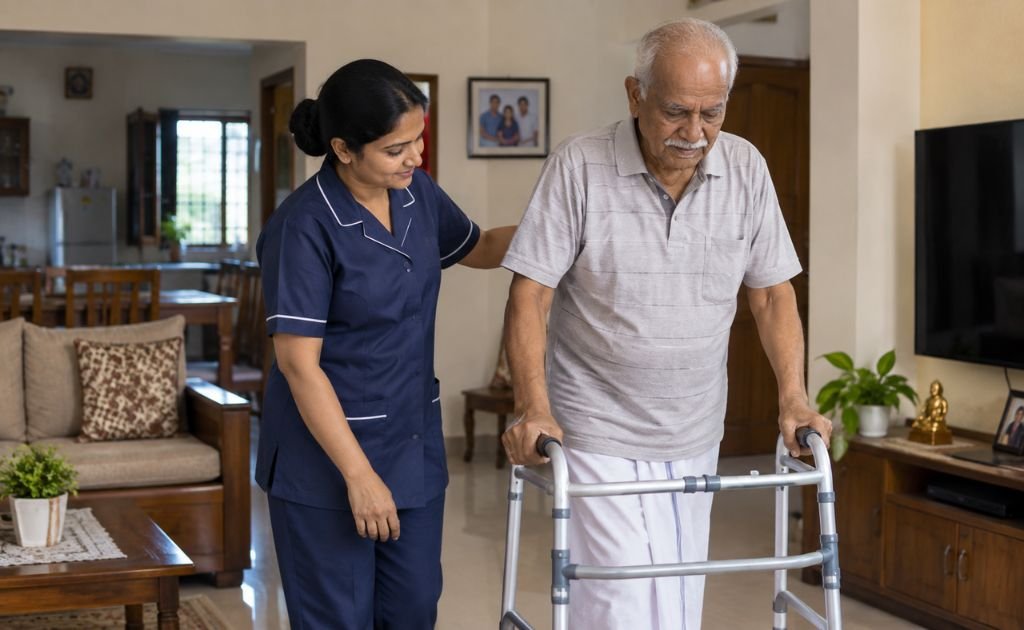
Helping the patient sit up, get out of bed, walk to the bathroom, use a walker or wheelchair, and get into a chair or car safely. For bedridden patients, repositioning roughly every two hours, keeping skin clean and dry, and noticing early redness on the hips, heels or tailbone – then telling the family or nurse. Falls are the danger here: the World Health Organization notes that adults over 60 suffer the greatest number of fatal falls, and most happen at home.
Meals, fluids and medication reminders
Serving meals in a safe position, feeding a patient who can’t feed herself, keeping fluids going through a Chennai summer, and reminding the patient to take medicines the doctor has prescribed. The word is reminding: an attender can prompt, hand over a pre-sorted dose and note that it was taken. She does not decide doses, give injections or manage insulin – those are nursing tasks (more below).
Supervision, company and family updates
Being present so the patient is never alone, conversation, a walk to the balcony or the temple, help with the phone or TV, keeping the day’s routine going, and a daily update to the family – what was eaten, how the night went, anything new. Some arrangements include light housework directly related to the patient (her laundry, her room, the bathroom she uses) and accompanying her to appointments.
What a female attender does not do
This is the part competitors’ pages leave out, and it’s the part that keeps your patient safe. A female attender does not:
- give injections, insulin or IV medicines
- clean or dress surgical wounds or treat pressure sores
- insert, change or manage a urinary catheter or Ryles (feeding) tube
- suction a tracheostomy or manage oxygen settings
- adjust medication doses or decide what to give when
- interpret blood pressure, sugar or oxygen readings and act on them
- replace a doctor’s follow-up or a physiotherapist’s programme
- do general housework for the whole family, cooking for everyone, or childcare (unless agreed separately)
If any item in the first six lines is part of your patient’s care, you need a home nurse involved – either for a daily visit or for the full shift.
Female attender vs home nurse: which one does your patient need?
| Female attender / caregiver | Home nurse (ANM / GNM / B.Sc) | Skilled / critical-care nurse | |
| Bathing, dressing, toileting, diaper change | Yes | Yes | Yes |
| Mobility support, transfers, repositioning | Yes | Yes | Yes |
| Feeding and hydration | Yes | Yes | Yes |
| Companionship and supervision | Yes | Yes | Yes |
| Medication reminders | Yes | Yes | Yes |
| Giving injections, insulin, IV medicines | No | Yes | Yes |
| Wound dressing, pressure-sore treatment | No | Yes | Yes |
| Catheter, Ryles tube, tracheostomy care | No | Yes | Yes |
| Recording vitals and escalating to a doctor | Basic observation only | Yes | Yes |
| Ventilator / ICU-level care at home | No | No | Yes |
Signs you need a nurse, not an attender
- The discharge summary mentions a wound that needs dressing, a catheter, a feeding tube, oxygen or injections.
- The patient has uncontrolled diabetes with insulin, a stroke with swallowing difficulty, or a tracheostomy.
- There are pressure sores already present.
- The doctor has said “nursing care” rather than “someone to help at home”.
When that’s the case, Sashitha’s home nursing in Chennai and skilled nursing pages describe what a nurse can take on, and our guides to stroke patient care at home and Ryles tube care at home go deeper. Many families pair a nurse for a short morning visit with a female attender for the remaining hours – clinical care where it’s needed, without paying nursing rates for companionship.
12-hour vs 24-hour female attender: how to decide
12-hour (day or night) cover suits a patient who needs help through the active part of the day but sleeps through the night, or the reverse – a patient who is fine by day with family around but wakes, wanders or needs turning at night. It’s also the right starting point after most surgeries, where the need reduces week by week.
24-hour cover is for a patient who cannot safely be left alone at any point: advanced dementia, bedridden with pressure-sore risk, the first days after a major discharge, or a patient who needs repositioning and toileting help through the night.
Ask yourself three questions:
- Does the patient need physical help between midnight and 6 am, or just someone present?
- Is there a family member who can reliably cover the other twelve hours, every day, including weekends?
- Will the need reduce in two to four weeks, or is this long-term?
How 24-hour care is actually staffed
This is the question to put to every provider: is 24-hour care one live-in attender, or two attenders on 12-hour shifts? One live-in woman is cheaper and works when the patient sleeps most of the night – she needs rest hours, a weekly day off (and someone to cover it), a place to sleep and meals. Two rotating attenders cost more but are the correct model when active care is needed at 3 am. A provider that quotes “24-hour” without saying which one is leaving the hard part for later.
How to choose a female patient attendant in Chennai
Ten questions to ask before you hire
- Will someone assess the patient at home first? Quoting without seeing the patient means guessing at the level of care.
- What training does the attender have, and in what? Look for personal-care and safe-handling training. If a provider says “medically trained”, ask exactly what that means – it should not mean she’ll do nursing tasks.
- What verification is done? Identity documents, address, references and police verification. Ask to see it – not just to be told it exists.
- Who supervises her? Is there a nursing supervisor or coordinator who checks in, or is she on her own?
- What happens if she’s unwell or on leave? Ask for the replacement time in hours. This single question tells you more about a provider than any brochure.
- Can I request a specific language or background? A Tamil-speaking attender, a vegetarian household, an older or younger carer – all reasonable requests.
- How will you update the family? Daily WhatsApp, a written log, a weekly call – agree the format before day one.
- What’s the emergency process? Who does she call first, which hospital, and is there a doctor or nurse she can escalate to?
- Can we start with a short trial? A few days before committing to a month is a fair ask.
- What exactly is included in the rate, and what’s extra? Diapers, gloves, food for a live-in attender, festival days, transport, GST.
Get the scope of duties (including what she will not do), hours, rate, replacement guarantee and notice period in writing. Most problems in home care come from unclear expectations, not from bad people.
Agency or direct hire?
Hiring a woman directly through a neighbour or a WhatsApp group is cheaper per month. It also means no verification, no replacement when she’s sick, no supervisor to call when something goes wrong, and no accountability if the patient is hurt. A provider costs more and, in return, carries those risks for you. For a short, low-dependency need direct hire can work; for a bedridden or vulnerable patient, or a family managing from another city, the provider route is usually the safer one.
What a female patient attendant costs in Chennai
There is no single price, because “attender” covers a 6-hour companion visit and a live-in carer for a bedridden patient. What moves the number:
- Hours and shift. Across the Chennai market, a non-clinical patient attendant generally runs ₹700–₹1,500 per day depending on shift length, with 12-hour cover typically landing around ₹15,000–₹25,000 per month and 24-hour live-in cover higher. Sashitha’s home nurse cost guide for Chennai sets these against nursing rates so you can see the difference clearly. Those are market ranges, not a Sashitha price list.
- One person or two. Two 12-hour shifts cost more than one live-in attender.
- Patient dependency. A fully bedridden patient needing two-hourly turning is priced above a mobile patient who needs supervision.
- Duration. Monthly packages are usually cheaper per day than short daily bookings, but daily is normal after surgery.
- Nursing requirement. If any clinical task is involved, part of the cost becomes nursing cost.
- Extras. Consumables (diapers, gloves, wipes), equipment rental (hospital bed, air mattress, commode chair), food for a live-in attender, and doctor visits are usually billed separately. Ask.
The most cost-effective long-term structure is often a nurse for a short daily window plus a female attender for the rest of the day.
What to tell the provider before they send someone
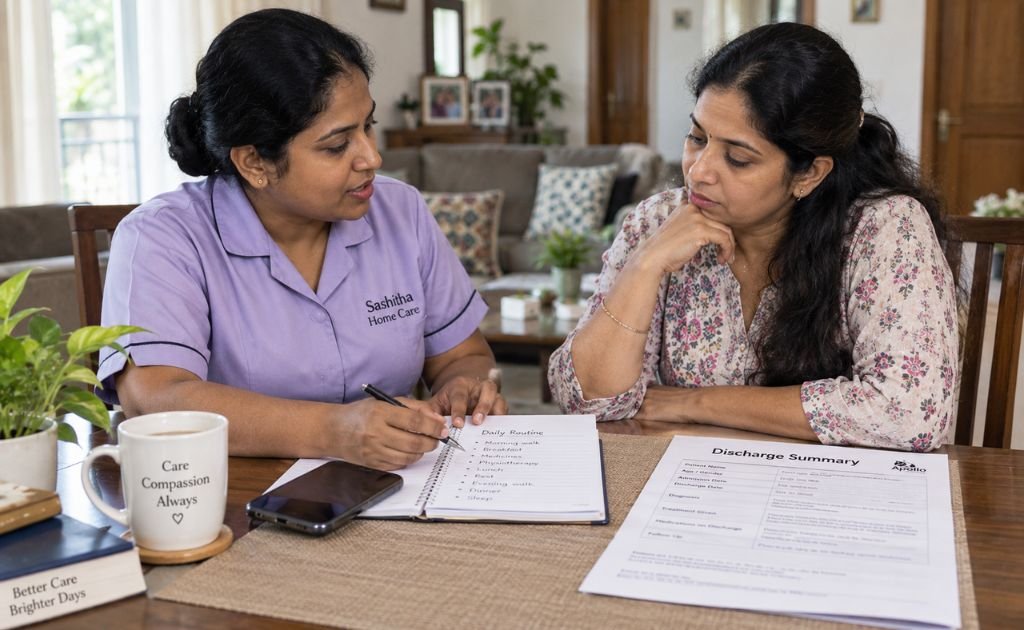
Having this ready means the right person is matched the first time, rather than after an awkward first week:
- Patient’s age, gender and weight (it affects safe lifting)
- Diagnosis or reason for care, and the latest discharge summary or doctor’s note
- Mobility: walks alone / walks with support / wheelchair / bedridden
- Help needed with bathing, toileting, dressing, feeding – and how much
- Diaper use, catheter, feeding tube, oxygen, wounds – anything clinical (this decides attender vs nurse)
- Medicines: what, when, and who currently manages them
- Night needs: sleeps through / wakes / needs turning or toileting
- Shift wanted: hours, days, start date, expected duration
- Language preference and any household rules (vegetarian, footwear, prayer times)
- Where a live-in attender would sleep and eat
- Who the family contact is, and the emergency plan (hospital, doctor, nearest relative)
- Anything the patient finds distressing or comforting
Send this by WhatsApp before the assessment call. It shortens everything that follows.
How Sashitha Home Care can help
Sashitha Home Health Care India Pvt Ltd is based at Santhome, Mylapore, and provides home-based care across Chennai, including Mylapore, R A Puram, Alwarpet, T Nagar, Ashok Nagar, Anna Nagar, Besant Nagar, Vadapalani, Ramapuram and Perungudi.
For families looking for a female attender, the team provides:
- A female caretaker service covering daily living assistance (bathing, dressing, personal care), mobility support, medication reminders and help with appointments, with care plans built around the treating doctor’s recommendations.
- Short-term, 12-hour and 24-hour options, including night cover and live-in arrangements, for elderly, post-hospitalisation and bedridden patients.
- Background-checked attenders, with Tamil, English and Hindi speakers available.
- Home nursing alongside the attender when the patient’s care includes clinical tasks – through the home nursing and post-surgery care teams – so families don’t have to choose between the wrong two options.
- A home assessment first, so the attender sent matches the patient’s actual needs, and regular updates to the family.
- Replacement support if the assigned attender is unavailable.
If your patient is an elderly parent and you’re still working out the level of care overall, our guide to choosing an elderly care service in Chennai walks through that wider decision.
Frequently asked questions
What does a female patient attendant do?
She supports the patient’s daily living: bathing, dressing, toileting, diaper changes, moving and repositioning, feeding, fluids, medication reminders, supervision and companionship, plus daily updates to the family. She does not perform clinical procedures.
What is the difference between a female attender and a home nurse?
An attender provides personal and daily-living care. A home nurse holds a nursing qualification and can give injections, dress wounds, manage catheters and feeding tubes, and record and escalate vitals. If the patient’s care includes any of those, a nurse is needed – sometimes only for a daily visit alongside the attender.
Can a female attender give medicines?
She can remind the patient and hand over medicines that the doctor has prescribed and that have been pre-sorted, and note that they were taken. She should not give injections, insulin or IV medicines, or change doses.
Can I hire a female attender for a bedridden patient?
Yes. An attender can handle repositioning, hygiene, diaper changes, feeding and skin checks for a bedridden patient. Pressure-sore treatment, catheter or tube care and other clinical tasks need a nurse – often arranged together.
Can a female attender stay 12 hours, or overnight, or 24 hours?
Yes. 12-hour day or night shifts, and 24-hour cover, are all standard in Chennai. Ask whether 24-hour cover means one live-in attender or two on rotating shifts, and what rest and weekly-off arrangements apply.
Can a female attender help after surgery or after delivery?
Yes, for the non-clinical side: hygiene, mobility, meals, rest and supervision. Wound care and injections stay with a nurse. Post-delivery support is usually arranged through mother-and-baby care rather than general patient attendance.
How much does a female patient attendant cost in Chennai?
Market rates for a non-clinical attendant are broadly ₹700–₹1,500 per day, with 12-hour monthly cover around ₹15,000–₹25,000 and 24-hour cover higher. Dependency level, one-vs-two attenders and consumables change the figure; a home assessment is the only way to get an accurate quote.
Are female attenders background verified?
Reputable providers verify identity, address and references and carry out police verification. Ask to see the documents rather than accepting the phrase “background checked”.
What should I check before hiring?
Home assessment before quoting, training in personal care and safe handling, verification documents, who supervises, replacement time in hours, emergency process, family-update routine, trial period, and a written scope of duties with what is and isn’t included in the rate.