
The conversation usually starts in a hospital corridor. The doctor says the worst is over, the patient no longer needs everything an ICU offers, and the family could think about taking them home with proper nursing support. Relief comes first. Then the questions: Can we really manage this at home? What would “proper support” mean? Who watches them at night? What if something goes wrong?
Critical care at home is the arrangement families in Chennai are usually looking at in that moment. It means providing a higher level of nursing, monitoring and equipment at home than routine home nursing offers, for a patient who is clinically stable enough to leave the hospital but still medically complex. It may be appropriate for selected patients, after assessment by the treating team. It is not appropriate for everyone, and it is not a hospital ICU relocated to a bedroom.
This guide explains what critical care at home actually involves, who it may suit, when a patient should remain in hospital, how post-ICU step-down care works, what drives the cost in Chennai, and how a family can evaluate a provider before agreeing to anything.
Table of Contents
What is critical care at home?
Critical care at home is intensive, structured nursing and monitoring delivered in the patient’s own home for someone who is medically stable but still dependent on skilled care. Typical features include:
- A nurse with critical-care or ICU experience, usually on 12-hour or 24-hour cover rather than short visits
- Closer, more structured observation of the patient’s condition than ordinary home nursing
- Medical equipment matched to the patient’s needs, which can range from a hospital bed and pulse oximeter to oxygen support or, for a small number of patients, ventilatory support
- A written care plan from the treating doctor, and a clear route back to that doctor or to a hospital if the patient’s condition changes
The word “critical” refers to the complexity of the patient’s needs, not to an emergency in progress. A patient who is actively unstable belongs in a hospital. Critical care at home is for the stage after stabilisation, when the main requirements are skilled nursing, monitoring, equipment and continuity.
How is critical care at home different from regular home nursing?
Families often hear “home nurse”, “attender”, “caretaker” and “ICU nurse” used interchangeably by agencies, relatives and even hospital staff. They are not the same thing, and the difference matters when a medically complex patient is involved.
Caregiver vs home nurse vs critical care at home
| Feature | Caregiver / attendant | Home nursing | Critical care at home |
| Personal care (bathing, feeding, hygiene) | Yes, depending on role | Yes | Yes, as appropriate |
| Clinical nursing (injections, IV lines, wound care, tubes) | No | Yes | Higher-complexity nursing where required |
| Patient monitoring | Basic observation | As clinically required | Closer, more structured monitoring |
| Medical equipment | Limited, condition-dependent | Condition-dependent | Potentially advanced |
| Patient complexity | Generally lower | Moderate / varied | Higher |
| Medical supervision | Not necessarily | As required | More structured, closely coordinated with the treating doctor |
Treat this table as a way of thinking, not a rulebook. There is no single legal definition of “critical care at home” in India, and the actual scope depends on the patient’s condition, the provider’s care model and the healthcare professionals involved. What it should help you avoid is the most common mistake: hiring an attendant or a general home nurse for a patient who actually needs intensive nursing care at home with someone experienced in reading early signs of deterioration.
Who may be suitable for critical care at home?
Suitability is a clinical decision made by the treating team, and it rests on one thing above all: stability. Broadly, the patients for whom home critical care may be considered include:
- People completing the acute phase of a serious illness who still need skilled nursing and close observation, often described as post-ICU or step-down care
- Patients recovering from major surgery who need more than routine wound care and mobilisation
- Patients who are stable on oxygen support, or in selected cases on non-invasive or long-term ventilatory support, whose treatment is not expected to change frequently
- Long-term bedridden patients with tracheostomy, feeding tube or catheter needs that require nursing rather than a hospital bed
- People with advanced or life-limiting illness whose treating team has agreed a comfort-focused plan that can be delivered at home
These are categories, not a checklist. Two patients with the same diagnosis can need completely different setups. The questions that matter are whether the patient’s condition is predictable, whether the required nursing skill is available, whether the home can safely hold the equipment, and whether there is an agreed plan for what happens if things change.
When should the patient stay in hospital?
An honest provider will tell you when home care is not the right option. Hospital or ICU care usually remains necessary when a patient:
- Is still being actively stabilised, or has a condition that is changing quickly
- Needs treatments that are being adjusted frequently and require an intensivist’s presence
- Requires interventions or procedures that cannot be performed at home
- Needs immediate access to advanced diagnostics, imaging or specialist teams
- Depends on multiple life-support systems at once
- Would be going home to a setting without a reliable caregiver, adequate space, hygiene or emergency access
None of these is a rule you should apply on your own. The treating doctor determines suitability. If the hospital team is hesitant about discharge, that hesitation is information, not an obstacle to negotiate around.
What does critical care at home involve day to day?
The daily shape of care depends on the patient, but most home critical care arrangements in Chennai are built from the same components.
Nursing and monitoring
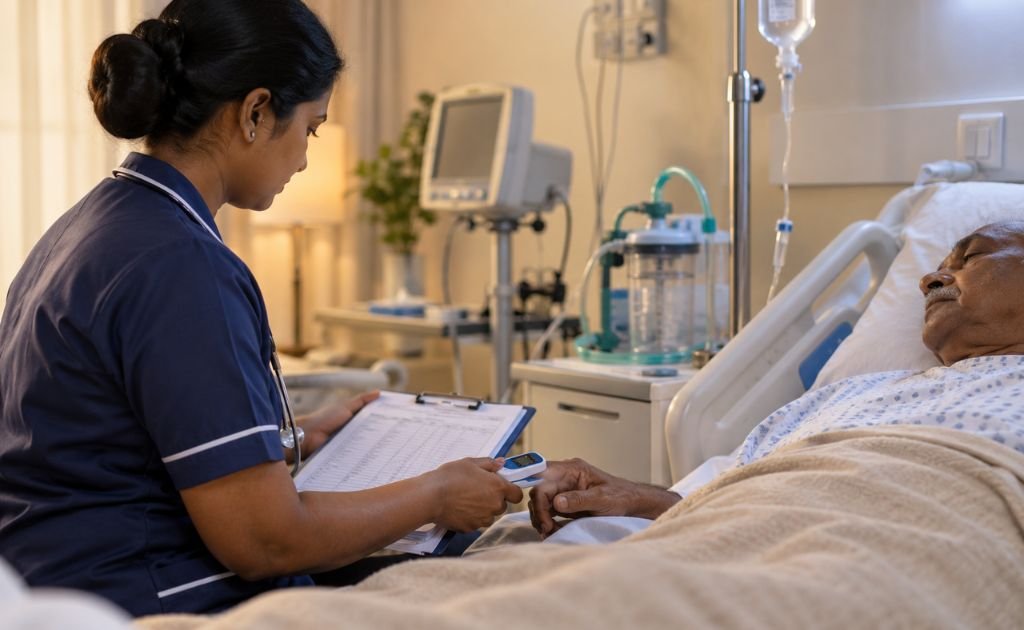
The core of the arrangement is a critical care nurse at home, present for the agreed shift pattern, who follows the care plan, checks and records vital signs, watches oxygen levels, manages medicines as prescribed by the doctor, and, most importantly, recognises early changes and knows who to call. Patient monitoring at home is about clinical observation and documentation, not just a screen with numbers on it. The frequency and type of monitoring are set by the treating team, not by the agency.
Breathing, feeding and skin care
Depending on the patient, this can include oxygen support, care of a tracheostomy tube and suctioning, support for a patient on non-invasive or home ventilation under the doctor’s plan, tube feeding through a Ryles (nasogastric) or PEG tube, catheter care, wound dressing, and regular repositioning with skin checks, at the interval the nursing plan specifies, to prevent pressure sores. Families with a tracheostomy patient will find a fuller picture in Sashitha’s guide to home care for tracheostomy patients, which covers suctioning, warning signs and the ventilator-dependent situation in detail.
Rehabilitation and daily needs
Once the patient is settled, physiotherapy, gentle mobilisation, hygiene, nutrition and sleep become the work of recovery. Many people who have been through intensive care experience weakness, confusion or low mood afterwards, something clinicians describe as post-intensive care syndrome; the Society of Critical Care Medicine’s overview of post-intensive care syndrome is a useful read for families who want to understand what recovery can look like.
What equipment may be needed?
Equipment is decided by the patient’s medical needs and the treating doctor’s discharge plan, not by what a provider has in stock. Examples that families in Chennai commonly encounter include:
- Hospital bed with adjustable back-rest and side rails, often with an air mattress for pressure-sore prevention
- Oxygen equipment such as a concentrator, with a cylinder as backup during power cuts
- Pulse oximeter for oxygen saturation and pulse
- Patient monitor for patients whose doctor wants more continuous observation
- Suction apparatus for patients who cannot clear their own secretions
- Infusion equipment where IV medicines or fluids are part of the plan
- BiPAP/CPAP or ventilator only for patients whose treating team has specifically planned home ventilatory support
Not every patient needs most of this, and no patient should have equipment prescribed by an agency. Ask the hospital for a written equipment list before discharge, and clarify who supplies, installs, maintains and removes each item. Sashitha offers medical equipment for rent in Chennai on daily, weekly and monthly plans; confirm availability of the specific items on your list when you enquire.
Who may be part of the care team?
The exact team varies with the patient and the care model. Roles that may be involved include:
- Treating doctor or intensivist at the hospital, who sets the care plan and remains the reference point for clinical decisions
- Critical care nurse with ICU experience, for patients who need higher-complexity nursing and closer monitoring
- Home nurse for patients whose needs have reduced, or to share a 24-hour rota
- Visiting physician for periodic review at home where the treating team agrees; Sashitha arranges doctor home visits in Chennai across several specialities
- Physiotherapist for chest physiotherapy, mobilisation and rehabilitation
- Respiratory specialist or technician where oxygen or ventilatory equipment is involved
- Family caregiver, who is part of the team whether or not anyone says so
Do not assume a provider supplies all of these automatically. Ask who exactly will be at the bedside, who supervises them, and who speaks to the hospital doctor when a question arises.
Post-ICU and step-down care at home
“Step-down” is the stage between intensive care and independence. In a hospital it might happen in a high-dependency ward. Increasingly in Chennai, when the treating team agrees, it happens at home. Post ICU care at home works best when it is planned as a transition rather than treated as a discharge.
Before leaving the hospital
- Medical assessment: the treating team confirms the patient is stable enough for home care and documents what could change that
- Discharge planning: a discharge summary, current medication list, and clear follow-up appointments
- Nursing requirement: what level of nurse, how many hours, and for roughly how long
- Equipment requirement: the written list described above
- Home planning: which room, power backup, access for a stretcher or wheelchair
- Emergency contacts: the hospital’s number, the treating doctor’s contact route, and the nearest emergency department
The World Health Organization treats the move between care settings as one of the riskiest moments in a patient’s journey; its technical series on transitions of care explains why communication and handover failures at discharge cause so much avoidable harm. The practical lesson for families is simple: get everything in writing, and make sure the home nursing team sees it before the patient arrives.
The first days at home
The first 48 to 72 hours are when most problems surface, usually because something in the handover was missed. A good transition includes the equipment being installed and tested before the patient arrives, a formal handover between the hospital nurses and the home nursing team, the care plan being walked through with the family, and someone confirming that every medicine in the house matches the discharge summary.
Ongoing care and reassessment
From there, care settles into observation, nursing support, communication with the treating team and periodic reassessment. Needs change in both directions. Some patients improve and can move from critical care nursing to a general home nurse or a trained attendant, which reduces cost. Others need the plan revisited. The provider should be able to tell you, without being asked, when either of these is happening.
How to prepare the home before discharge
A short checklist families in Chennai can work through in the days before discharge:
- Choose a room close to a bathroom, with space to move around the bed on both sides
- Arrange power backup (inverter or UPS) for oxygen and monitoring equipment; confirm how long it lasts
- Have the equipment delivered, installed and tested before the patient comes home
- Keep the discharge summary, medication list and doctor’s contact details in one folder by the bed
- Save the hospital emergency number and the nearest emergency department’s address; check ambulance access to your building, including lifts
- Agree a nursing shift pattern (12-hour or 24-hour) and confirm who covers the nurse’s off-days
- Decide which family member is the single point of contact for the nursing team
- Stock the first week’s consumables (gloves, dressings, suction catheters, feeds) as advised by the hospital
- Remove loose rugs and clutter from the path between the bed and the door
- If you are coordinating from another city or abroad, agree how and how often you will receive updates
Johns Hopkins Medicine’s plain-language guide to what to ask before hospital discharge is a good companion to this list.
How much does critical care at home cost in Chennai?
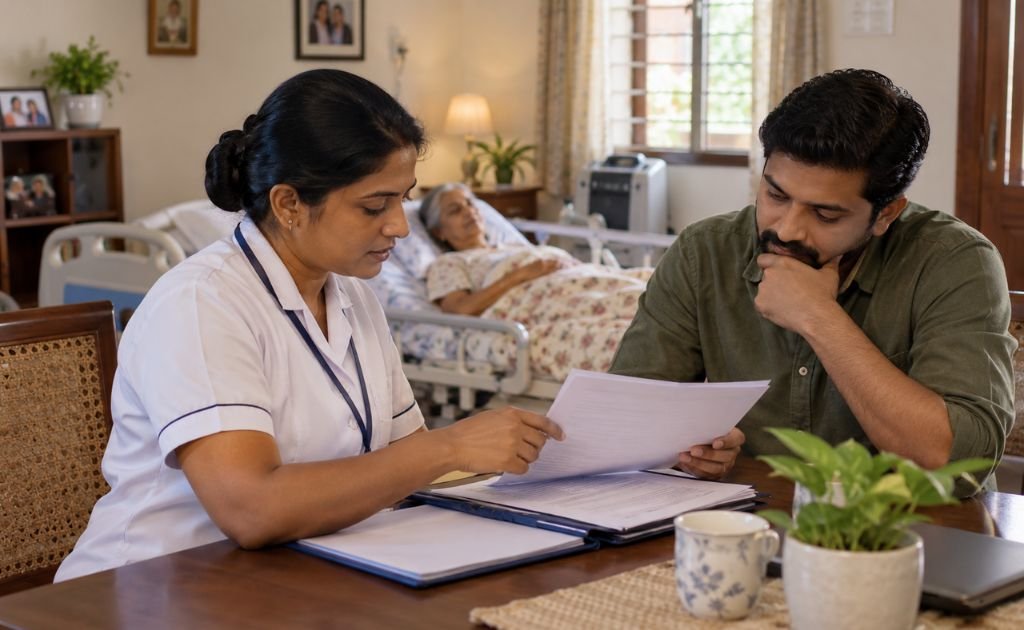
There is no single price for critical care at home in Chennai, and a figure quoted before anyone has assessed the patient should be treated with caution. The cost is built from several parts, and the most useful thing a family can do is insist on seeing them separately.
Factors that influence the cost
- Level of care: a critical care or ICU-trained nurse costs more per shift than a general home nurse, who costs more than a trained attendant
- Hours and shifts: 24-hour cover, especially with two nurses on rotation, costs substantially more than a single 12-hour shift
- Patient dependency: ventilatory support, tracheostomy, tube feeding and immobility all increase the nursing workload
- Equipment: rented separately; a hospital bed and oxygen concentrator cost far less than a ventilator or patient monitor
- Specialist involvement: doctor home visits, physiotherapy and respiratory support are usually charged per visit
- Duration: monthly packages are typically cheaper per day than daily billing
- Consumables and medicines: gloves, dressings, feeds, suction catheters and medicines are almost always billed at actuals
- Location and complexity: travel distance for shift nurses and the overall complexity of the plan
When you receive a quote, ask for it in four lines: nursing or service charges, equipment rental, consumables and medicines, and doctor or specialist visits. For current indicative rate ranges for general, 24-hour and ICU-trained nurses, see Sashitha’s guide to home nurse cost in Chennai, which also explains the difference between live-in and shift-based pricing.
How to choose a critical care at home provider in Chennai
Because this is healthcare, not housekeeping, the provider’s answers matter more than their brochure. Use this checklist:
- Clinical assessment first. A serious provider assesses the patient (ideally at the hospital) and speaks to the treating team before quoting
- Nurse profile. Ask what qualification and ICU experience the assigned nurse has, and whether you can meet or speak to them before discharge
- Supervision. Who supervises the nurse, and how often does that person review the patient?
- Escalation plan. What exactly happens if the patient deteriorates at 2 a.m.? Who is called first, and which hospital is the patient taken to?
- Backup cover. What happens when the nurse is sick or on leave?
- Equipment responsibility. Who installs, maintains and replaces equipment, and how fast?
- Documentation. Are vital signs and events recorded in a chart the family and doctor can see?
- Communication. How are family updates handled, especially for relatives outside Chennai?
- Transparent pricing. Is the quote itemised, and what triggers a change in price?
- Honesty about limits. Does the provider ever say “this patient should not come home yet”? If they never do, be careful
Questions families should ask before starting care
- Who will provide the nursing care, and what is their qualification and critical-care experience?
- What is the written care plan, and who prepared it?
- What equipment is needed, who supplies it, and who is responsible if it fails?
- Who coordinates with our treating doctor, and how often?
- What happens if the patient’s condition changes? Walk me through it step by step
- What backup arrangements exist for nurse absence and equipment failure?
- How and when will the family receive updates?
- What exactly is included in the quoted cost, and what is billed separately?
- When would you recommend stepping care down, or moving the patient back to hospital?
How Sashitha Home Care can help
Sashitha Home Health Care is a Chennai-based home healthcare provider, headquartered in Mylapore, with more than fifteen years of experience in nursing and care at home. For families arranging care after a serious illness or hospital stay, Sashitha’s home nursing service in Chennai covers ICU care at home with ventilator and oxygen management, tracheostomy and catheter care, post-surgical care, physiotherapy and rehabilitation, and palliative care, delivered by qualified nurses on 12-hour or 24-hour arrangements. Doctor home visits and medical equipment rental are available alongside nursing, and the team serves neighbourhoods across Chennai including Mylapore, Anna Nagar, T. Nagar, Ashok Nagar, Besant Nagar, R.A. Puram, Ramapuram, Vadapalani and Perungudi.
The right starting point is a conversation about your patient’s discharge plan, not a price list. If the treating team considers home care appropriate, Sashitha can help you work out what level of nursing, equipment and support the plan actually requires.
Frequently asked questions
What is critical care at home?
Critical care at home is intensive, structured nursing, monitoring and equipment support provided in the patient’s home for someone who is medically stable but still dependent on skilled care, typically after an ICU or hospital stay. It is arranged under a treating doctor’s care plan and is suitable only for selected patients.
Is critical care at home the same as a hospital ICU?
No. A hospital ICU has intensivists, advanced diagnostics and the ability to intervene immediately. Critical care at home provides skilled nursing and monitoring for patients who no longer need those things continuously. If a patient’s condition becomes unstable, hospital care may be required again.
Who decides whether a patient is suitable for critical care at home?
The treating medical team. A home healthcare provider can assess the practical requirements, but the clinical decision that a patient is stable enough to go home rests with the hospital doctors.
What is post-ICU or step-down care at home?
It is the stage of care between intensive care and recovery, when the patient no longer needs an ICU but still needs skilled nursing, monitoring and often equipment. At home, it is planned as a transition: discharge planning at the hospital, handover to the home nursing team, and ongoing reassessment.
What is the difference between a critical care nurse and a home nurse?
A critical care nurse has ICU experience and is used to monitoring complex patients, managing airway and ventilatory equipment, and recognising early deterioration. A general home nurse provides clinical nursing such as wound care, injections and medication for patients with more predictable needs. An attendant or caregiver provides personal care, not clinical nursing.
Can a patient on a ventilator be cared for at home?
In selected cases, yes, when the treating team has specifically planned long-term or non-invasive home ventilation and the patient is stable. It is the most demanding form of home care and needs a nurse experienced with ventilators, reliable power backup and a clear equipment-failure and emergency plan. It is not appropriate for patients whose ventilation needs are still changing.
What happens if the patient’s condition worsens at home?
The nurse follows the escalation plan agreed before discharge: contacting the treating doctor or provider’s supervising clinician, and arranging emergency transfer to hospital where needed. Families should confirm this plan, including which hospital and how the ambulance is arranged, before care begins. Home care does not replace emergency services.
How much does critical care at home cost in Chennai?
It depends on the level of nursing, the number of hours and shifts, the patient’s dependency, equipment, specialist visits, duration and consumables. Ask for an itemised quote that separates nursing charges, equipment rental, consumables and doctor visits. Indicative nurse rate ranges for Chennai are covered in Sashitha’s home nurse cost guide.
What should families check before choosing a provider?
Whether the provider assesses the patient before quoting, the qualification and ICU experience of the assigned nurse, who supervises the care, what the escalation and backup plans are, who is responsible for equipment, how the family is updated, and whether the quote is itemised.
Making the decision
Critical care at home in Chennai can be a good option for the right patient: someone the treating team considers stable, whose needs are predictable, and whose family can arrange skilled nursing, suitable equipment and a clear plan for when things change. It is not a way to leave hospital early, and it is not equivalent to an ICU. The decision framework is simple even if the situation is not: confirm suitability with the doctors, understand exactly what care will involve, prepare the home before discharge, insist on an itemised cost, and choose a provider who is willing to tell you what they cannot do.
If your family is at that point now, Sashitha’s team can talk through your patient’s discharge plan and what it would take to support them at home.